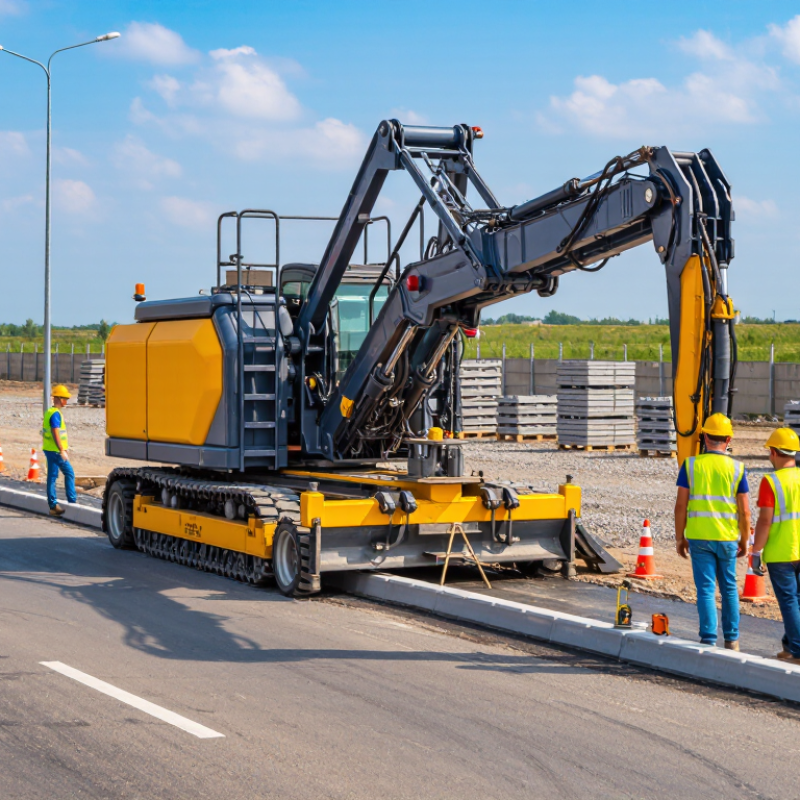
| Curb paver | A self-propelled or guided paving machine that places and shapes fresh concrete into a continuous curb profile. | Forms curb sections as the machine moves along a prepared alignment. | Often called a curb-and-gutter machine when it forms both a curb and an adjoining gutter. |
| Concrete hopper | The receiving bin at the front or top of the machine. | Receives concrete from a delivery vehicle and holds it for controlled feeding. | The concrete mix must be suitable for the machine and the intended curb profile. |
| Feed system | A conveyor, auger, or other material-moving mechanism, depending on machine design. | Moves concrete from the hopper toward the forming area. | Consistent feeding helps maintain a steady flow through the mold. |
| Mold or extrusion form | A shaped forming assembly, commonly positioned beneath or behind the machine. | Shapes the concrete into the required curb cross-section as it passes through. | The mold profile is selected to suit the project design, such as a vertical curb or a curb-and-gutter section. |
| Vibrators or compaction system | Components that apply vibration or other compaction during forming, when fitted. | Help consolidate concrete and fill the mold profile. | Settings depend on the mix, machine, and placement conditions. |
| Tracks or wheels | The machine’s ground-contact system. | Supports and moves the machine along the work area. | The travel system and steering arrangement vary by machine design and site requirements. |
| Engine and hydraulic system | The power source and hydraulic components used by many curb pavers. | Provide power for travel and operate machine functions such as steering and material handling. | Exact systems and functions differ among machine types. |
| Grade and alignment controls | Manual or automatic controls that help guide the machine along the planned line and elevation. | Help maintain the curb’s position, grade, and alignment. | Some setups use a stringline or other reference; requirements depend on the project and equipment. |
| Operator station and controls | The area and controls used by the operator to monitor and operate the machine. | Manage travel, steering, concrete flow, and other available functions. | Operators should follow the machine’s operating and safety instructions. |
| Common applications | Projects requiring continuous, formed concrete edging. | Produces curbs that help define edges and separate paved areas. | Common examples include roads, streets, parking areas, sidewalks, and curb-and-gutter installations. |



 Close