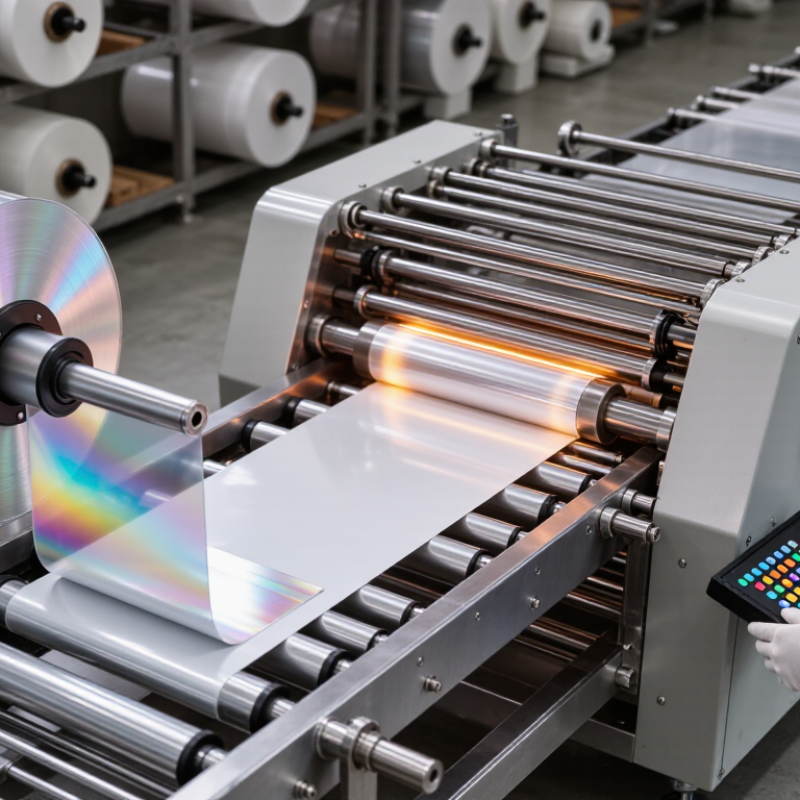
| 1 | Substrate preparation | Paper, coated board, plastic film, or another compatible substrate is cleaned, dried, and positioned for feeding. | Surface energy, moisture, flatness, thickness, dust level | The material must be smooth and stable enough to receive heat, pressure, and foil transfer. | No visible dust, wrinkles, excessive moisture, or surface contamination |
| 2 | Foil unwinding | A roll of holographic foil is mounted on an unwind shaft and guided toward the transfer area. | Roll direction, web alignment, tension, foil width, repeat length | Tension control prevents stretching, slack, edge wandering, and pattern distortion. | Foil travels smoothly with consistent lateral alignment |
| 3 | Registration and web guiding | Sensors, guide rollers, or servo-driven systems align the foil pattern with the printed or embossed artwork. | Registration mark position, line speed, sensor sensitivity, lateral offset | The registration system compensates for small changes in foil position and substrate movement. | Holographic images appear in the intended location without noticeable drift |
| 4 | Heating or activation | A heated die, heated cylinder, or thermal roller brings the foil adhesive layer to its activation temperature. | Temperature, dwell time, heating uniformity, line speed | Many hot-stamping processes operate approximately between 90°C and 180°C, depending on foil, substrate, and equipment. | Adhesive is sufficiently activated without scorching, shrinking, or damaging the substrate |
| 5 | Embossing or pattern contact | A patterned die, shim, roller, or embossing cylinder contacts the foil and substrate to create or transfer the optical structure. | Die geometry, contact pressure, nip setting, surface hardness | Microscopic grooves or diffraction structures redirect light and produce the holographic appearance. | Pattern is sharp, continuous, and free from crushed or incomplete areas |
| 6 | Pressure application | Controlled pressure bonds the activated foil layer to selected areas of the substrate and transfers the design. | Pressure level, pressure distribution, contact time, substrate thickness | Pressure must be high enough for complete transfer but low enough to avoid substrate marking or foil squeeze-out. | Uniform adhesion with clean edges and consistent visual brightness |
| 7 | Cooling and release | The foil and substrate separate from the die or roller after transfer, while the adhesive cools and stabilizes. | Cooling rate, release angle, peel tension, surface temperature | Stable release reduces lifting, smearing, blisters, and distortion of fine details. | Transferred areas remain firmly attached during foil peeling |
| 8 | Waste foil rewinding | The used carrier film is collected on a rewind shaft after the holographic layer has been transferred. | Rewind tension, roll diameter, waste width, splice condition | Synchronized unwinding and rewinding prevents web breaks and unnecessary foil waste. | Waste roll is compact, stable, and free from telescoping |
| 9 | Inspection and adjustment | The operator or an inline vision system checks registration, coverage, brightness, adhesion, and surface defects. | Color shift, missing transfer, pinholes, wrinkles, scratches, registration error | Temperature, pressure, speed, and tension are adjusted in small increments to correct defects. | Consistent holographic effect across the production run |
| 10 | Finished material handling | The finished sheets or web are conveyed, stacked, slit, rewound, or sent to a later converting process. | Stack alignment, surface protection, drying or curing time, handling speed | Finished pieces should be protected from abrasion, excessive heat, moisture, and blocking during storage. | Clean, durable, accurately registered holographic decoration ready for further processing |



 Close
Close