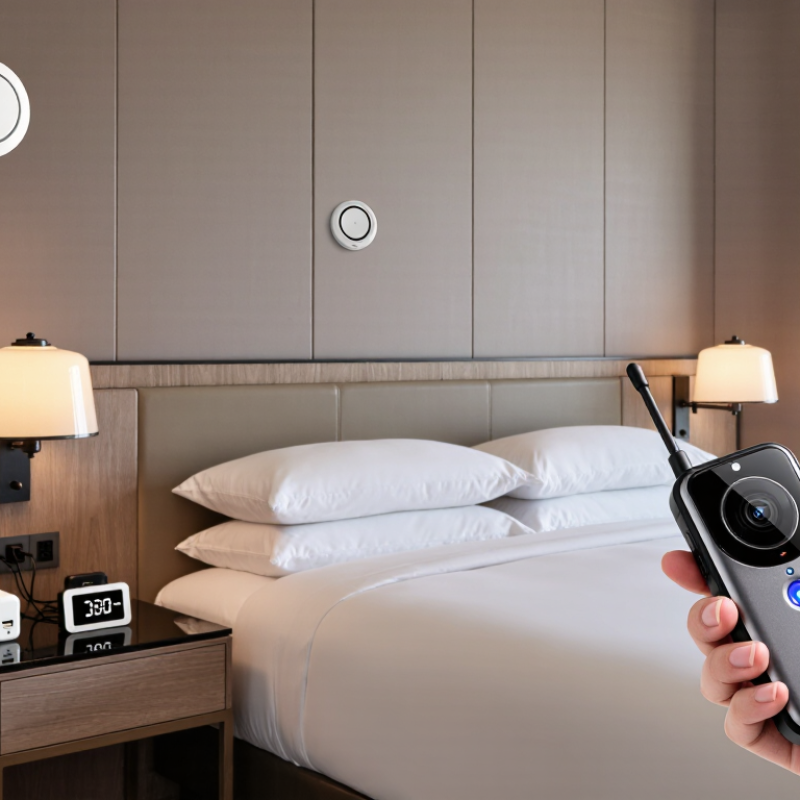
| Hotel room or short-term rental | Small rooms may contain many ordinary electronic devices, creating distracting signals. | Adjustable radio-frequency (RF) sensitivity, signal-strength display, and an optical lens-reflection finder. | Check likely concealment points visually, then scan slowly and compare readings near suspected objects with readings elsewhere in the room. | RF detection can locate active transmitters, but it cannot reliably identify a device by itself. A camera that is off or recording locally may not transmit. |
| Meeting room or office | Wi-Fi networks, phones, wireless peripherals, and other authorized electronics can produce RF activity. | Frequency-range information, adjustable sensitivity, and the ability to scan in sections. | Record or note normal background activity first. Investigate persistent or unusually localized readings rather than treating every signal as suspicious. | RF readings do not prove that a camera is present; common wireless equipment can create similar signals. |
| Bedroom or other dark room | Small camera lenses may be difficult to see among reflective surfaces and low light. | Optical lens finder with visible illumination and a viewfinder or viewing window. | Dim the room when practical and inspect likely positions from different angles. Look for a distinct lens reflection and verify it visually. | Reflection methods need a usable line of sight and can produce reflections from ordinary glass, polished surfaces, or other lenses. |
| Large home or multi-room property | Coverage takes time, and walls or furnishings can make signals harder to localize. | Portable design, clear signal-strength feedback, and controls that are easy to use during a systematic search. | Search one room at a time. Check objects with a plausible view of private areas, and repeat a scan from more than one position. | Walls, distance, interference, and device placement can affect RF readings. A single pass cannot establish that an area is clear. |
| Vehicle | Metal surfaces and vehicle electronics can complicate signal interpretation and physical inspection. | Portable RF scanning plus a bright optical inspection aid; a separate magnetic-field sensor may help locate some magnet-attached objects. | Inspect the cabin and accessible areas methodically, comparing readings around suspected items with the vehicle’s normal electronic background. | A magnetic-field sensor detects magnetic materials, not cameras specifically. RF activity from the vehicle’s own systems can also cause readings. |
| Area with weak or no network access | A device may record to local storage instead of sending data over a wireless network. | Optical lens detection and careful physical inspection, supplemented by RF scanning where appropriate. | Prioritize a visual search of objects with an unobstructed view of sensitive spaces, then use a lens finder to check suspicious openings. | An offline or powered-off camera may produce no detectable RF signal. No handheld detector guarantees detection of every concealed device. |
| Shared or electronics-heavy space | Many legitimate transmitters can make it difficult to distinguish relevant signals from background activity. | Adjustable sensitivity, frequency-range details, and a way to observe whether signal strength changes with distance or position. | Reduce avoidable sources of interference when possible, establish a baseline, and investigate readings that remain localized during repeat checks. | Signal patterns are clues, not identification. Results depend on the detector’s supported frequencies and the transmitter’s operating state. |



 Close
Close