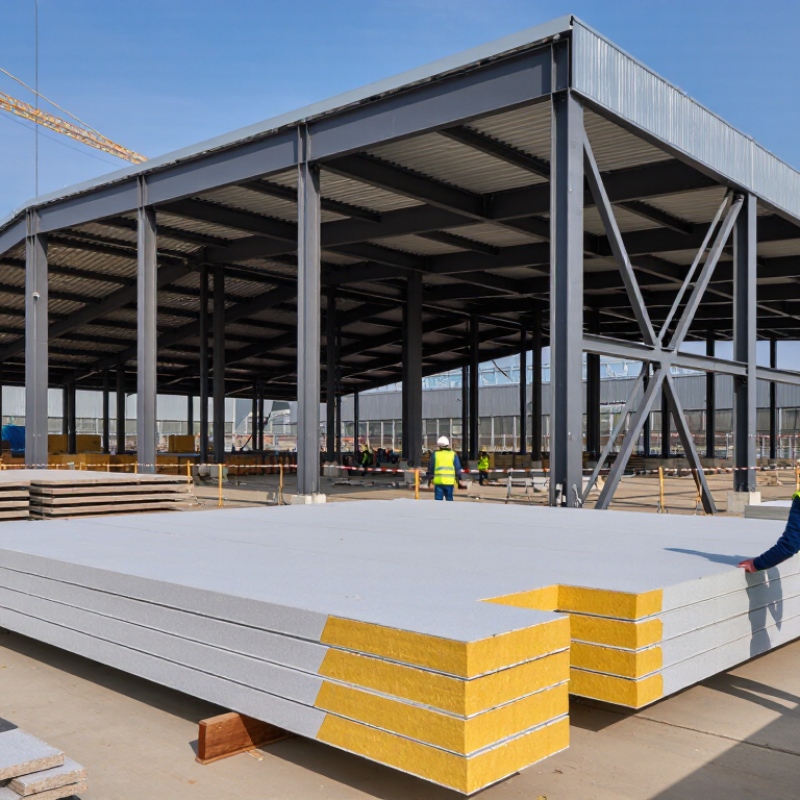
| Basic construction | Two metal facings bonded to a rigid polyurethane or polyisocyanurate foam core. | The foam core reduces heat transfer, while the facings provide protection, stiffness and weather resistance. | Confirm the core type, facing material, coating system, joint design and panel manufacturing tolerances. |
| Common core type | PUR is widely used for thermal insulation; PIR is commonly selected where improved fire performance is required. | The closed-cell foam structure traps low-conductivity gas and limits heat movement through the panel. | Do not treat PUR and PIR as identical. Review the exact tested product classification and installation conditions. |
| Typical density | Approximately 35–45 kg/m³ for many rigid PU panel cores; actual values vary by product and test method. | Lower density can reduce weight, while density, formulation and cellular structure influence strength and insulation performance. | Use the declared density and mechanical test results rather than selecting by density alone. |
| Thermal conductivity | Typically about 0.020–0.028 W/(m·K), depending on core formulation, thickness, temperature and aging. | Lower thermal conductivity means less insulation thickness is needed to achieve a target U-value. | Compare declared aged values and use the same test standard when reviewing different products. |
| Typical panel thickness | Common commercial thicknesses are approximately 40–200 mm; thicker panels are used for colder or more energy-sensitive spaces. | Increasing thickness generally increases thermal resistance and reduces heat flow, subject to joints and thermal bridges. | Select thickness from the required U-value, indoor temperature, climate, condensation risk and energy code. |
| Thermal resistance | A 100 mm panel may provide roughly R-4.0 to R-5.0 m²·K/W for the core, depending on conductivity and aging. | Thermal resistance is approximately thickness divided by thermal conductivity; joints, fasteners and facings affect the installed result. | Compare whole-panel or assembled-system U-values, not only the published foam-core R-value. |
| Facing materials | Common options include pre-painted galvanized steel, aluminum and stainless steel; facing thickness is often about 0.40–0.80 mm. | The outer face resists weather and impact, while the inner face protects the insulated space and supports hygienic cleaning. | Check corrosion exposure, coating durability, cleaning chemicals, impact requirements and required face thickness. |
| Moisture behavior | Closed-cell PU foam generally has low water absorption, but panel joints, cut edges and penetrations can admit moisture. | Continuous facings and properly sealed interlocking joints help limit air leakage and vapor movement. | Specify joint seals, flashing, vapor-control details, drainage and protection for exposed cut edges. |
| Fire performance | Performance varies significantly between PUR and PIR systems and depends on facings, joints, thickness and installation. | The foam is combustible, while the complete assembly may achieve a tested reaction-to-fire or fire-resistance classification. | Request assembly-specific test reports and classifications under the code or standard applicable to the project. |
| Structural capacity | Panels can provide useful spanning capacity, but values depend on thickness, span, support spacing, wind, snow and load direction. | Composite action between facings and the foam core allows the panel to resist bending and transfer loads to supports. | Use manufacturer load tables or project-specific engineering calculations; account for deflection and fastener capacity. |
| Typical applications | Industrial buildings, warehouses, food-processing areas, cold rooms, logistics facilities, commercial buildings and controlled environments. | Factory-made insulated elements reduce site assembly time compared with separately installing structure, insulation and cladding. | Match panel type to temperature range, hygiene level, humidity, traffic, cleaning regime and fire strategy. |
| Best overall selection approach | Choose by complete-system performance rather than price or insulation thickness alone. | Energy performance depends on the core, facings, joints, fasteners, openings and installation quality working together. | Verify thermal, fire, structural, hygienic, moisture, durability and compliance requirements before ordering. |



 Close
Close