| Wavelength Compatibility | Confirm the lamp spectrum matches the coating, adhesive, ink, resin, or disinfection process. | Common UV LED peak wavelengths include 365 nm, 385 nm, 395 nm, and 405 nm. Mercury UV lamps commonly provide strong output around 254 nm and 365 nm, depending on lamp design. | A wavelength mismatch can cause slow curing, incomplete curing, poor adhesion, or reduced treatment effectiveness. | Measured spectral distribution, wavelength tolerance, optical test report, and application trial results. | 20% |
| Irradiance and Dose | Evaluate irradiance at the work surface and the required UV dose over the exposure area. | Irradiance is normally expressed in W/cm² or mW/cm²; dose is expressed in J/cm². Dose is calculated as irradiance multiplied by exposure time. | Rated optical power alone does not confirm process performance. Working distance, reflector design, and uniformity also affect the delivered dose. | Irradiance map, dose verification method, calibrated meter information, and test data at the specified working distance. | 20% |
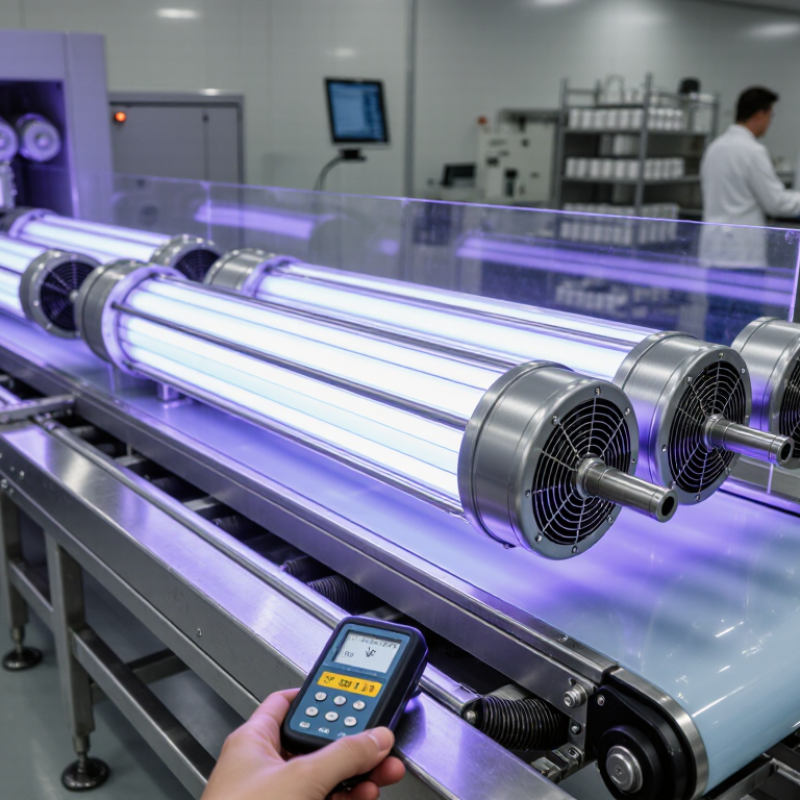
| Air-Cooling Performance | Check fan capacity, airflow direction, heat-sink design, ambient-temperature range, and ventilation requirements. | The supplier should specify allowable ambient temperature, airflow requirements, continuous-duty limits, and thermal protection settings. Air cooling is generally simpler than liquid cooling but may provide less heat-removal capacity. | Insufficient cooling can reduce UV output, shorten LED or lamp life, trigger thermal shutdown, or damage nearby components. | Thermal test report, temperature-rise data, fan specification, alarm logic, and installation clearance drawing. | 15% |
| Uniformity Across the Working Area | Compare the minimum, maximum, and average irradiance across the complete treatment or curing width. | Ask for a measurement grid and uniformity calculation. A practical project target should be defined according to the process; many industrial applications use a minimum-to-average ratio or a maximum-to-minimum ratio as the acceptance criterion. | Uneven UV exposure may produce partially cured areas, inconsistent color, or variable surface treatment. | Grid-based irradiance map measured at the actual conveyor speed, height, and operating temperature. | 10% |
| Electrical and Control Compatibility | Verify input voltage, frequency, current, power supply type, dimming method, communication interface, and machine interlocks. | Common industrial control requirements may include digital enable signals, emergency-stop integration, power regulation, fault output, and real-time status monitoring. | Electrical incompatibility can cause unstable output, nuisance trips, electromagnetic interference, or unsafe machine operation. | Wiring diagram, interface protocol, EMC test information, operating manual, and sample controller communication test. | 10% |
| Safety and Compliance | Review UV shielding, interlocks, warning labels, electrical protection, restricted-access controls, and applicable market requirements. | UV risk assessment should consider exposure to ultraviolet radiation. IEC 62471 is commonly used for photobiological safety assessment of lamps and lamp systems; other electrical and EMC requirements depend on the destination market. | UV-C and high-intensity UV-A exposure can harm eyes and skin. A compliant system reduces operational and regulatory risk. | Safety assessment, declaration of conformity where applicable, electrical test reports, risk-control drawings, and user safety instructions. | 10% |
| Service Life and Output Stability | Compare expected useful life, output-maintenance definition, operating cycle, and replacement recommendations. | For LED systems, useful life is often specified by an output-maintenance metric such as L70, meaning 70% of initial light output under defined conditions. For arc lamps, replacement intervals depend on lamp type, operating hours, and output requirements. | Stable output improves process consistency and reduces unplanned maintenance. | Aging test data, output-monitoring method, replacement schedule, warranty terms, and spare-parts availability. | 10% |
| Customization and Mechanical Fit | Check mounting dimensions, optical window, working distance, cable routing, cooling clearance, and integration with the existing machine. | The supplier should provide dimensional drawings, mounting tolerances, connector details, minimum ventilation clearance, and interface specifications before production. | A mechanically unsuitable unit may require costly redesign and can create thermal or safety problems. | 2D or 3D drawings, prototype sample, fit-check record, and documented engineering-change process. | 5% |
| Quality System and Traceability | Assess incoming inspection, production testing, calibration control, serial-number traceability, and final inspection procedures. | Relevant records may include spectral output, electrical power, irradiance, temperature, leakage current, functional testing, and final visual inspection. | Traceable records make it easier to identify process drift and manage warranty or replacement issues. | Quality manual, inspection plan, calibration certificates, batch records, corrective-action procedure, and sample test report. | 5% |
| Total Cost of Ownership | Compare purchase price, power consumption, cooling requirements, maintenance, consumables, downtime, shipping, and spare parts. | A lower purchase price does not necessarily mean a lower operating cost. Evaluate cost per operating hour and cost per treated unit where process data are available. | Lifecycle cost provides a more reliable comparison than initial price alone. | Five-year cost model, energy data, warranty coverage, spare-parts pricing, lead time, and service response terms. | 5% |



 Close
Close