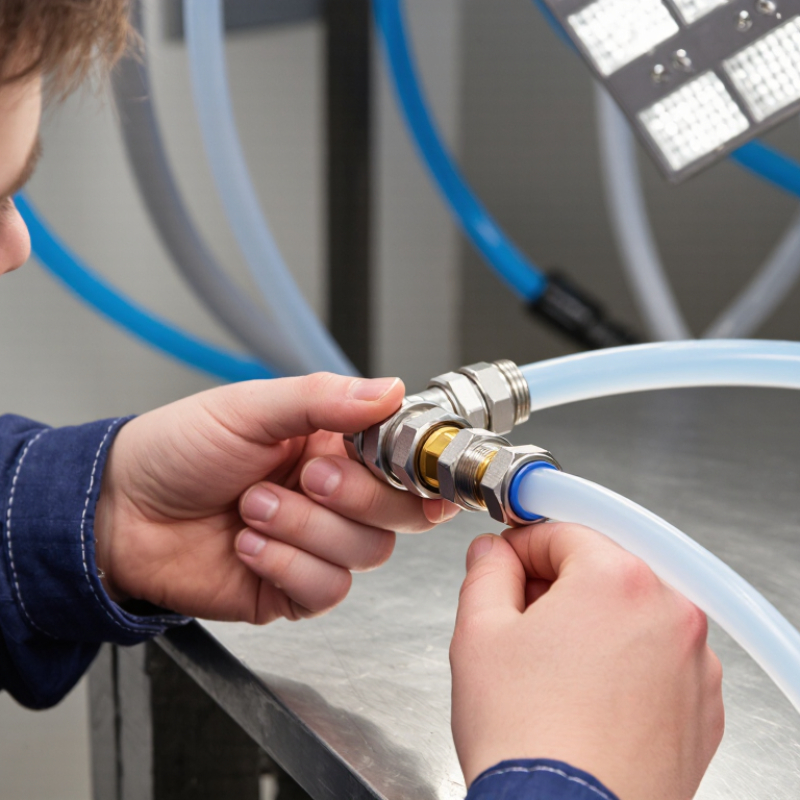
Push-to-Connect Tube Fitting
Fast installation | A tube is pushed through an internal collet and sealed with an O-ring. | Compressed air, vacuum, inert gases, water, and selected low-pressure fluids, depending on the seal and body material. | Commonly up to approximately 10 bar for pneumatic service; the actual rating depends on tube size, material, and temperature. | Often about −20°C to 80°C with standard polymer seals; higher or lower limits require suitable materials. | Pneumatic controls, automation equipment, instrumentation, air preparation units, and compact tubing assemblies. | Cut the tube squarely, remove burrs, insert it fully to the tube stop, and pull lightly to confirm retention. Depress the release collar before removing the tube. |
Barbed Quick-Connect Fitting
Flexible tubing | A tapered barb grips the inside of flexible tubing; a clamp may be added for demanding service. | Water, air, fuel, chemicals, and other fluids only when the tubing and fitting materials are chemically compatible. | Frequently used in low- to medium-pressure systems; the safe rating is strongly affected by tubing hardness and clamp selection. | Commonly about −40°C to 80°C for general-purpose elastomer tubing; verify the rating for the selected hose. | Irrigation, laboratory equipment, drainage, low-pressure fluid transfer, and small pump systems. | Cut the hose cleanly, push it completely over the barb, and secure it with an appropriate clamp when required. Do not use a hose that is too loose or damaged. |
Cam-and-Groove Coupling
Hose transfer | Two arms lock the male adapter into the female coupler; no wrench is normally required. | Water, wastewater, agricultural liquids, dry bulk materials, oils, and selected chemicals with compatible seals. | Commonly used from vacuum service to approximately 10 bar, depending on size, material, and coupling design. | Often about −25°C to 80°C with common elastomer seals; temperature limits vary by seal compound. | Tank transfer, agricultural irrigation, chemical handling, dewatering, and large-diameter hose connections. | Inspect the gasket, align the adapter and coupler, insert the adapter fully, and close both cam arms evenly. Never pressurize an incompletely locked coupling. |
Pneumatic Quick Coupler
Compressed air | A plug enters a socket and locks with a sleeve, ball-lock mechanism, or equivalent retainer. | Compressed air and inert gases such as nitrogen, when the coupling is rated for the gas. | Commonly approximately 7–15 bar in industrial pneumatic systems; confirm the pressure rating stamped or specified for the coupling. | Often about −20°C to 80°C for standard pneumatic service. | Air tools, production lines, pneumatic cylinders, maintenance drops, and test equipment. | Shut off and bleed pressure, inspect the plug and seal, insert the plug until locked, and test for leakage before operation. Use a safety lock or whip-check where required. |
Hydraulic Quick Coupler
High pressure | A locking sleeve, ball-lock, or screw-to-connect mechanism joins the hydraulic plug and socket. | Hydraulic oil and other approved hydraulic fluids; compatibility must include the hose, seals, and system fluid. | Commonly approximately 100–350 bar for industrial and mobile equipment; specialized couplers can be rated higher. | Often about −20°C to 100°C, subject to seal material, fluid type, and manufacturer limits. | Agricultural machinery, construction equipment, hydraulic power units, lifting equipment, and mobile attachments. | Stop the system, fully relieve trapped pressure, clean both halves, align without forcing, and lock completely. Never connect or disconnect a pressurized hydraulic line. |
Flat-Face Hydraulic Coupler
Low contamination | Flat mating faces seal when the coupler is locked, minimizing fluid loss and air inclusion during connection. | Hydraulic oil and selected biodegradable or fire-resistant hydraulic fluids when approved by the seal and body materials. | Commonly approximately 200–400 bar, depending on size and coupling construction. | Often about −25°C to 100°C, with the seal compound determining the final limit. | Excavators, loaders, hydraulic attachments, road equipment, and systems exposed to dirt or frequent connection cycles. | Clean both flat faces, release all line pressure, align the halves axially, engage the locking sleeve, and verify that the sleeve is fully seated. |
Dry-Break Coupling
Minimal spillage | Valved halves open only after they are correctly connected, reducing leakage and vapor release. | Fuels, solvents, chemicals, pharmaceutical fluids, and other liquids requiring controlled disconnection. | Commonly approximately 5–30 bar, depending on the coupling size, valve design, and fluid service. | Often about −20°C to 120°C, subject to body, seal, and chemical compatibility. | Chemical transfer, process skids, fuel handling, laboratory systems, and controlled fluid distribution. | Confirm the line is isolated, clean the mating surfaces, align the coupling, engage the locking mechanism fully, and check for leaks before opening the system. |
Refrigeration Quick Coupler
Service access | A self-sealing coupling connects service hoses to refrigeration or air-conditioning circuits. | Refrigerants and refrigeration oils only when the coupling, hose, and seals are rated for the specific refrigerant. | Often approximately 30–45 bar for many service applications; systems using higher-pressure refrigerants require higher-rated equipment. | Commonly about −40°C to 125°C, depending on refrigerant, seal material, and service equipment. | HVAC maintenance, refrigeration charging, recovery, evacuation, and pressure testing. | Verify refrigerant compatibility, isolate or control the circuit as required, connect the coupler straight onto the service port, and confirm that the valve opens only after secure engagement. |
Instrumentation Quick Connect
Small-bore tubing | A precision plug-and-socket connection uses an O-ring, metal seal, or face seal for repeatable service access. | Air, gases, water, hydraulic fluids, and process liquids compatible with the selected materials. | Commonly approximately 10–250 bar, depending on tube size, connection design, and sealing method. | Often about −40°C to 150°C, depending on metal, polymer, and seal selection. | Pressure gauges, calibration equipment, analytical instruments, sampling panels, and test manifolds. | Depressurize the line, keep the connection clean, align the plug with the socket, lock it without side loading, and perform a pressure or leak test. |



 Close