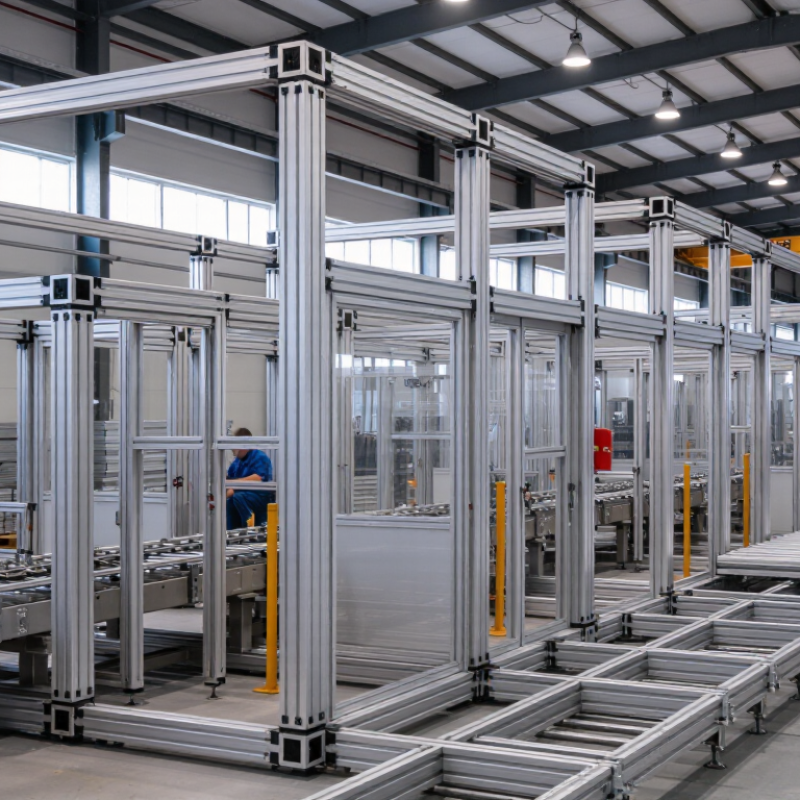
| What an industrial aluminum profile is | A length of aluminum alloy shaped by extrusion into a consistent cross-section. Profiles may be solid, hollow, or designed with slots and channels for fastening. | T-slotted framing, square tubes, channels, angles, and custom structural sections | The cross-section can combine strength, low weight, and useful mounting features. |
| Machine and equipment frames | Profiles are assembled into modular frames, guards, workstations, and support structures. | Automation cells, inspection stations, machine enclosures, and assembly benches | Modular connections can simplify assembly, adjustment, and later reconfiguration. |
| Conveyors and material handling | Extrusions provide structural rails and frames for moving, guiding, or supporting products and components. | Conveyor frames, guide rails, transfer tables, and handling equipment supports | A favorable strength-to-weight ratio helps limit structural mass while providing practical rigidity. |
| Workstations and safety guarding | Profiles form configurable supports for benches, panels, doors, and protective barriers. | Production workstations, machine guards, tool racks, and protective enclosures | Cut-to-length members and mechanical connectors can make modifications straightforward. |
| Heat sinks and thermal components | Profiles with fins or other extended surfaces are used to transfer heat away from components. | Electronic equipment cooling, LED fixtures, and power-device heat sinks | Aluminum conducts heat effectively and can be extruded into complex fin geometries. |
| Common alloys and tempers | Alloy and temper are selected according to requirements such as strength, formability, corrosion resistance, and surface finish. | 6063 is commonly used for many architectural and general-purpose extrusions; 6061 is often chosen where higher strength is needed. | Different alloy compositions and heat treatments provide different property combinations. |
| 1. Billet preparation | An aluminum alloy billet is cut to length and heated to a controlled temperature suitable for extrusion. | Billet size and alloy are matched to the press, die, and required profile. | Controlled heating helps the metal flow through the die during forming. |
| 2. Die design and extrusion | A hydraulic press pushes the heated billet through a shaped steel die to create a continuous profile with the die's cross-section. | The die opening determines features such as walls, hollows, slots, and fins. | One extrusion process can produce a long, consistent section that can later be cut to length. |
| 3. Cooling and straightening | The emerging profile is cooled, stretched or straightened as needed, and cut into manageable lengths. | Cooling methods and handling depend on alloy, section shape, and production requirements. | These steps help control shape and prepare the extrusion for subsequent processing. |
| 4. Heat treatment and finishing | Depending on the required temper, profiles may be heat-treated, then finished with processes such as anodizing, painting, or powder coating. | Finishing may improve appearance or provide a surface suited to the intended environment. | Heat treatment can develop specified mechanical properties; surface treatments can alter surface protection and appearance. |
| 5. Fabrication and inspection | Finished profiles may be cut, drilled, milled, or assembled, followed by checks against relevant dimensional and quality requirements. | Fabricated lengths, machined parts, and assembled modular structures | Secondary operations adapt standard or custom extrusions to their final application. |



 Close