Why Use an Injection Machine Robot for Your Production Needs?
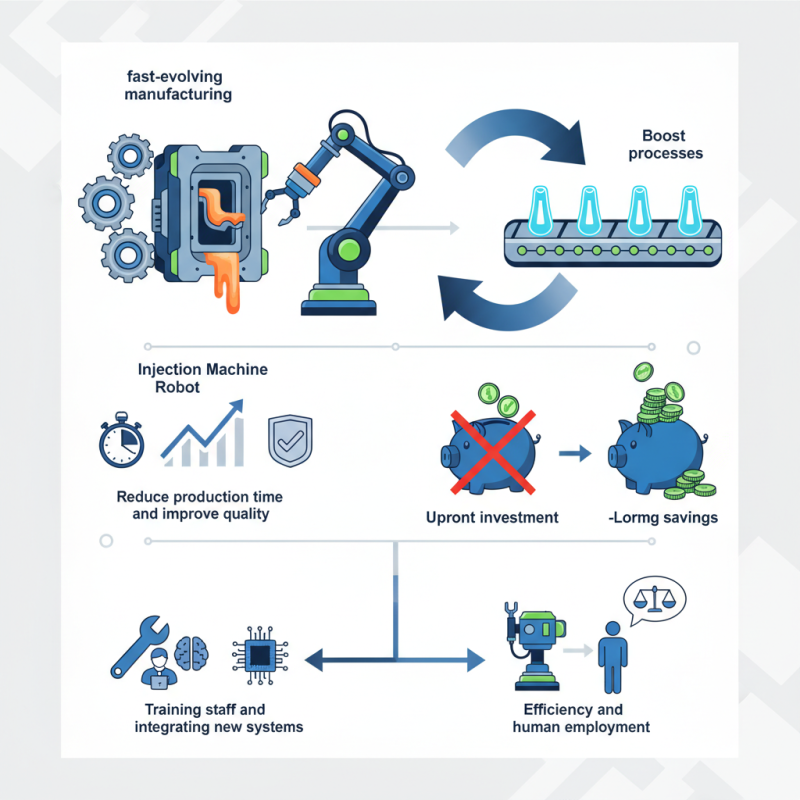
In the fast-evolving manufacturing landscape, the use of an Injection Machine Robot is becoming pivotal. Industry expert John Smith states, "Automation in injection molding can significantly reduce production time and improve quality." This highlights a common trend where businesses seek efficiency and precision.
Injection Machine Robots are designed to streamline processes. They handle tasks like injection molding with remarkable accuracy. With their ability to operate continuously, they boost productivity. Yet, some manufacturers overlook the upfront investment needed for such technology. The benefit of long-term savings sometimes gets overshadowed by initial costs.
Transitioning to automation isn’t always smooth. Training staff and integrating new systems can be challenging. Moreover, some may question whether robotic technology could replace skilled workers. This debate remains crucial as companies balance efficiency and human employment. An Injection Machine Robot can revolutionize production, but careful consideration is essential.
Advantages of Using Injection Machine Robots in Manufacturing
Injection machine robots represent a significant advancement in manufacturing. These machines enhance efficiency and precision. They automate repetitive tasks, reducing human error and operational costs. The robots can work tirelessly around the clock, maximizing production output. Their programming allows for quick adjustments, making them adaptable to different products and designs.
Using injection machine robots offers many advantages. They improve product consistency and quality. This uniformity can lead to fewer defects and waste. Productivity increases as robots can operate at a faster pace than human workers. Additionally, they can be integrated into existing production lines with minimal disruption.
Tips for utilizing injection machine robots successfully include assessing production needs carefully. Understand the specific requirements for your products. Training staff on operating and maintaining the machines is crucial. Always consider the long-term benefits versus the initial investment.
Keep track of machine performance for continuous improvement. This data can guide adjustments to optimize productivity further. Sometimes the best machine setup might not be apparent initially. Reflect on challenges faced in production to find innovative solutions. Flexibility is key in adapting to new requirements in the manufacturing landscape.
Types of Injection Machine Robots Available for Production
Injection machine robots have become essential in modern production. They offer precision, speed, and efficiency. Different types of these robots cater to varying production needs.
One common type is the Cartesian robot. It moves along three axes: X, Y, and Z. This design enables straightforward operations, especially in assembly lines. According to industry data, Cartesian robots can increase production speed by up to 30%. However, they may struggle with complex tasks.
Another option is the SCARA robot. Known for its speed and flexibility, it excels in pick-and-place operations. Reports suggest that SCARA robots can handle 1,200 picks per hour. They are ideal for applications that require quick repetitive tasks.
Collaborative robots (cobots) are also gaining traction. These robots work alongside human operators. Their safety features make them suitable for diverse environments. A recent study highlights their potential to boost productivity by 25%. However, some industries are hesitant to adopt them due to safety concerns.
Each robot type has its strengths and limitations. Companies must assess their production needs carefully to choose the best fit. Investing in the right injection machine robot can yield significant returns, but it requires thoughtful consideration.
How Injection Machine Robots Improve Efficiency and Productivity
Injection machine robots have revolutionized production lines. These machines automate processes, making them much faster. Speed is crucial in meeting market demands. With quick cycle times, businesses can produce more units in less time. This scalability is especially useful when demand fluctuates.
Efficiency is not just about speed; it also involves precision. Injection machine robots minimize waste by delivering exact material amounts. This precision reduces material costs. However, it can take time to adjust settings for different designs. Mistakes during setup might lead to wasted materials initially.
Additionally, these robots work tirelessly. They can operate around the clock with minimal downtime. This constant productivity is beneficial for meeting tight deadlines. Yet, human oversight is still necessary. Operators need to monitor performance and address issues. Balancing automation with human insight ensures both efficiency and quality in production.
Cost-Effectiveness of Implementing Injection Machine Robots
The cost-effectiveness of implementing injection machine robots in production is significant. According to a recent industry report, automation can reduce production costs by up to 30%. Robots enhance efficiency and have a quick return on investment. Many companies see payback within two years. This benefit is crucial in today’s competitive market.
Labor costs are often high. Human workers require salaries, benefits, and training. Robots, however, can operate 24/7 with minimal downtime. They produce consistent quality, which reduces waste. A study showed that manufacturers achieved up to a 20% decrease in material costs after deploying robotic systems.
While the initial investment can be daunting, the long-term savings are compelling. Companies must consider their unique situations. Some may overlook maintenance costs, which can add up. Proper planning is essential. An overall strategy should include workforce training to adjust to new roles. Balancing automation with human input is a challenge worth addressing.
Future Trends in Injection Machine Robotics for Production Needs
The landscape of injection machine robotics is rapidly evolving. Companies are increasingly adopting robotic systems for production needs. These machines not only enhance efficiency but also improve precision in manufacturing processes. As automation becomes commonplace, the demand for skilled robotic workers grows. However, integrating these systems can pose challenges.
Consider the learning curve. Staff may need training to operate new machines effectively. It’s important to invest in proper training to avoid operational hiccups. Regular assessments help identify gaps in skills. Addressing these gaps ensures smoother workflows and higher output quality.
Another aspect is maintenance. Robots require periodic checks to function optimally. Neglecting maintenance can result in costly downtimes. Set a maintenance schedule to preempt issues. Pay attention to the finer details of machine performance. Evaluate how robots impact production speed and quality. Continuous monitoring is essential for long-term success.

 Close
Close