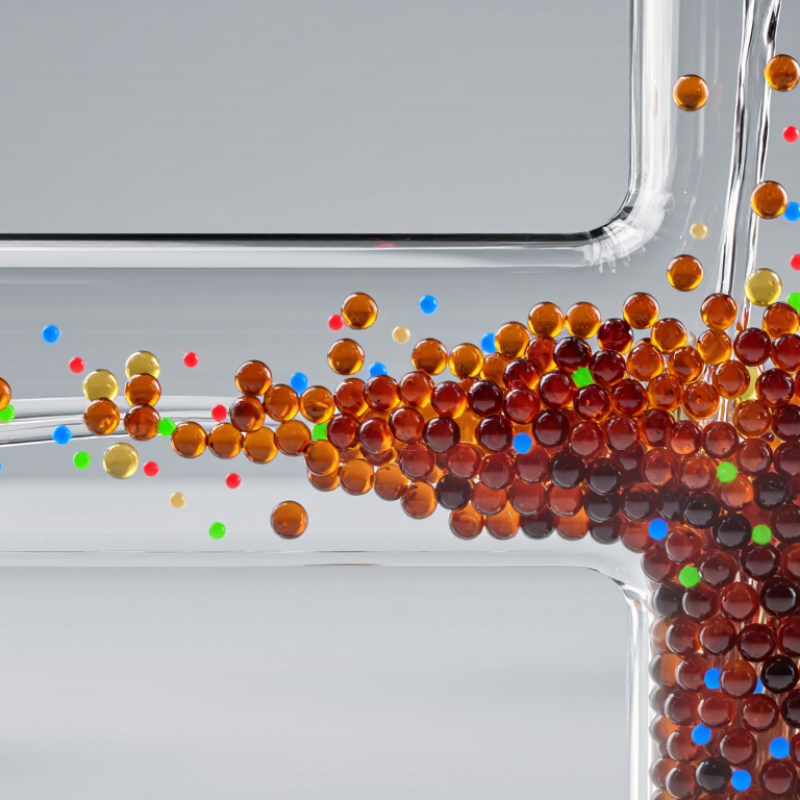
| What it is | A water-insoluble material containing fixed, electrically charged sites that can exchange mobile ions with a surrounding solution. | Most water-treatment resins are small, porous polymer beads with functional groups attached to their structure. |
| Resin structure | The polymer matrix provides a stable framework, while functional groups provide the sites that attract ions. | The matrix is commonly made from cross-linked polymers; water and dissolved ions move through pores in the bead. |
| Basic exchange process | An ion in the water replaces a mobile counterion associated with a fixed charged site on the resin. | For example, a cation resin in sodium form can exchange sodium ions for calcium ions in water. |
| Charge balance | Exchange maintains electrical neutrality: the resin releases an equivalent amount of charge as it takes up ions. | One calcium ion with a 2+ charge generally displaces two sodium ions with 1+ charges. |
| Cation-exchange resin | Contains negatively charged functional sites and exchanges positively charged ions (cations). | Common targets include calcium, magnesium, and other dissolved cations. Hydrogen-form cation resins can exchange hydrogen ions for cations. |
| Anion-exchange resin | Contains positively charged functional sites and exchanges negatively charged ions (anions). | Depending on the resin and water chemistry, targets can include chloride, nitrate, or sulfate ions. |
| Strong-acid and strong-base types | These resins have functional groups that remain ionized across a broad pH range. | Strong-acid cation resins commonly use sulfonic acid groups; strong-base anion resins commonly use quaternary ammonium groups. |
| Weak-acid and weak-base types | Their ionization and exchange behavior depend more strongly on solution pH. | Weak-acid cation resins commonly contain carboxylic groups; weak-base anion resins commonly contain amine groups. |
| Selectivity | Resins may prefer some ions over others, but the degree of preference depends on resin chemistry and solution conditions. | Ion charge, concentration, competing ions, and the resin’s functional groups can all affect which ions are taken up first. |
| Capacity and exhaustion | Exchange capacity describes how much ionic charge a quantity of resin can hold under specified conditions. | As exchange sites fill, the resin approaches exhaustion and its ability to remove the target ions declines. |
| Regeneration | A regenerant solution restores the resin to a chosen ionic form by displacing ions captured during service. | The regenerant depends on the process and resin form; regeneration produces a waste stream containing displaced ions and excess regenerant. |
| Common applications | Ion exchange is used to selectively remove, recover, or change the ionic composition of liquids. | Applications include water softening, demineralization, and treatment or recovery of selected dissolved ions. |



 Close