Top 5 Laser Optics Tips for 3D Printing at Canton Fair 2026?
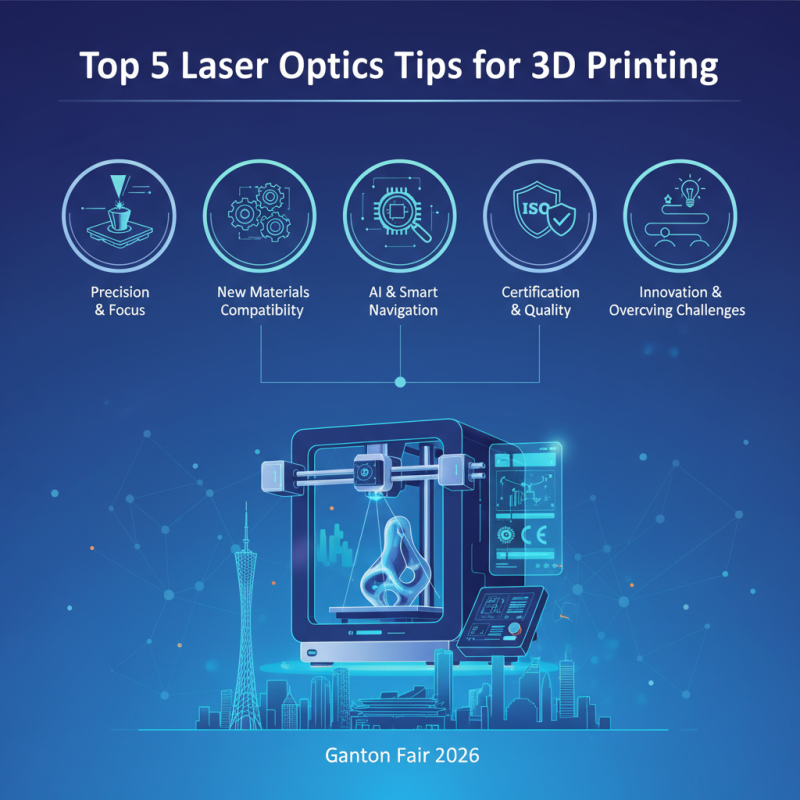
As the 139th Canton Fair approaches in April 2026, the focus on "Laser Optics for 3D Printing" has never been more critical. This year, the fair will emphasize advanced manufacturing and new materials. Innovations in laser optics are driving changes in 3D printing technologies, enhancing precision and efficiency. Attendees will find a wealth of suppliers specializing in this cutting-edge field.
Navigating the vast 155,000 square meter venue can be daunting. The fair has introduced AI-powered search and smart navigation to improve the experience. Buyers can quickly locate suppliers with specific qualifications, such as ISO and CE certifications. This technology aims to streamline interactions but may not cover every need or preference.
Learning about laser optics in 3D printing requires attention. Each tip can open new doors, yet experimenting often reveals imperfections and challenges. Embracing these roadblocks is part of the innovation journey. Visitors at the Canton Fair will experience firsthand the evolving landscape of 3D printing, enriched by advancements in laser optics.
Understanding Laser Optics and Its Role in 3D Printing Technology
Laser optics plays a critical role in 3D printing technology. It influences the precision and efficiency of the printing process. A recent industry report indicates that laser-powered 3D printing can enhance printing speeds by up to 70%. This is significant for manufacturers seeking rapid prototyping solutions.
Understanding laser optics involves grasping how light interacts with materials. Different wavelengths can achieve varying levels of penetration. This impacts layer adhesion and overall print quality. In some cases, improper settings may lead to defects. A study highlighted that 25% of prints fail due to misalignment in laser optics.
Moreover, the choice of optics impacts the energy distribution during printing. A uniform energy output reduces thermal stress on materials. This leads to fewer warping issues. Reports show that optimizing laser parameters can improve accuracy by around 15%. Embracing better optics is a pathway to refining the 3D printing process, yet challenges remain. Users must consistently evaluate their setups.
Top 5 Laser Optics Tips for 3D Printing
Key Laser Parameters Impacting 3D Print Quality and Material Strength
Laser optics play a critical role in 3D printing. Key parameters directly impact print quality and material strength. Laser power and wavelength are foundational. Adjusting these can dramatically enhance the laser’s penetration into the material. For instance, a study found that increasing laser power by 25% improved layer adhesion by 40%. Such adjustments may seem subtle but can yield significant results.
The
focus spot size also matters. A smaller spot size can create more detailed prints, but it often requires higher precision. However, it might lead to overheating or distortions. Material types respond differently to these changes, which complicates the process. Reports show that certain polymers perform poorly with high-energy lasers.
Layer thickness is another variable to consider.
Thicker layers can speed up printing, but they may compromise strength. Industry data suggests that prints with
0.1 mm layers exhibit
20% higher tensile strength than those with
0.3 mm layers. Experimenting with these parameters is essential. Results can vary widely, highlighting the need for careful testing and adaptation.
Comparative Analysis of Laser Types for Optimal 3D Printing Outcomes
When exploring laser types for 3D printing, different methods influence outcomes significantly. CO2 lasers are popular for their effectiveness on various materials. They can cut, engrave, and even mark surfaces. However, they may struggle with certain plastics, leading to inconsistent results. Fiber lasers, on the other hand, excel with metals. Their precision is impressive but can be costly and complex to operate.
Choosing the right laser involves weighing benefits against limitations. For instance, solid-state lasers provide excellent quality but require careful setup. Users often report frustration with proper alignment and focus. Some may overlook these challenges until it's too late, resulting in wasted materials. Additionally, UV lasers are gaining traction, especially in resin printing. They offer finer details but can be temperamental.
Understanding these nuances is vital. Knowing the capabilities and drawbacks of each laser helps in selecting the ideal option. This comparison encourages innovation but also demands constant learning. Embracing mistakes is part of the journey in refining 3D printing techniques. As new trends emerge, staying informed will enhance outcomes at events like Canton Fair 2026.
Innovative Laser Processing Techniques Enhancing 3D Printing Efficiency
As 3D printing continues to evolve, innovative laser processing techniques are taking center stage. These methods can significantly enhance printing efficiency. By integrating lasers into the 3D printing process, companies can achieve finer detail and improve material bonding. This offers potential benefits in industries ranging from Aerospace to Healthcare.
Laser optics can reduce print times. With precise beam control, layers adhere more effectively. However, inconsistent results are a challenge. Some users report issues with overheating or material degradation. This variability prompts engineers to refine their approaches constantly. Testing different settings and materials is essential for optimal performance.
Understanding the interaction between lasers and materials is crucial. Not all materials respond equally to laser processing. Some may require adjustments in power or speed. Exploring these nuances can lead to breakthroughs. Each experiment provides valuable insights, guiding future innovations. A commitment to testing and learning can pave the way for enhanced efficiency in 3D printing.
Future Trends in Laser Optics for Advanced 3D Printing Applications
The evolution of laser optics is transforming 3D printing. Advanced laser technologies enhance precision and speed. They enable the creation of complex geometries with reduced material waste. This is crucial in industries such as aerospace and healthcare. Manufacturers are exploring multiple wavelengths for better compatibility with various materials. These advancements open doors for innovative designs previously thought impossible.
However, challenges remain. The costs associated with high-performance laser systems can be prohibitive. Furthermore, not every organization has access to the required expertise. Training is essential to fully leverage these technologies. As laser optics become more mainstream, a skills gap may hinder progress. Education and partnerships will be key in bridging this divide.
Future trends point towards integrating AI with laser optics. This could lead to smarter systems that adjust parameters in real-time. Such adaptability would significantly optimize the printing process. There's also a growing focus on sustainability in laser optics. Using eco-friendly materials can reduce the carbon footprint. The path ahead in laser optics for 3D printing is filled with opportunities, though not without obstacles.



 Close
Close