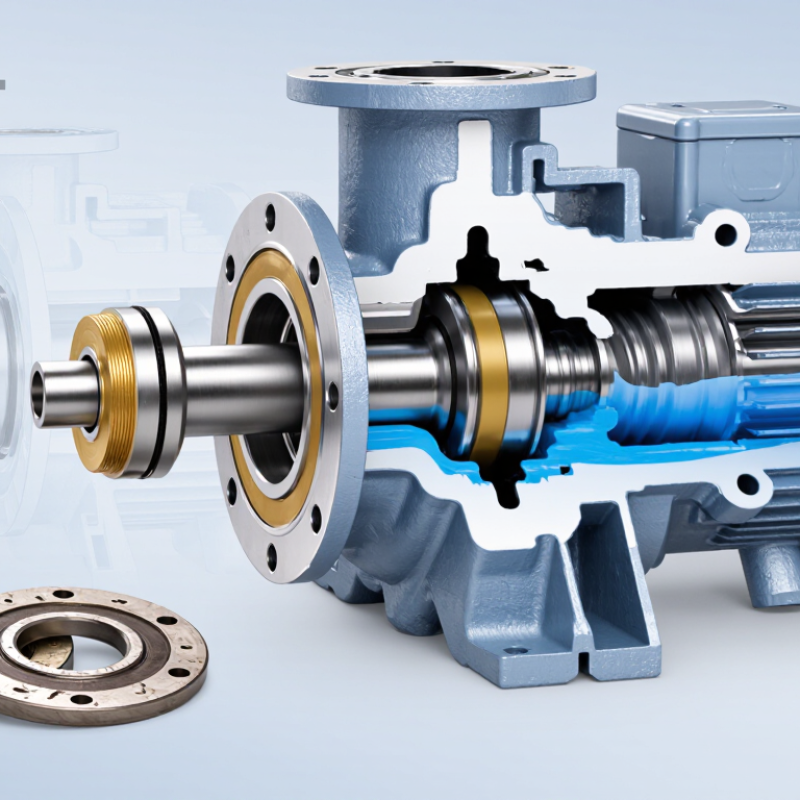
| Primary sealing faces | Two closely fitted, flat annular faces: one rotates with the shaft and the other is held stationary. | The faces restrict fluid escaping along the shaft while allowing rotation with very little contact. |
| Lubricating film thickness | Typically on the order of a few micrometres; the exact thickness varies with seal design and operating conditions. | A thin process-fluid film separates and lubricates the faces. It also carries away heat generated at the interface. |
| Film composition | Usually the sealed liquid itself; in some services, the film may include a small amount of vapor. | The fluid’s viscosity, vapor pressure, temperature, and cleanliness influence film stability and leakage behavior. |
| Face loading | A spring and fluid pressure apply closing force; hydraulic forces in the seal balance help determine the net load. | The closing force maintains face proximity, while the fluid film prevents excessive solid-to-solid contact during normal operation. |
| Surface finish | Seal faces are precision lapped to a very smooth finish; the specified finish depends on materials and design. | Flat, smooth faces help maintain a stable film and reduce localized wear and leakage paths. |
| Leakage path | Fluid can pass through the microscopic interface between the faces. | Some leakage is inherent in a lubricated face seal. Depending on conditions, it may be extremely small and may evaporate near the seal exterior. |
| Heat management | Heat is produced by fluid shear and any face contact, especially during start-up or poor lubrication. | Circulation of the liquid film and, where provided, a seal flush or cooling arrangement help control face temperature. |
| Start-up and dry running | The lubricating film may not be fully established before the equipment reaches operating conditions. | Running without suitable liquid at the faces can cause rapid heating, wear, or face damage. Start-up procedures depend on the equipment and seal arrangement. |
| Performance influences | Pressure, shaft speed, temperature, fluid properties, alignment, vibration, and contamination all matter. | These conditions affect film formation, face loading, leakage, and service life; values should be checked against the specific seal design. |
| Typical materials | Face pairs commonly use combinations such as carbon graphite against silicon carbide or tungsten carbide. | Material selection balances wear resistance, chemical compatibility, thermal behavior, and the properties of the sealed fluid. |



 Close