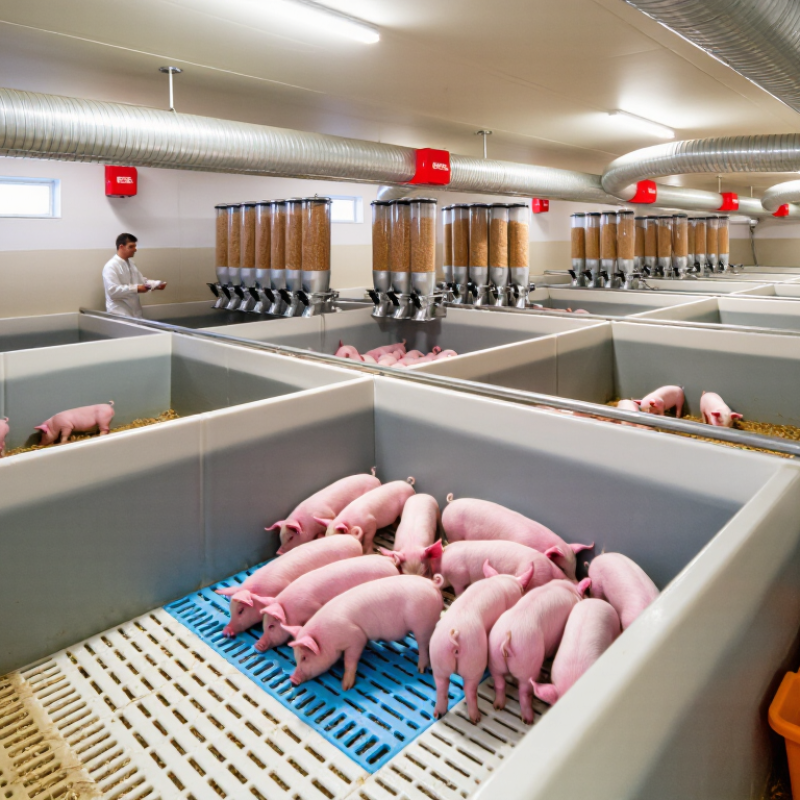
| Purpose of the nursery house | Post-weaning housing, commonly from about 3–8 weeks of age until approximately 20–30 kg live weight | Provides a controlled environment for temperature management, feeding, watering, health observation, and gradual growth after weaning | Use an all-in/all-out flow where possible, with cleaning and disinfection between groups |
| Stocking space | 0.3–0.4 m² per piglet, adjusted for piglet size, climate, flooring, and ventilation | Gives each piglet enough room to rest, eat, drink, and move without excessive competition | Reduce stocking density when heat stress, poor ventilation, wet floors, or larger finishing weights are expected |
| Pen group size | Often 15–30 piglets per pen; keep groups as uniform as practical | Smaller, evenly sized groups make it easier to monitor feed intake, health, and social behavior | Avoid mixing unfamiliar groups unless necessary; separate markedly smaller or compromised piglets |
| Pen layout | Rectangular pens with a clear resting area, feeding area, and drinking area; service alleys should allow safe inspection | Functional zoning encourages piglets to rest in the dry area and use separate locations for feeding and manure deposition | Keep feeders and drinkers accessible without blocking the main walkway or creating dead corners |
| Pen partitions | Smooth, durable partitions commonly about 0.6–0.8 m high | Provide group separation while allowing staff to observe piglets and clean the pen efficiently | Use corrosion-resistant materials with no sharp edges, protrusions, or gaps that can trap legs |
| Flooring | Partially or fully slatted flooring with good traction; avoid excessively wide openings | Allows manure and urine to pass below the animal area, helping keep the resting surface cleaner and drier | Inspect for broken slats, slippery surfaces, blocked channels, and conditions that may injure feet or legs |
| Feeder access | Provide enough feeding space for the selected feeder type; trough systems should allow simultaneous access or minimize waiting | Dry or liquid feed is delivered in controlled amounts so piglets can eat frequently during the day | Set feed flow to reduce bridging, dust, feed wastage, and accumulation of stale feed |
| Feeder placement | Position on a firm, well-drained surface, away from the main resting zone and direct manure flow | Separating feed from waste helps maintain hygiene and encourages normal feeding behavior | Check feeder adjustment daily during transitions because young piglets are sensitive to poor feed availability |
| Drinkers | At least two drinker points per pen are commonly used to provide backup and reduce competition; exact numbers depend on group size and system design | Nipple, cup, or bowl drinkers supply fresh water whenever piglets activate or access the valve | Place drinkers at a height piglets can reach comfortably and inspect water flow, leaks, and cleanliness every day |
| Water quality and flow | Clean, palatable water with adequate flow for the age and number of piglets | Reliable water access supports feed intake, thermoregulation, digestion, and medication delivery when prescribed | Flush lines when required and test water quality according to local veterinary or agricultural guidance |
| Temperature control | A warm zone is typically needed after weaning; temperature is gradually reduced as piglets grow and produce more body heat | Heating systems, insulation, and ventilation work together to maintain a stable pig-level environment | Observe piglet behavior: huddling may indicate cold stress, while spreading out and panting may indicate overheating |
| Ventilation | Adjustable air inlets and mechanical or natural exhaust sized for both minimum and maximum seasonal ventilation | Removes moisture, heat, dust, and gases while supplying fresh air without creating drafts at piglet level | Monitor humidity, condensation, odor, and air movement; minimum ventilation must continue in cold weather |
| Lighting and inspection | Even lighting that allows staff to see feed, water, manure, injuries, and abnormal behavior | Good visibility supports routine checks and early identification of sick or injured piglets | Inspect each pen at least daily, including appetite, coughing, diarrhea, lameness, and access to water |
| Cleaning and biosecurity | Cleanable surfaces, dedicated tools where practical, and a defined entry and exit routine | Removal of organic matter followed by washing, disinfection, and drying reduces pathogen pressure between groups | Follow product labels and veterinary guidance; disinfectants are less effective when surfaces are not cleaned first |
| Example pen calculation | 20 piglets × 0.35 m² = 7.0 m² of usable pen area | A pen measuring approximately 2.5 m × 2.8 m provides about 7.0 m² before accounting for fixed equipment and access considerations | Confirm local welfare regulations and adjust the final layout for equipment footprints, walkways, and expected finishing weight |



 Close
Close