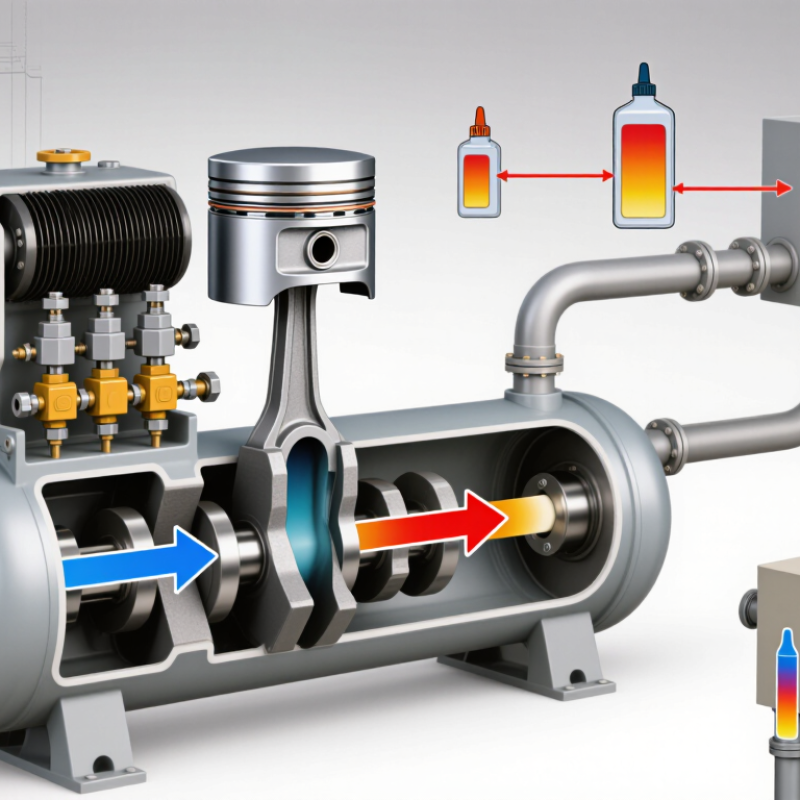
A reciprocating compressor traps gas inside a cylinder and reduces its volume with a moving piston.
The cycle begins during suction. As the crankshaft pulls the piston back, cylinder pressure falls below inlet pressure. The suction valve opens, and gas fills the space. At the end of this stroke, the valve closes. Small timing errors matter.
Compression starts when the piston moves inward. Both valves remain closed, so the trapped gas occupies less volume and its pressure rises. Temperature rises too, which technicians can feel near the discharge line after steady operation.
When cylinder pressure exceeds discharge pressure, the discharge valve opens. Compressed gas leaves through the outlet, often producing a sharp mechanical pulse. The piston then reverses direction, and the cycle repeats.
A small clearance volume remains above the piston. Gas trapped there expands during the next return stroke, delaying fresh intake. This reduces actual capacity, even when the cylinder’s theoretical displacement looks impressive.
The U.S. Department of Energy’s Improving Compressed Air System Performance sourcebook reports that compressed air may account for roughly 10% of industrial electricity use, depending on the facility.
That figure explains why valve leakage, high discharge pressure, and poor cooling deserve attention. Industry efficiency assessments also show that operating conditions can change substantially across a shift.
In practice, a clean filter and correct lubrication may matter more than a perfect calculation. Engineers should verify pressure, temperature, vibration, and flow on site. Theory helps, but machines remain slightly untidy.



 Close
Close