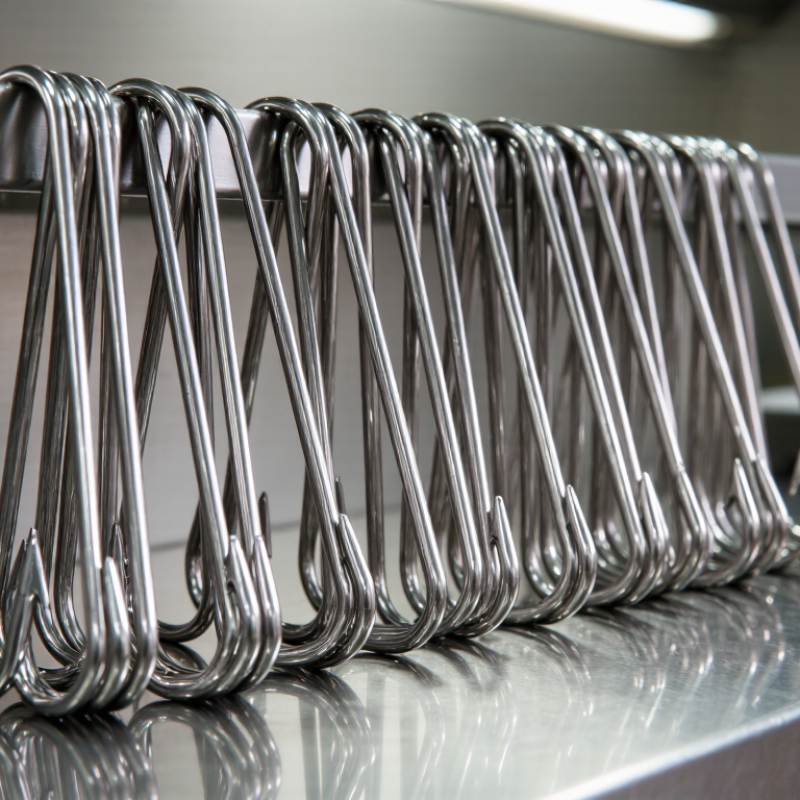
| Stainless steel grade | Type 304 is commonly selected for general food-processing environments. | Type 316 contains molybdenum and offers improved resistance to chloride-related corrosion. | Match the grade to the meat, cleaning chemicals, salt exposure, and operating environment. Request material documentation. |
| Hook style | S-hooks can suspend products from a rail or another support point. | Single-prong hooks provide one hanging point; other designs may include multiple prongs or a closed end. | Choose the shape for the product and handling process. Confirm that the hook can be safely removed and handled during use. |
| Wire diameter and dimensions | Size should be specified by wire diameter, overall length, opening, and bend dimensions. | Thicker wire or a different geometry may be appropriate for a heavier application, but does not establish capacity by itself. | Compare supplier drawings and tolerances; do not rely on terms such as “large” or “heavy duty” without measurements. |
| Load capacity | Capacity depends on material, wire size, shape, bends, welds, and how the hook is supported. | A different grade or thicker wire alone does not guarantee a higher safe working load. | Request a documented working-load rating and test method for the exact hook design. Keep loads within the stated rating. |
| Surface finish | A smooth, cleanable finish helps reduce areas where residue can collect. | Passivation or electropolishing may be available as a finishing option; the result depends on the process and specification. | Ask for the finish specification and inspect for burrs, sharp edges, pits, and rough areas that could hinder cleaning. |
| Welds and joints | Some hook designs are formed from continuous wire and have no welded joint. | Fabricated designs may include welded areas that require particular attention during inspection and cleaning. | Check drawings and samples for cracks, incomplete welds, sharp projections, and corrosion-prone crevices. |
| Cleaning and maintenance | Stainless steel hooks still require cleaning, rinsing, drying, and routine inspection according to site procedures. | More corrosion-resistant steel can help in harsher environments, but it does not eliminate maintenance needs. | Confirm compatibility with the facility’s cleaning agents and procedures; inspect regularly for damage or corrosion. |
| Traceability and quality documents | Documentation can identify the stated grade, dimensions, finish, and inspection criteria. | For more demanding applications, buyers may request material test documentation and batch identification. | Agree in advance on required certificates, inspection records, labeling, and acceptance criteria for each shipment. |
| Wholesale packaging | Bulk cartons can suit buyers who receive and distribute hooks in larger quantities. | Smaller inner packs can make inventory counting and downstream distribution easier. | Confirm pieces per pack, carton quantity, protective packing, labeling, and whether mixed sizes are allowed. |
| Best purchasing approach | Use a written specification for the intended product, hook style, material grade, and dimensions. | Compare samples against the same specification before approving a larger order. | Evaluate total delivered cost, consistency between batches, documentation, lead time, and replacement terms—not unit price alone. |



 Close