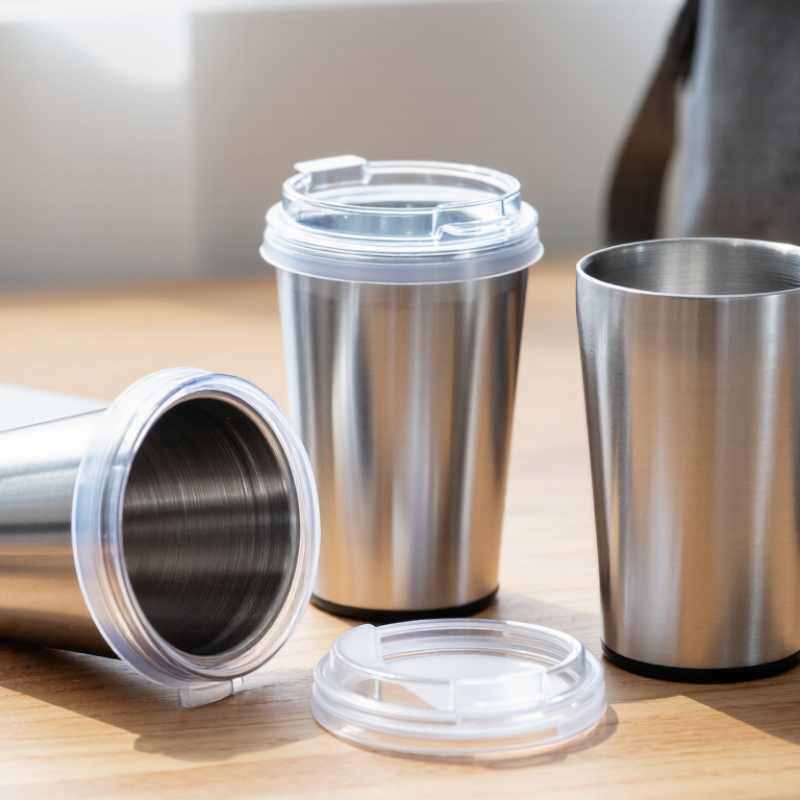
| 1 | Verify the material specification | Ask whether the cup’s stainless-steel sheet or strip is specified as ASTM A240/A240M Type 304. ASTM A240/A240M covers stainless-steel plate, sheet, and strip—not every finished-cup performance requirement. | Request documentation that identifies Type 304 and the applicable specification edition. Confirm separately that the finished cup meets your product and food-contact requirements. |
| 2 | Confirm the full Type 304 chemistry | For Type 304 under ASTM A240/A240M, the typical specified limits are chromium 18.0–20.0%, nickel 8.0–10.5%, carbon 0.07% maximum, manganese 2.00% maximum, silicon 0.75% maximum, phosphorus 0.045% maximum, and sulfur 0.030% maximum. | Compare the mill test report’s heat analysis with the applicable standard. Do not rely on a statement that the product is “18/8” alone; it does not document every required element or the tested heat. |
| 3 | Request traceable test documentation | Check that the material test report identifies the grade, heat or lot number, chemical analysis, and relevant mechanical test results. The reported material should be traceable to the production lot. | Match the heat or lot number on the documentation to supplier records and, where available, packaging or production records. Treat an untraceable generic certificate as limited evidence. |
| 4 | Use material identification tests appropriately | Portable X-ray fluorescence (XRF) can help check chromium and nickel, but it does not reliably measure carbon. Surface condition, coatings, geometry, and calibration can affect readings. | Use XRF as a screening check, not as a substitute for a full chemical analysis. If carbon or formal compliance must be verified, use an appropriate laboratory method and a representative sample. |
| 5 | Check every stainless-steel component | A cup may use different materials for its inner wall, outer wall, rim, base, handle, lid, or drinking spout. Confirm which parts are 304 and identify any other metals or polymers. | Obtain a component or bill-of-materials list. Do not assume the entire product is Type 304 because one surface or the product description says “304.” |
| 6 | Specify and measure wall thickness | Wall thickness affects weight, rigidity, and feel. There is no single thickness that is correct for every cup design; formed parts may also vary locally. | Set a nominal thickness and tolerance in the purchase specification, then measure samples at agreed locations with a suitable instrument. Compare results with the agreed drawing or specification. |
| 7 | Inspect seams, welds, and the rim | Look for incomplete joints, cracks, sharp edges, burrs, uneven finishing, and gaps that may trap residue. Weld appearance alone does not establish corrosion resistance or hygiene. | Inspect representative samples visually and by touch; check seams and rim finishing against agreed workmanship criteria. Define any additional weld or leak testing needed for the design. |
| 8 | Check the interior finish and cleanliness | Review the inside surface for pits, scratches, scale, embedded particles, or residue. Surface finish requirements should be specified for the intended use rather than assumed from the grade. | Set a visual cleanliness and finish standard, inspect samples under consistent lighting, and confirm the cleaning process leaves no visible manufacturing residue. |
| 9 | Test the finished cup for its intended use | Material grade alone does not prove that a cup is leakproof, thermally insulating, dishwasher-safe, or suitable for every beverage. These properties depend on construction, seals, coatings, and care instructions. | Agree on product-specific tests, such as leak checks, fit checks, or thermal performance tests, and request results from representative finished units using the defined method. |
| 10 | Define inspection and compliance requirements | Food-contact rules and documentation vary by market and by component. A stainless-steel grade designation by itself does not certify the complete cup for every jurisdiction or use. | Specify the destination market, required declarations or test reports, sampling plan, acceptance criteria, and documentation to be supplied with each production lot. |



 Close