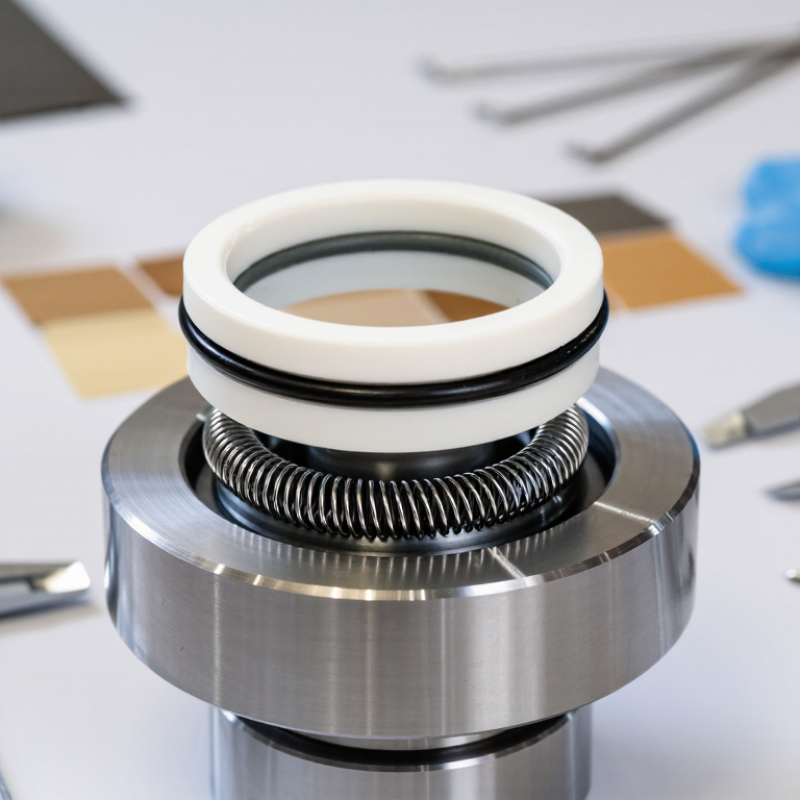
| 1 | Temperature range | PTFE has a broad service range and a melting point of approximately 327°C. Its practical seal limit depends on pressure, load, design, and the specific compound. | Elgiloy is a cobalt-based alloy with strong resistance to oxidation and high-temperature strength retention compared with many common spring alloys. | Select a grade and design that cover both the continuous and peak temperatures. Confirm stress relaxation and material compatibility at the actual operating temperature. |
| 2 | Pressure and extrusion risk | PTFE has low friction and excellent chemical resistance, but unfilled PTFE can deform or extrude under high pressure, especially with a large clearance gap. | The spring mainly maintains sealing force; it does not replace proper anti-extrusion design or adequate gland support. | Check pressure, clearance, temperature, and dynamic speed together. Use a filled PTFE compound, a back-up feature, or a tighter gland design when extrusion is possible. |
| 3 | Chemical exposure | PTFE is resistant to most chemicals, including many acids, bases, solvents, and fuels. Exceptions and permeation effects still require verification. | Elgiloy provides good corrosion resistance in many demanding environments, but aggressive halides, strong acids, and other specific media must be evaluated. | Review the complete media composition, concentration, temperature, pressure, and exposure time. Check both the PTFE compound and the energized spring. |
| 4 | Motion and friction | PTFE offers a low coefficient of friction and is suitable for reciprocating, rotary, and static sealing when the surface finish and lubrication conditions are appropriate. | The spring must provide stable contact force without excessive loading that could increase wear or friction. | Specify shaft or bore speed, stroke, oscillation, start-stop frequency, surface hardness, and finish. Validate wear and heat generation under representative cycling. |
| 5 | Spring energizer selection | The PTFE jacket supplies the primary sealing interface, while the spring compensates for material deformation, dimensional variation, and wear. | Elgiloy combines high strength, good fatigue performance, and useful corrosion resistance for many high-demand applications. | Choose a spring type and load that match the seal diameter, motion, pressure direction, installation method, and required deflection. Avoid over-compressing the energizer. |
| 6 | Permeation and leakage control | PTFE has very low absorption and strong chemical resistance, but gases and low-viscosity fluids can permeate through or around a seal under pressure. | A corrosion-resistant spring helps maintain contact force, but it cannot eliminate permeation through the polymer or leakage caused by poor gland design. | Define the allowable leakage rate and test method. Consider pressure cycling, vacuum conditions, gas type, temperature, surface finish, and seal orientation. |
| 7 | Installation and gland design | PTFE has limited elasticity compared with elastomers and can be damaged by sharp edges, twisting, excessive stretching, or incorrect compression. | The spring must remain correctly positioned and able to energize the sealing lip after installation. | Use lead-in chamfers, protect the seal from threads and ports, control gland dimensions, and verify spring orientation. Test the installed assembly rather than relying only on material data. |



 Close
Close