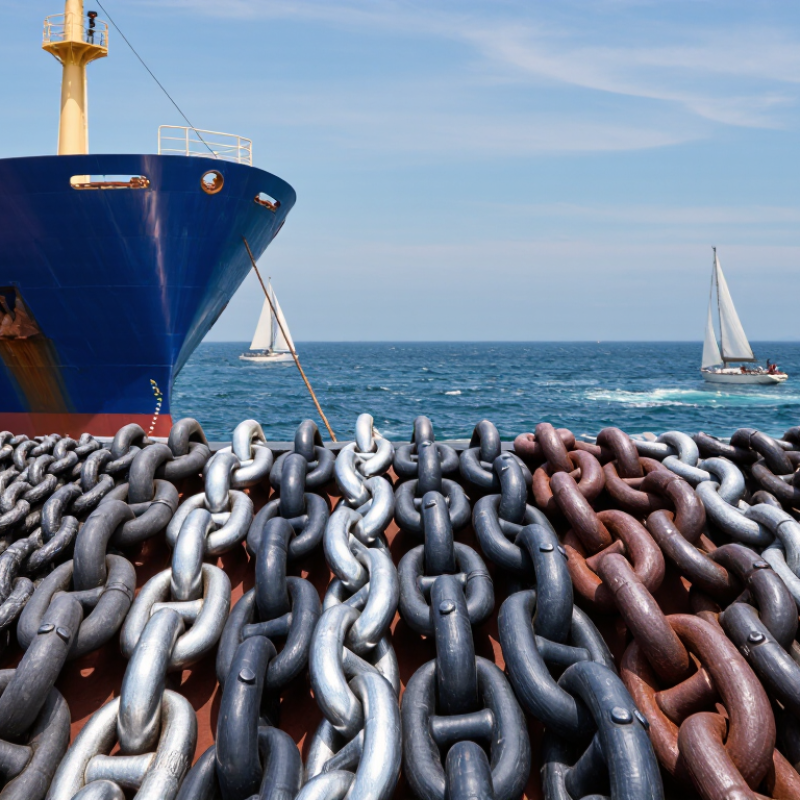
| 1 | Stud-link chain, Grade U1 | Welded links contain transverse studs that help resist link deformation. U1 is the lowest of the three common ISO 1704 strength grades and is generally considered for less demanding applications where the vessel and equipment requirements permit it. | Check for cracked or loose studs, distorted links, damaged welds, corrosion, and measurable wear at link crowns and contact areas. | ISO 1704 covers stud-link anchor-chain dimensions and mechanical properties. Verify grade, nominal diameter, certificates, and compatibility with the vessel’s approved equipment. | Rinse off salt and sediment, allow the locker to drain, and follow the vessel’s inspection and retirement criteria. Replace damaged or out-of-limit components rather than repairing them without approval. |
| 2 | Stud-link chain, Grade U2 | A higher-strength ISO 1704 grade than U1, commonly selected for ship anchor equipment when specified by the vessel’s design or classification requirements. | Inspect links, studs, welds, joining shackles, and end connections. Measure wear and check for elongation or permanent deformation. | Confirm the required grade rather than assuming that a higher grade is automatically interchangeable. Check traceability, test documentation, and windlass compatibility. | Keep chain and locker clean and drained; examine frequently used sections and connection points during scheduled maintenance. |
| 3 | Stud-link chain, Grade U3 | The highest of the three common ISO 1704 grades (U1, U2, U3). Used where the approved anchor equipment specification calls for this grade and its associated mechanical properties. | Look for impact damage, cracks, corrosion, worn crowns, distorted links, and damage to studs or connecting components. | Check that the chain grade matches the vessel documentation, anchor, joining hardware, and windlass. Request the applicable inspection and test records. | Do not mix grades or connecting parts unless the equipment design and applicable rules allow it. Follow the vessel’s survey and renewal requirements. |
| 4 | Studless anchor chain | Links have no transverse studs. Used in some mooring and marine applications; suitability as anchor chain depends on the equipment design and specified standard. | Check for link distortion, cracks, weld defects, corrosion, and wear, with particular attention to high-contact areas and end connections. | Do not treat studless chain as a direct substitute for stud-link anchor chain. Verify its intended service, applicable specification, proof-test records, and compatibility with the chain-handling equipment. | Clean and inspect according to its actual service and governing specification; replace parts that fail the applicable acceptance criteria. |
| 5 | Calibrated chain | Manufactured to controlled dimensions intended to engage with a matching windlass gypsy. Commonly used for powered anchoring systems. | Check link dimensions and pitch, wear on bearing surfaces, smooth engagement with the gypsy, and signs of slipping or jumping under load. | Match the chain’s nominal size and calibration to the exact gypsy specification; nominal diameter alone does not guarantee compatibility. Confirm the required chain standard and grade. | Keep the gypsy and chain free of grit and salt deposits. Inspect their fit together and renew worn components before poor engagement risks uncontrolled chain movement. |
| 6 | Uncalibrated chain | Chain not supplied to the dimensional calibration required for a particular windlass gypsy. May be suitable for non-windlass arrangements or equipment specifically designed for it. | Inspect dimensions, link shape, corrosion, welds, and fit through any guides or chain-handling equipment used on board. | Confirm the intended application and check that the equipment manufacturer permits its use. Do not assume it will operate safely on a gypsy designed for calibrated chain. | Rinse, drain, and inspect regularly. If powered handling is involved, check for irregular feeding and stop use if the chain binds or slips. |
| 7 | Short-link chain | Has a relatively short link pitch compared with long-link chain. It can be useful where compact handling is needed, but its suitability depends on the chain’s rated design and the vessel’s equipment. | Check pitch and diameter against the equipment specification; inspect for wear, deformation, cracks, and secure connections. | “Short-link” describes geometry, not a strength grade or proof of anchor-chain certification. Verify the applicable marine specification and intended service. | Keep links free of packed debris and verify that any windlass, fairlead, or connector is designed for the chain dimensions. |
| 8 | Long-link chain | Has a longer link pitch than short-link chain. It may be used in some anchoring or general marine arrangements, but is not automatically suitable for a powered windlass. | Inspect link dimensions, overall condition, welds, and how the chain runs through the vessel’s handling equipment. | Check the manufacturer’s equipment limits and the chain’s rated specification. Geometry labels alone do not establish load capacity or certification. | Wash down after saltwater use, allow drainage, and monitor for abnormal movement or jamming when deploying and recovering the anchor. |
| 9 | Stainless-steel chain | Used in selected small-craft or specialist applications where appearance or corrosion resistance is desired. Stainless steel can still corrode, particularly in stagnant, oxygen-poor, or chloride-rich conditions. | Look for pitting, crevice corrosion, cracking, damaged welds, and wear. Inspect areas where links touch or remain wet for long periods. | Verify the alloy, mechanical rating, traceability, and intended marine service. Do not assume stainless chain has the same strength or certification as a specified anchor-chain grade. | Rinse thoroughly with fresh water where practical, keep lockers ventilated, and avoid prolonged contact with dissimilar metals without suitable isolation. |
| 10 | Offshore mooring chain (R-grade) | High-strength mooring chain grades, such as R3 and R4, are used in offshore mooring systems. They are not automatically interchangeable with ship anchor chain specified to ISO 1704. | Use the project inspection plan to assess wear, corrosion, deformation, fatigue-related damage, and connector condition; underwater sections may require specialist inspection. | Confirm the governing offshore mooring specification, grade, certification, and design requirements. Check with the responsible engineer or classification body before considering it for another service. | Follow the asset-specific inspection and maintenance program, including monitoring, detailed examination, and replacement criteria established for the mooring system. |



 Close