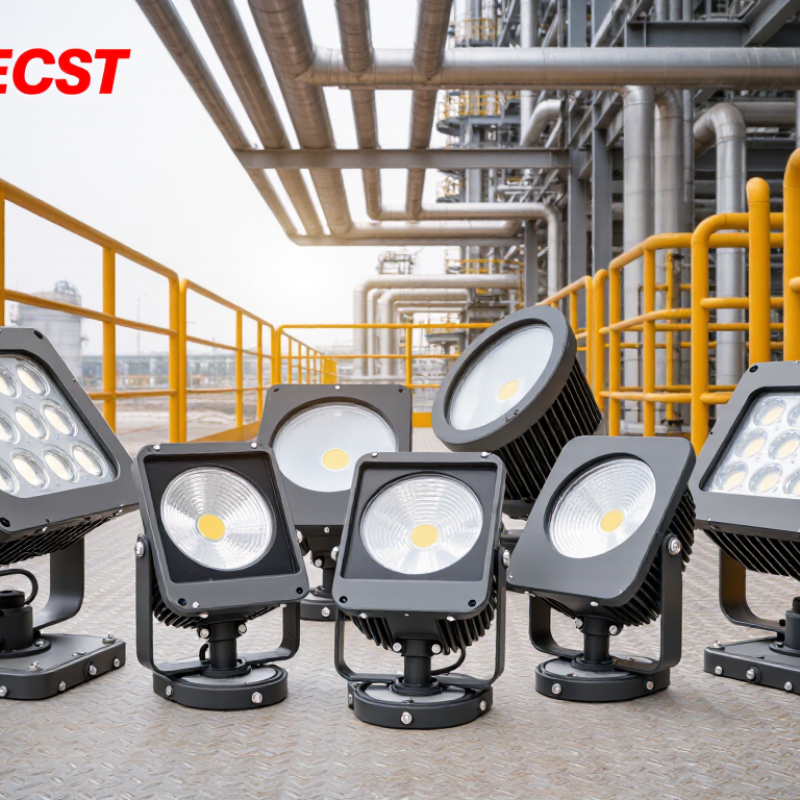
| 1 | LED floodlight | 50–200 W | Approximately 6,000–30,000 lm | Open process areas, loading zones, and equipment yards | Ex db IIB or IIC T4–T6 Gb; exact marking depends on certification | Often IP66; ambient limits are model-specific |
| 2 | LED high-bay light | 50–150 W | Approximately 6,000–22,500 lm | High-ceiling production buildings and covered process areas | Ex db or Ex eb, with gas group and temperature class as certified | Often IP66; check the certified operating-temperature range |
| 3 | Linear LED batten | 20–80 W | Approximately 2,400–12,000 lm | Walkways, workshops, and industrial rooms | Ex eb IIB or IIC T4–T6 Gb is a common marking family | Often IP66 or IP67; model-specific ambient limits |
| 4 | LED emergency light | 3–15 W in emergency mode | Output varies by optics and emergency duration | Escape routes and emergency egress locations | Ex marking and emergency performance must both be verified for the model | Ingress protection and battery operating limits vary by design |
| 5 | LED bulkhead light | 10–40 W | Approximately 1,200–6,000 lm | Low-ceiling areas, doors, and local task-lighting points | Ex db or Ex eb; gas group and temperature class are certificate-specific | Often IP66; confirm the declared ambient range |
| 6 | LED street or area light | 50–150 W | Approximately 6,000–22,500 lm | Hazardous-area roads, perimeter routes, and outdoor installations | Use only where the complete luminaire has the required area certification | Outdoor designs commonly specify IP66; corrosion resistance varies |
| 7 | LED tank-top or canopy light | 30–120 W | Approximately 3,600–18,000 lm | Tank farms, pump canopies, and sheltered process structures | Ex db IIB or IIC T-class options may be available by certified model | Often IP66; verify mounting, temperature, and environmental limits |
| 8 | Portable explosion-protected LED work light | 5–30 W | Approximately 500–4,500 lm | Inspection, maintenance, and temporary work locations | Portable-equipment marking must cover the intended zone and gas group | Ingress protection, battery type, and charging arrangements vary |
| 9 | LED sign or indicator light | 1–10 W | Typically specified by visibility and viewing distance | Status indication, warnings, and local process identification | Ex marking must apply to the complete sign or indicator assembly | Check enclosure rating, viewing conditions, and ambient limits |
| 10 | Dust-hazardous-area LED luminaire | 20–150 W | Approximately 2,400–22,500 lm | Areas with combustible dust, such as grain, feed, or powder handling | Example dust marking: Ex tb IIIC T80°C Db; actual marking varies | Dust ingress protection and maximum surface temperature are critical |
| Ex Marking Decoder |
| Gas group | IIA | A gas group for less easily ignited gases; propane is a commonly cited example. |
| Gas group | IIB | A more demanding gas group than IIA; ethylene is a commonly cited example. |
| Gas group | IIC | The most demanding of these gas subgroups; hydrogen and acetylene are commonly cited examples. Equipment marked IIC is generally suitable for IIA and IIB gas groups, subject to the certificate and installation requirements. |
| Temperature class | T1 — 450°C | Maximum permitted equipment surface temperature: 450°C. |
| Temperature class | T2 — 300°C | Maximum permitted equipment surface temperature: 300°C. |
| Temperature class | T3 — 200°C | Maximum permitted equipment surface temperature: 200°C. |
| Temperature class | T4 — 135°C | Maximum permitted equipment surface temperature: 135°C. |
| Temperature class | T5 — 100°C | Maximum permitted equipment surface temperature: 100°C. |
| Temperature class | T6 — 85°C | Maximum permitted equipment surface temperature: 85°C. A lower maximum surface temperature corresponds to a more stringent temperature class. |
| Important: The ten light types above are illustrative categories, not a ranked list or claims about specific certified products. Power, lumen output, enclosure rating, protection concept, gas group, temperature class, zones, and ambient limits vary by model. ATEX or IECEx certification must be confirmed against the exact product model, certificate, nameplate, and intended installation conditions. Gas examples and temperature classes do not replace a site-specific hazardous-area assessment. |



 Close