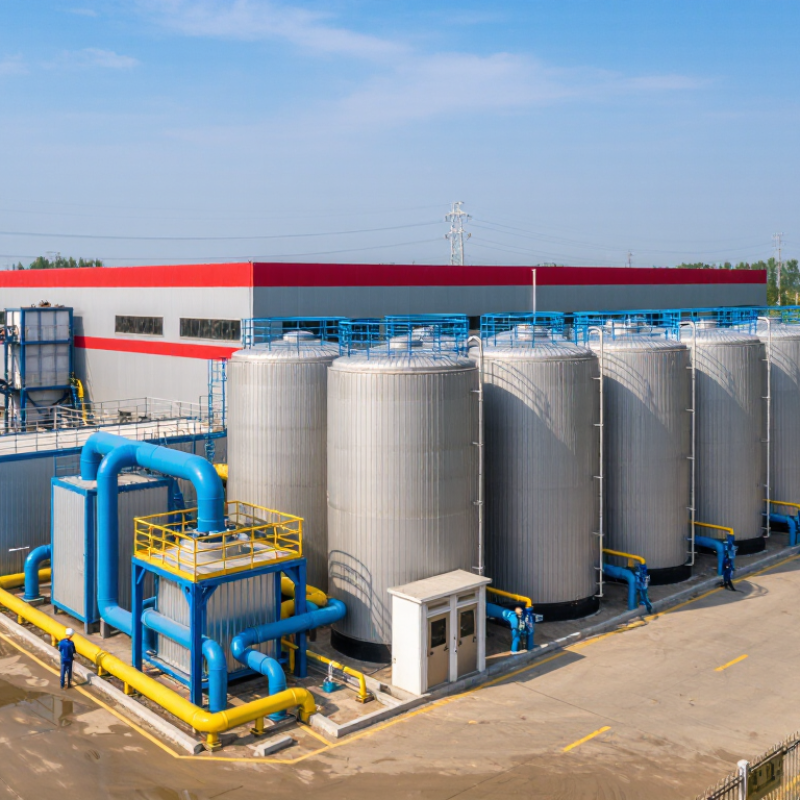
| 1 | Anaerobic digestion systems | Livestock manure, food-processing residues, organic municipal waste, or wastewater sludge | Feed preparation, anaerobic reactors, mixing, heating, gas collection, and digestate handling | Digester process design, tank and equipment integration, instrumentation, commissioning, and operating support | Feedstock composition, solids content, temperature regime, retention time, loading rate, and digestate outlet requirements |
| 2 | Feedstock receiving and pretreatment | Organic wastes containing solids, packaging, grit, or variable particle sizes | Screening, size reduction, grit removal, blending, homogenization, and, where appropriate, hygienization | Receiving stations, pumps, conveyors, pretreatment equipment, odor control, and process controls | Contaminant levels, material handling, corrosion, cleaning access, and compatibility with the digester process |
| 3 | Biological desulfurization | Raw biogas containing hydrogen sulfide (H₂S) | Biological oxidation using controlled oxygen or air addition, commonly in a digester headspace or a separate treatment vessel | Biological treatment equipment, gas-flow and oxygen controls, monitoring, and downstream protection | H₂S concentration, oxygen control, moisture, gas safety, and protection of engines or upgrading equipment |
| 4 | Media-based desulfurization | Raw or partly treated biogas requiring H₂S reduction | Iron-based media, activated carbon, or other suitable adsorbents in fixed-bed vessels | Vessel sizing, media selection, change-out arrangements, bypasses, and H₂S monitoring | Inlet H₂S and flow, media service life, pressure drop, spent-media handling, and required outlet quality |
| 5 | Biogas drying and condensate management | Moist biogas from digesters or gas-treatment stages | Cooling and condensation, condensate traps, demisters, and, where required, further drying | Gas coolers, condensate drainage, piping, insulation, and moisture monitoring | Gas temperature, pressure, water-vapor load, freeze protection, and prevention of liquid carryover |
| 6 | Water-scrubbing upgrading | Pretreated biogas containing methane and carbon dioxide | Pressurized absorption of carbon dioxide in water, followed by water regeneration and gas conditioning | Absorption and regeneration equipment, pumps, water circuits, controls, and product-gas handling | Feed-gas pretreatment, water use and recycle, methane slip, energy demand, and product-gas specification |
| 7 | Pressure swing adsorption (PSA) upgrading | Dry, suitably pretreated biogas | Adsorption beds operated through pressure cycles to separate carbon dioxide and other adsorbable components from methane | Adsorber vessels, valves, cycle controls, off-gas management, and product-gas monitoring | Feed composition, pretreatment requirements, operating pressure, methane recovery, and off-gas handling |
| 8 | Membrane upgrading | Filtered and conditioned biogas | One or more membrane separation stages that preferentially permeate carbon dioxide and certain minor components | Compression, filtration, membrane modules, recycle or staging, controls, and product-gas conditioning | Feed-gas quality, pressure, membrane configuration, methane recovery, replacement planning, and permeate management |
| 9 | Gas compression, storage, and safety systems | Treated biogas or upgraded biomethane, depending on the project | Blowers or compressors, gas holders, pressure regulation, isolation, flame arresting, and gas detection | Gas transfer equipment, storage integration, safety instrumentation, emergency shutdowns, and interconnecting pipework | Gas pressure and flow, hazardous-area classification, ventilation, leak detection, and local safety requirements |
| 10 | Biogas utilization and plant integration | Treated biogas for on-site energy use, or upgraded gas for an approved downstream application | Combined heat and power (CHP), boilers, flares, heat recovery, metering, and plant-wide control systems | Equipment selection, electrical and heat integration, flare provision, automation, commissioning, and operator training | Gas quantity and quality, heat and power demand, grid or pipeline requirements where applicable, emissions rules, and backup operation |



 Close