| 1 | Road and Expressway High Mast System | 20–40 m | 150–600 W per luminaire | Expressways, interchanges, toll plazas, and large junctions | IES-compliant road distribution, glare control, surge protection, and corrosion-resistant housing | Photometric files, wind-load calculation, maintenance access, and roadway uniformity |
| 2 | Airport Apron High Mast System | 25–45 m | 300–1,000 W per luminaire | Aircraft stands, cargo aprons, hangar surroundings, and service roads | Low-glare optics, high color rendering, aviation-compatible controls, and reliable surge protection | Uniform illumination, emergency operation, remote monitoring, and aviation authority requirements |
| 3 | Port and Container Yard Lighting | 25–50 m | 400–1,200 W per luminaire | Container terminals, bulk ports, loading yards, and logistics areas | IP66 or higher enclosure protection, marine-grade coating, high wind resistance, and narrow or asymmetric optics | Salt-spray resistance, thermal management, anti-corrosion testing, and crane-operation visibility |
| 4 | Industrial Yard High Mast System | 15–35 m | 150–800 W per luminaire | Factories, steel plants, warehouses, mines, and outdoor production areas | Dust- and moisture-resistant construction, industrial-grade drivers, and stable thermal performance | Operating temperature range, hazardous-area restrictions, maintenance intervals, and energy consumption |
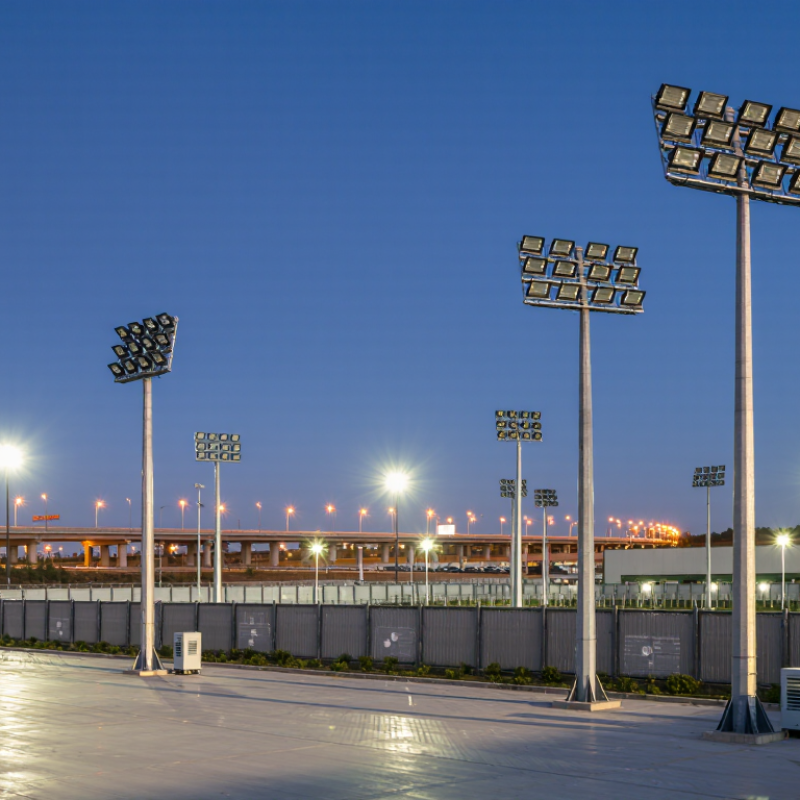
| 5 | Sports Field High Mast Lighting | 18–45 m | 500–2,000 W per floodlight | Football fields, athletics venues, tennis centers, and multipurpose stadiums | Precisely aimed floodlights, low flicker, glare limitation, high color rendering, and instant controllability | Horizontal and vertical illuminance, television requirements, spill-light limits, and aiming accuracy |
| 6 | Large Parking Area Lighting | 15–30 m | 100–500 W per luminaire | Shopping centers, park-and-ride facilities, exhibition grounds, and transport hubs | Wide-area distribution, pedestrian glare control, photocell or smart controls, and robust structural design | Uniformity, lighting-class compliance, pole spacing, dimming capability, and total cost of ownership |
| 7 | Retractable High Mast Lighting System | 15–40 m | 150–1,000 W per luminaire | Sites where lamps must be lowered for ground-level servicing | Winch or lowering mechanism, locking devices, stainless or galvanized cables, and fail-safe operation | Mechanical reliability, lowering speed, spare parts availability, inspection access, and safety certification |
| 8 | Fixed-Crown High Mast Lighting System | 20–50 m | 200–1,200 W per luminaire | Open industrial, transportation, and municipal areas with limited servicing needs | Rigid luminaire bracket, galvanized steel shaft, weatherproof junction box, and certified foundation design | Access equipment, structural fatigue, wind speed, coating system, and planned maintenance method |
| 9 | Solar-Assisted High Mast Lighting | 10–25 m | 30–200 W per luminaire | Remote roads, rural yards, emergency areas, and locations with limited grid access | Photovoltaic sizing, battery autonomy, charge controller protection, and seasonal energy analysis | Solar resource, required backup days, battery replacement plan, nighttime dimming, and theft protection |
| 10 | Smart-Controlled High Mast Lighting | 15–45 m | 100–1,000 W per luminaire | Connected highways, airports, ports, campuses, and municipal infrastructure | DALI, 0–10 V, or wireless control, remote fault reporting, programmable dimming, and surge protection | Communication coverage, cybersecurity, interoperability, control-system ownership, and measurable energy savings |



 Close
Close