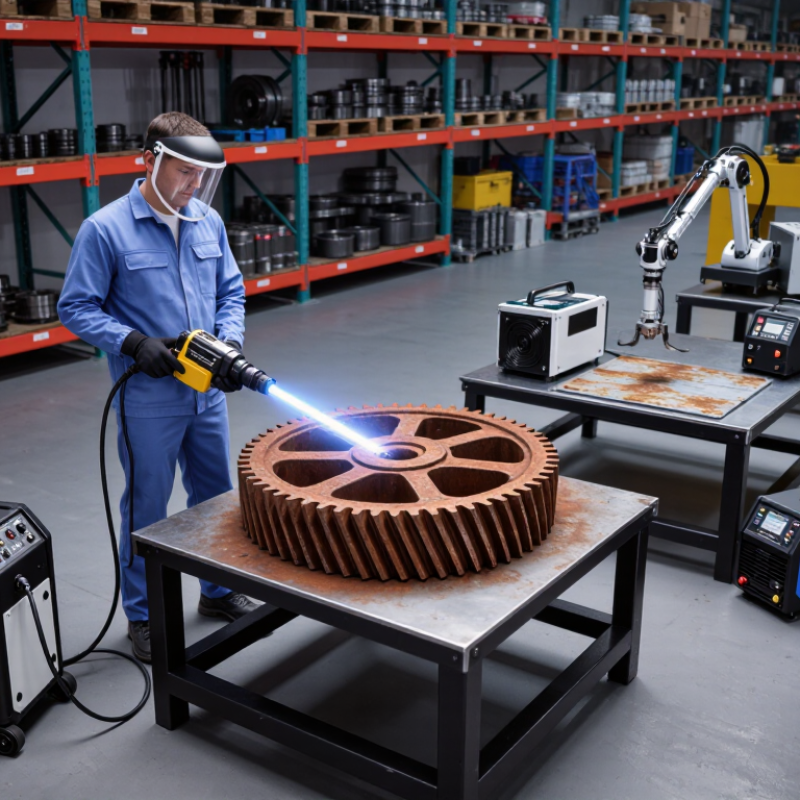
| Pulsed Fiber Laser Cleaning Equipment | Q-switched or master-oscillator fiber laser | Commonly 1,064 nm
Approximately 20–500 W average power
Nanosecond pulses | Short, high-peak-power pulses selectively remove rust, paint, oxide, oil, and other deposits through photothermal ablation and rapid thermal expansion. The low heat input helps reduce substrate distortion. | - Fiber laser source
- Pulse controller
- Galvanometer scanning head
- Focusing lens and protective window
- Air or water cooling system
- Control cabinet and safety interlock
| Metal derusting, paint removal, mold maintenance, weld preparation, conservation work, and removal of production residues. | Steel, stainless steel, aluminum, copper, and many coated metal surfaces. Particularly effective for rust, thin paint, oil, and oxide layers. |
| Continuous-Wave Fiber Laser Cleaning Equipment | Continuous-wave ytterbium fiber laser | Commonly 1,064–1,080 nm
Approximately 1–20 kW
Continuous output | A steady beam rapidly heats and vaporizes or melts contaminants. It provides high material-removal throughput but requires careful control of travel speed, power density, and heat accumulation. | - Continuous-wave fiber laser
- Beam delivery fiber
- Processing head
- Protective optics
- Cooling unit
- Motion system and process controller
| Heavy rust removal, large-area coating removal, ship and structural steel maintenance, and high-throughput industrial preparation. | Thick steel components and robust metal substrates. Best for heavy contamination where high productivity is more important than minimal heat input. |
| CO2 Laser Cleaning Equipment | Gas-discharge carbon dioxide laser | Approximately 10.6 µm
Commonly 100 W–several kW
Continuous-wave or pulsed operation | Infrared energy is strongly absorbed by many organic contaminants, coatings, and water-containing layers. Rapid heating causes vaporization, decomposition, or lifting of the unwanted layer. | - CO2 laser tube or resonator
- High-voltage power supply
- Beam mirrors or articulated delivery arm
- Focusing optics
- Gas-management and cooling system
- Extraction and safety enclosure
| Removal of paint, polymer residues, rubber deposits, labels, and organic contamination from large surfaces. | Metals, ceramics, stone, and selected heat-resistant materials. Process testing is required because many plastics absorb infrared energy strongly and may deform. |
| UV Laser Cleaning Equipment | Ultraviolet solid-state laser | Commonly 355 nm
Approximately 5–100 W
Nanosecond or short-pulse operation | Short-wavelength photons can break molecular bonds and provide efficient photochemical ablation. The shallow interaction zone produces low thermal loading and high precision. | - UV laser source
- Harmonic-generation crystal assembly
- Beam expander
- Galvanometer or precision scanning head
- F-theta focusing lens
- Chiller, controller, and enclosure
| Precision cleaning of electronics, semiconductor parts, optics, medical components, and delicate coatings. | Polymers, ceramics, glass, thin films, and sensitive metals. Suitable for residues requiring minimal heat-affected zones. |
| Green Laser Cleaning Equipment | Frequency-doubled solid-state laser | Commonly 532 nm
Approximately 10–200 W
Pulsed or continuous operation | Green light is absorbed differently from near-infrared light by copper, gold, and certain oxides. This can improve coupling on reflective materials and enable controlled removal of thin surface layers. | - Solid-state laser source
- Nonlinear frequency-doubling crystal
- Beam-conditioning optics
- Scanning head
- Focusing assembly
- Cooling and control electronics
| Cleaning and surface preparation of copper components, electrical contacts, precision parts, and selected optical or decorative surfaces. | Copper, brass, gold, and other reflective metals, as well as thin coatings and oxide films where near-infrared absorption is limited. |
| Q-Switched Solid-State Laser Cleaning Equipment | Q-switched Nd:YAG or related solid-state laser | Commonly 1,064 nm
Approximately 20–200 W average power
Nanosecond pulses | Energy is stored in the laser medium and released in short pulses with high peak power. Contaminants are removed by rapid heating, evaporation, and mechanical stress at the interface. | - Laser crystal and pump source
- Q-switch module
- Resonator optics
- Beam delivery system
- Scanning head
- Cooling, control, and safety systems
| Mold cleaning, cultural-heritage conservation, graffiti removal, oxide removal, and precision surface treatment. | Metals, stone, ceramics, and selected painted surfaces. Effective where controlled pulse energy and moderate cleaning speed are required. |
| Diode Laser Cleaning Equipment | High-power semiconductor diode laser | Commonly 808, 940, or 980 nm
Approximately 100 W–several kW
Continuous-wave or modulated output | Diode-generated near-infrared energy heats the contaminant and substrate interface. The layer is softened, decomposed, or vaporized depending on absorption and process settings. | - Diode laser array or bar
- Optical collimation assembly
- Beam homogenizer
- Processing head
- Cooling plate or chiller
- Power and motion-control system
| Broad-area coating removal, pre-weld cleaning, adhesive removal, and treatment of large industrial components. | Coated metals and heat-resistant substrates. Useful for large areas, although thermal management is more important than with short-pulse systems. |
| Picosecond Laser Cleaning Equipment | Ultrafast solid-state or fiber laser | Commonly 1,064, 532, or 355 nm
Approximately 10–100 W average power
Pulse duration in the picosecond range | Extremely short pulses limit heat diffusion into the substrate. Contaminants are removed mainly through non-linear absorption, rapid ionization, and highly localized ablation. | - Ultrafast laser oscillator and amplifier
- Pulse compressor or stretcher system
- Beam scanner
- Precision focusing optics
- Motion stage
- Environmental and cooling controls
| Microelectronics, precision molds, medical devices, thin-film processing, and high-value component cleaning. | Fine coatings, oxides, residues, and delicate surfaces where a very small heat-affected zone is essential. |
| Femtosecond Laser Cleaning Equipment | Ultrafast fiber or solid-state femtosecond laser | Commonly 1,030–1,064 nm or harmonics
Approximately 1–100 W average power
Femtosecond pulses | Peak intensities exceed the threshold for non-linear absorption, allowing material removal before significant thermal conduction occurs. This supports cold or near-cold ablation in carefully selected conditions. | - Femtosecond oscillator
- Pulse amplifier and compressor
- Beam-stabilization optics
- High-speed scanner
- Precision objective or telecentric lens
- Vibration isolation and control system
| Precision cleaning of optical components, microstructures, medical parts, semiconductor components, and sensitive heritage materials. | Thin contamination layers and delicate substrates that are vulnerable to melting, discoloration, or thermal cracking. |
| Automated Robotic Laser Cleaning Cell | Usually a pulsed fiber, continuous-wave fiber, or diode laser integrated with a robot | Typically 20 W–several kW, depending on the integrated laser source
Fixed or scanned beam delivery | A robot or multi-axis motion platform controls the laser head, working distance, angle, speed, and path. Sensors and software can support repeatable cleaning over complex three-dimensional surfaces. | - Selected laser source
- Industrial robot or gantry
- Laser processing head
- Scanning and focusing optics
- Vision or distance sensors
- Fume extraction and safety enclosure
- Programmable controller
| Automotive parts, rail components, aerospace structures, large molds, weld preparation, and repetitive production-line cleaning. | Complex or large three-dimensional metal parts requiring consistent process coverage, repeatability, and reduced manual handling. |



 Close
Close