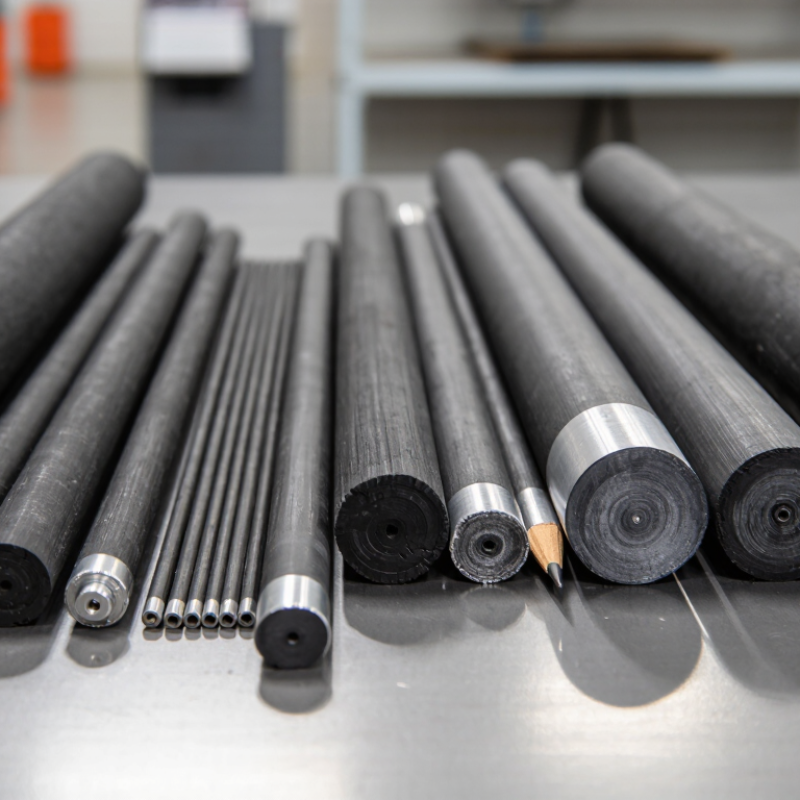
| 1 | Extruded Graphite Rods | Manufacturing process and grain orientation | Produced by forcing a graphite mix through a die. They generally have directional properties and are suitable for continuous lengths and standard round sections. | Furnace components, heat-treatment fixtures, electrical contacts, laboratory parts, and general machining stock. | Directional structure
Commonly supplied in continuous lengths; properties vary between parallel and perpendicular directions. |
| 2 | Molded Graphite Rods | Compression molding and material structure | Formed by pressing a carbon mixture in a mold. They can provide economical production of standard shapes and may have more uniform properties than simple extrusions. | Mechanical seals, furnace supports, electrical components, crucible parts, and machined industrial components. | Moderate grain size
Available in a wide range of densities, strengths, and cross-sectional dimensions. |
| 3 | Isostatically Pressed Graphite Rods | Isostatic pressing and isotropic performance | Pressed uniformly from multiple directions, giving relatively consistent properties in different orientations. Usually selected for demanding thermal, chemical, or electrical service. | Semiconductor processing, high-temperature furnaces, vacuum equipment, precision tooling, and laboratory heating systems. | High uniformity
Often associated with fine grain, low porosity, and good dimensional stability. |
| 4 | Vibration-Molded Graphite Rods | Vibration molding and bulk structure | Manufactured by compacting the raw mix through vibration. This process is commonly used for large or relatively simple carbon-graphite shapes. | Large furnace parts, thermal-processing supports, industrial electrodes, and applications where very fine microstructure is not essential. | Large-section capability
Usually selected for cost-effective bulk components rather than ultra-precision parts. |
| 5 | Fine-Grain Graphite Rods | Particle size and microstructure | Made from relatively small carbon particles, resulting in a smoother machined surface, improved strength, and better suitability for detailed geometries. | Precision fixtures, semiconductor tooling, EDM components, laboratory parts, and small high-temperature components. | Typical grain size: submillimeter
Fine-grain grades may offer better surface finish and lower permeability than coarse-grain grades. |
| 6 | High-Purity Graphite Rods | Ash content and chemical purity | Processed to minimize mineral ash and metallic impurities. Purity requirements depend on the thermal, chemical, and contamination limits of the application. | Semiconductor manufacturing, vacuum furnaces, analytical equipment, crystal growth, and high-temperature laboratory systems. | Often specified at ≥99.9% carbon
Some applications require ≥99.99% or higher; the exact value must be confirmed by a test certificate. |
| 7 | Impregnated Graphite Rods | Pore sealing or property enhancement | Open pores are filled with resin, metal, or another compatible impregnant. Impregnation can reduce permeability and improve resistance to certain fluids or increase strength. | Bearings, pump components, mechanical seals, corrosive-service parts, and applications requiring reduced fluid penetration. | Lower permeability
Service temperature and chemical compatibility depend strongly on the impregnant; resin-impregnated grades have lower temperature limits than unfilled graphite. |
| 8 | Coated Graphite Rods | Surface treatment and protective coating | Graphite is covered with a selected coating to limit oxidation, reduce reaction with a process material, or modify surface wear and contamination behavior. | High-temperature fixtures, semiconductor processing, molten-material handling, and specialized chemical or vacuum equipment. | Coating-dependent performance
Common coating families include silicon carbide, pyrolytic carbon, and refractory metals; maximum temperature depends on atmosphere and coating integrity. |
| 9 | EDM Graphite Rods and Electrodes | Electrical-discharge machining grade and electrode performance | Engineered for electrical conductivity, low electrode wear, fast machining, and accurate reproduction of fine details during EDM operations. | Die-sinking EDM, mold and die production, precision cavities, ribs, slots, and fine-feature tooling. | Low electrode wear
Fine or ultrafine grades are commonly chosen for detailed work; electrical resistivity and machinability are key selection criteria. |
| 10 | Carbon-Graphite Composite Rods | Material composition and reinforcement | Combine graphite with carbon fibers, binders, or other carbon-based constituents to balance strength, friction, thermal behavior, and wear resistance. | Brushes, sliding contacts, seals, bearings, friction components, and specialized mechanical assemblies. | Property-tailored composition
Electrical conductivity, coefficient of friction, strength, and operating temperature vary according to the composite formulation. |



 Close