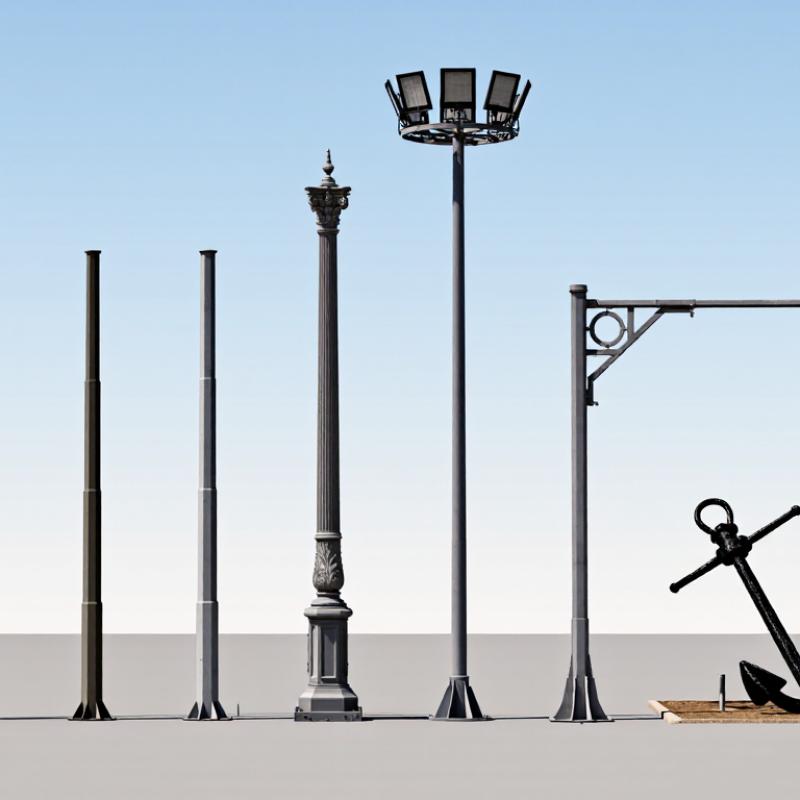
| Tapered Round Pole | Circular shaft that gradually narrows toward the top; often supplied with a handhole and a top tenon or arm attachment. | Hot-dip galvanized; galvanized steel with a compatible paint or powder-coat system. | Anchor-base plate bolted to a concrete foundation; direct burial is available for some designs. | Roadways, parking areas, pathways, and general site lighting. |
| Tapered Octagonal Pole | Eight-sided tapered shaft. The faceted profile provides a different appearance from a round shaft and is commonly used for roadway poles. | Hot-dip galvanized; optional exterior coating over galvanized steel where specified. | Anchor-base plate with anchor bolts; arm or luminaire attachment selected for the project. | Streets, highways, parking lots, and public infrastructure. |
| Straight Round Pole | Uniform-diameter circular shaft, typically made from a steel tube or formed section; may have a tenon or side-mounted bracket. | Hot-dip galvanized; painted or powder-coated finish may be specified for appearance or added surface protection. | Base plate and anchor bolts, or direct burial when the pole design and site conditions allow. | Walkways, campuses, parking areas, and utility or site lighting. |
| Square or Rectangular Pole | Four-sided shaft, available straight or tapered. Flat faces can suit contemporary site designs and certain bracket arrangements. | Hot-dip galvanized; optional paint or powder coating over a suitable prepared surface. | Base plate and anchor bolts; some models are designed for direct burial. | Commercial properties, campuses, parks, and architectural outdoor lighting. |
| High-Mast Pole | Tall, engineered steel pole that commonly supports a lowering ring or fixed headframe carrying multiple luminaires. | Hot-dip galvanized is common for outdoor corrosion protection; coating systems depend on the environment and specification. | Typically anchor-base mounted to a project-engineered concrete foundation; lowering systems require compatible pole and hardware. | Highways, interchanges, ports, large parking areas, and other expansive sites. |
| Sports-Lighting Pole | Engineered pole sized for luminaire weight, wind loading, aiming requirements, and the height needed for the playing area. | Hot-dip galvanized; optional exterior coating may be used to meet aesthetic or environmental requirements. | Usually anchor-base mounted to a designed foundation; mounting frames or crossarms are selected for the lighting layout. | Sports fields, courts, stadiums, and recreational facilities. |
| Davit-Arm Roadway Pole | Steel shaft fitted with a curved or offset arm that projects the luminaire over a roadway or other target area. | Hot-dip galvanized; galvanized steel with a compatible paint or powder coat is also used. | Commonly anchor-base mounted; arm orientation and attachment are set to suit the roadway layout. | Roadways, streets, intersections, and perimeter roads. |
| Traffic-Signal Pole | Structural steel shaft designed to support traffic signals, signs, or related equipment; configurations may include a mast arm. | Hot-dip galvanized is widely used; additional coating may be specified for local exposure or appearance. | Typically bolted to a concrete foundation using an anchor-base connection; assemblies are designed for their specific loads. | Signalized intersections and roadway control locations. |
| Decorative Steel Pole | Appearance-focused shaft that may incorporate fluting, a base cover, ornamental details, or a traditional or contemporary profile. | Paint or powder coat in a specified color; galvanizing may be used beneath a compatible coating system. | Usually base-plate and anchor-bolt mounted; mounting details depend on the pole and luminaire design. | Downtown streets, parks, civic spaces, campuses, and commercial developments. |
| Direct-Burial Steel Pole | Shaft designed to be embedded in the ground rather than attached to an exposed base plate; the buried section requires suitable protection. | Protective coating or galvanizing selected for the pole design and soil exposure; buried-zone protection should follow the project specification. | Embedded directly in a prepared foundation or soil according to the engineered installation details. | Pathways, parks, parking areas, and other sites where an exposed base plate is not preferred. |



 Close