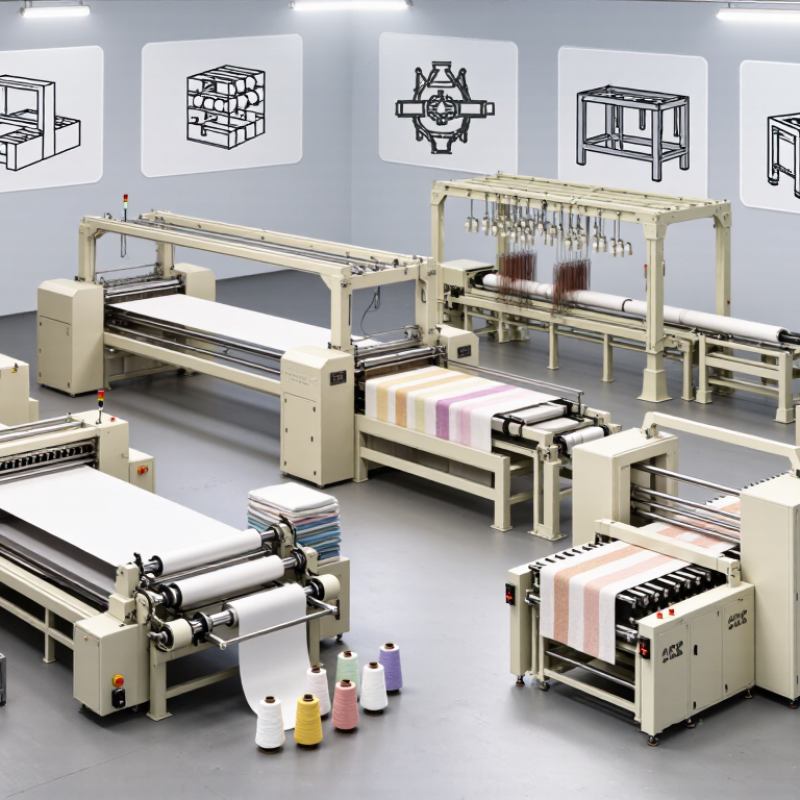
| Standard terry weaving loom | Plain bath towels, hand towels, washcloths, hotel towels | Combed or carded cotton; cotton/polyester blends; recycled polyester blends; selected regenerated-cellulose yarns | Approximately 1.9–3.6 m, depending on configuration | Approximately 400–750 picks per minute; fabric construction and yarn count affect the actual rate | Adjustable pile height, electronic let-off and take-up, automatic weft control, warp-break and weft-break sensors | Balanced choice for high-volume basic towels and consistent terry structure | Compare pile stability, yarn tension control, energy use, changeover time and spare-part availability |
| Electronic dobby terry loom | Striped towels, bordered towels, textured towels and small-to-medium repeat designs | Cotton, cotton blends, bamboo-viscose blends, modal blends and recycled-fiber yarns when yarn strength is suitable | Approximately 1.9–3.4 m | Approximately 350–650 picks per minute | Programmable shedding, multiple pile-height settings, pattern memory, quick design changes and digital monitoring | More design flexibility than a basic terry loom without the complexity of full jacquard production | Check repeat-size limits, control-system usability, operator training requirements and pattern-change efficiency |
| Electronic jacquard terry loom | Logo-free decorative towels, figured towels, complex borders, pictorial patterns and premium bath sets | Cotton, combed cotton, cotton/modal, cotton/bamboo-viscose and selected recycled-content yarns | Approximately 1.9–3.6 m | Approximately 250–550 picks per minute, depending on pattern complexity and pile settings | Individual warp control, multi-level pile effects, CAD pattern transfer, automatic fault detection and recipe storage | Produces highly differentiated products and supports frequent style changes | Higher capital cost, greater electronic complexity and potentially higher maintenance requirements; verify design resolution and service support |
| Air-jet terry loom | High-volume lightweight and medium-weight towels with stable, repeatable constructions | Best suited to adequately sized cotton and blended yarns; yarn quality and lint level are important | Approximately 1.9–3.6 m | Approximately 500–900 picks per minute in suitable constructions | Air-jet weft insertion, electronic tension control, automatic stop motions, integrated lubrication and production monitoring | High productivity and low mechanical contact during weft insertion | Compressed-air consumption can be significant; compare air quality requirements, compressor capacity and noise levels |
| Rapier terry loom | Heavy bath sheets, dense towels, delicate yarn constructions and varied small-batch products | Cotton, linen blends, bamboo-viscose blends, modal blends and yarns that require gentler insertion | Approximately 1.9–4.0 m | Approximately 250–550 picks per minute | Flexible weft insertion, positive yarn control, programmable pile height, multi-color weft capability and low-tension handling | Handles a broad range of yarns and constructions, including heavier or more delicate fabrics | Generally slower than air-jet technology; compare gripper maintenance, insertion-system durability and fabric-width utilization |
| Towel knitting machine | Knitted spa towels, stretch towels, cleaning cloths, tubular products and specialized absorbent articles | Cotton, microfiber, polyester, polyamide, bamboo-viscose and elastane-containing yarn combinations | Usually defined by cylinder diameter or knitting width rather than woven width; common flat-product widths vary by machine design | Usually specified in revolutions per minute or courses per minute; practical output depends strongly on stitch density and structure | Loop-length control, stitch-density adjustment, automatic yarn feeders, pattern programming and optional terry-plush structures | Can provide stretch, seamless structures and distinctive surface effects unavailable from conventional weaving | Not a direct replacement for woven terry in every application; compare dimensional stability, shrinkage, edge finishing and absorbency after laundering |
| Towel cutting and hemming line | Converting woven towel fabric into finished bath towels, hand towels and washcloths | Finished terry fabric made from cotton, blends, regenerated cellulose or recycled-content fibers | Commonly configured for fabric rolls or towel panels approximately 1.6–3.6 m wide | Approximately 20–60 pieces per minute, depending on towel size, folding method and sewing configuration | Automatic length measurement, straight cutting, edge folding, multi-needle hemming, label insertion and stack counting | Improves dimensional accuracy and reduces manual handling after weaving | Compare cut-length tolerance, seam strength, thread trimming, fabric alignment and compatibility with different towel weights |
| Towel shearing and finishing machine | Surface leveling, lint reduction, appearance improvement and preparation for washing or packaging | Cotton terry, cotton blends, microfiber and other pile fabrics compatible with controlled shearing | Typically matched to the fabric line, commonly around 1.8–3.6 m | Approximately 10–40 m per minute, depending on pile height, fabric weight and finishing target | Adjustable cutting height, dust extraction, fabric-centering control, surface inspection and optional brushing or compacting | Creates a more uniform surface and can improve visual consistency before final packing | Excessive shearing can reduce pile height and absorbency; compare cutting precision, extraction efficiency and fabric-loss rate |



 Close