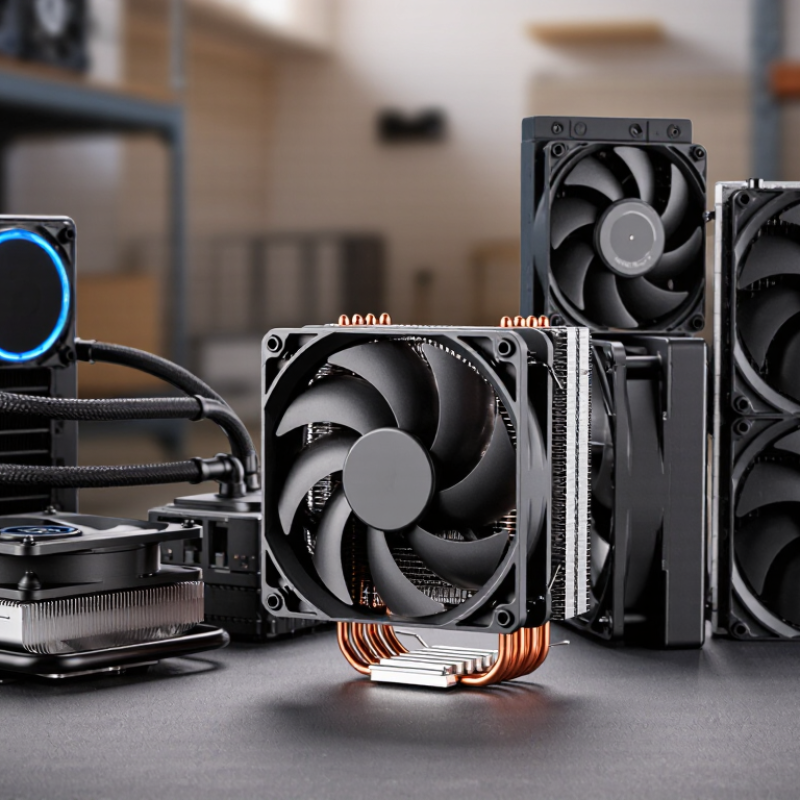
| Main Product Categories | Air coolers, all-in-one liquid coolers, low-profile coolers, server coolers, and passive or semi-passive heatsinks. | Air coolers use heatsinks and fans; liquid coolers add a pump, radiator, tubing, coolant, and cold plate. | Select the product class according to thermal load, chassis clearance, operating noise, service life, and target price. |
| Common Manufacturing Regions | The Pearl River Delta and Yangtze River Delta are widely used sourcing areas for metal forming, tooling, plastics, electronics assembly, and computer hardware components. | Regional supply chains commonly support CNC machining, stamping, die casting, injection molding, fan assembly, and packaging. | Compare factory location, port access, component sourcing distance, tooling ownership, and export experience. |
| Heatsink Materials | Aluminum is common for fins and bodies; copper is frequently used for base plates, heat pipes, and vapor chambers. | Typical thermal conductivity at room temperature: aluminum approximately 200–240 W/m·K; copper approximately 390–410 W/m·K. | Request alloy specifications, surface treatment details, base flatness, solder or sintering method, and corrosion-control requirements. |
| Heat Pipe Production | Manufacturing commonly includes copper tube forming, wick installation, vacuum evacuation, working-fluid charging, sealing, bending, and thermal testing. | Common heat pipe outside diameters include approximately 4 mm, 6 mm, and 8 mm, depending on cooler size and heat-transfer design. | Verify leak testing, vacuum consistency, bend-radius control, charge quantity, and thermal performance after forming. |
| Indicative Thermal Classes | Entry-level, mainstream, high-performance, workstation, and server-oriented designs are available through OEM and ODM production. | Indicative design groups are below 65 W, 65–125 W, 125–250 W, and above 250 W thermal design targets. These ranges are not a universal performance rating. | Require standardized test conditions, ambient temperature, test processor or heater load, fan speed, thermal paste, and mounting pressure. |
| Fan Configuration | Single-fan, dual-fan, push-pull, slim-fan, and high-static-pressure configurations are commonly manufactured. | Common fan frame sizes include 92 mm, 120 mm, and 140 mm. Four-wire PWM control is widely used for variable-speed operation. | Compare airflow, static pressure, acoustic output, bearing type, rated voltage, PWM response, and expected operating life. |
| Liquid Cooler Capabilities | Production may cover cold plates, pumps, radiators, tubing, reservoirs, liquid filling, sealing, leak testing, and full-system assembly. | Common radiator formats include 120 mm, 240 mm, 280 mm, and 360 mm classes, subject to chassis compatibility. | Request continuous leak testing, pump-life data, coolant compatibility, transport testing, tubing permeation data, and warranty procedures. |
| Surface Finishing | Available processes include anodizing, nickel plating, passivation, painting, powder coating, polishing, and brushed-metal finishing. | Finishing affects corrosion resistance, appearance, emissivity, solderability, and contact-surface performance. | Confirm coating thickness, adhesion, salt-spray requirements, color tolerance, RoHS compliance, and contact-area masking. |
| Quality-Control Testing | Typical controls include incoming-material inspection, dimensional checks, fan balancing, thermal testing, noise testing, vibration testing, aging, and packaging inspection. | Key measurements include thermal resistance, temperature rise, airflow, static pressure, rotational speed, acoustic output, leakage, and electrical safety. | Request inspection plans, calibration records, lot traceability, sample approval procedures, and corrective-action reports. |
| Compliance Framework | Export-oriented factories commonly prepare documentation for product safety, restricted substances, chemicals, packaging, and electromagnetic compatibility requirements. | Frequently requested references include EU RoHS Directive 2011/65/EU, REACH Regulation (EC) No. 1907/2006, WEEE requirements, and applicable electrical or EMC standards. | Compliance depends on the destination market and product configuration. Obtain current test reports and declarations before shipment. |
| OEM and ODM Flexibility | Many manufacturers can support custom dimensions, fin geometry, mounting hardware, fan specifications, lighting integration, packaging, manuals, and product labeling. | Customization may involve tooling, engineering validation, thermal simulation, prototype approval, pilot production, and production-change control. | Define ownership of molds, drawings, firmware, test fixtures, tooling maintenance, quality limits, and engineering-change notifications in the contract. |



 Close