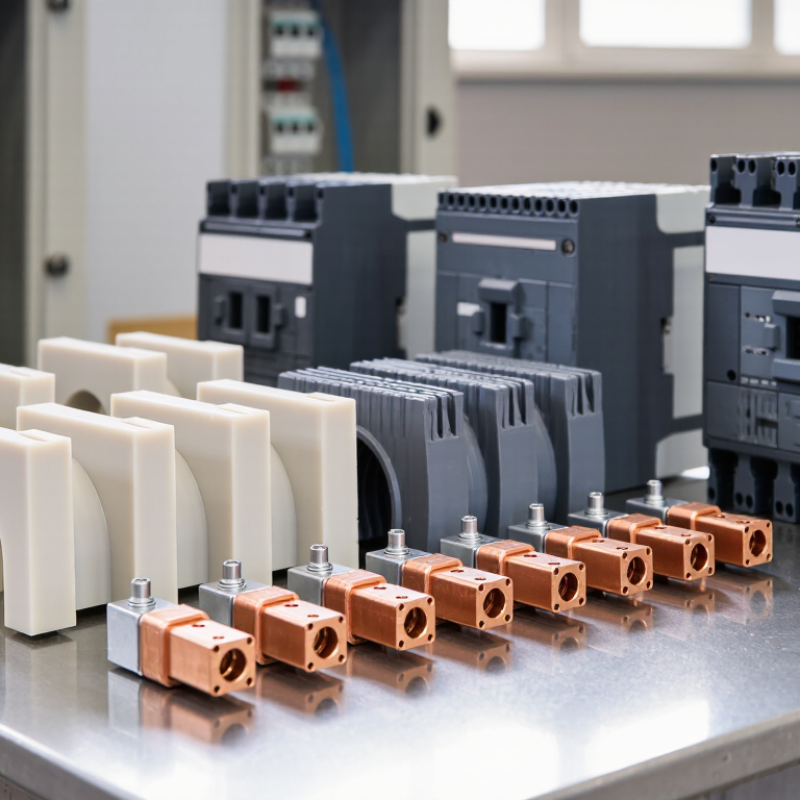
Supplier Profile A
Low-voltage molded-case breaker component specialist | Thermal-magnetic trip units, contact assemblies, arc chutes, terminals, molded housings, operating mechanisms | Up to 1,000 V AC
Typical current classes: 16–1,600 A | IEC 60947-2
UL 489 component requirements where applicable
RoHS and REACH substance controls | ISO 9001 common
Incoming material inspection, dimensional inspection, dielectric testing, mechanism endurance sampling | 6–10 weeks for standard parts
10–16 weeks for tooling or engineering changes | 2–5 weeks | 500–5,000 pieces, depending on the part | Thermoset or thermoplastic insulation, copper or copper alloy contacts, silver-based contact tips, galvanized or nickel-plated steel | Confirm interrupting rating, creepage and clearance, trip-current tolerances, terminal temperature rise, mold-shrinkage control, and compatibility with the finished breaker family |
Supplier Profile B
Miniature circuit breaker and residual-current device parts supplier | Toggle mechanisms, contact bridges, bimetal elements, magnetic trip coils, terminals, DIN-rail housings, test-button assemblies | Up to 440 V AC
Typical current classes: 1–125 A | IEC 60898-1 for household and similar MCB applications
IEC 61008-1 and IEC 61009-1 for residual-current devices
IEC 60947-2 for industrial applications | ISO 9001 common
Electrical resistance checks, trip-time verification, contact-force testing, automated dimensional inspection | 5–8 weeks for repeat orders
8–14 weeks for new designs | 2–4 weeks | 1,000–10,000 pieces | Copper alloys, ferromagnetic steel, engineering thermoplastics, silicone or EPDM seals where required | Request trip curves, calibration tolerances, number of poles, neutral-pole switching requirements, RCD sensitivity, residual-current test method, and endurance data |
Supplier Profile C
Air circuit breaker mechanism and switching assembly supplier | Draw-out chassis, racking mechanisms, main contacts, arcing contacts, closing mechanisms, shunt trips, undervoltage releases | Up to 1,000 V AC
Typical current classes: 630–6,300 A | IEC 60947-2
IEC 60947-1
UL 1066 or UL 489 where specified by the end application | ISO 9001 generally requested
Contact resistance testing, mechanical endurance testing, release operating checks, traceability by batch or serial number | 8–14 weeks for standard assemblies
14–24 weeks for engineered mechanisms | 4–8 weeks | 10–100 assemblies | Silver-plated copper contacts, copper busbar, stainless or plated steel mechanisms, glass-filled engineering plastics | Verify short-circuit withstand, making and breaking capacity, draw-out interlocking, service-position indication, auxiliary-contact arrangement, coil voltage, and mechanical endurance rating |
Supplier Profile D
Vacuum circuit breaker interrupter and operating-part supplier | Vacuum interrupters, fixed and moving contacts, bellows assemblies, insulating housings, operating rods, spring mechanisms | Typical medium-voltage class: 3.6–40.5 kV
Typical current classes: 630–3,150 A | IEC 62271-100
IEC 62271-1
IEEE C37.04 and IEEE C37.09 for applicable North American designs | ISO 9001 common
Vacuum integrity testing, contact-resistance testing, X-ray or visual inspection where specified, dielectric and mechanical routine tests | 12–20 weeks for standard interrupters
20–32 weeks for customized designs | 6–10 weeks | 10–100 units | Copper-chromium contact material, ceramic or glass insulation, stainless-steel bellows, epoxy or silicone insulation components | Confirm rated short-circuit breaking current, power-frequency withstand, lightning impulse withstand, contact erosion allowance, vacuum integrity, stroke data, and altitude correction requirements |
Supplier Profile E
Medium-voltage load-break and fuse-switch component supplier | Load-break contacts, arc-control components, fuse carriers, interlocks, operating shafts, insulating barriers, switch-disconnector hardware | Typical medium-voltage class: 3.6–36 kV
Typical current classes: 200–630 A | IEC 62271-103
IEC 62271-105
IEC 60282-1 for high-voltage fuses where included in the assembly | ISO 9001 common
Contact alignment checks, insulation inspection, mechanical operation tests, routine dielectric tests for complete assemblies | 8–16 weeks | 4–8 weeks | 20–200 units | Silicone or epoxy insulation, copper or copper alloy contacts, stainless steel, plated steel, arc-resistant polymers | Check fuse dimensions, striker compatibility, interlock logic, insulation coordination, operating torque, enclosure clearances, and switching duty classification |
Supplier Profile F
Protection-release, auxiliary-contact, and electronic accessory supplier | Electronic trip units, shunt trips, undervoltage releases, auxiliary switches, alarm contacts, motor operators, communication accessories | Accessory control voltages commonly include 24 V DC, 48 V DC, 110–125 V AC/DC, and 220–240 V AC
Application-dependent breaker ratings | IEC 60947-2
IEC 60947-5-1 for control-circuit devices
IEC 61000 series for applicable electromagnetic-compatibility testing | ISO 9001 common
Firmware or parameter control, functional testing, insulation testing, EMC verification where required, component traceability | 6–12 weeks for standard accessories
12–20 weeks for programmed or customized products | 3–6 weeks | 100–1,000 units | Flame-retardant engineering plastics, copper alloys, electronic components, plated steel, elastomer seals | Specify control voltage tolerance, pulse or continuous-duty operation, response time, auxiliary-contact configuration, communication protocol, EMC environment, and cybersecurity requirements for connected devices |
Supplier Profile G
Precision metal and stamped-part supplier for breaker assemblies | Contact carriers, springs, clips, brackets, latch parts, shafts, pins, terminals, shields, and custom stamped or machined hardware | Used across low-voltage and medium-voltage breakers
Electrical rating depends on the finished assembly | Production parts generally qualified to the finished breaker’s applicable standard, including IEC 60947 or IEC 62271 series | ISO 9001 commonly specified
Gauge calibration, first-article inspection, plating-thickness measurement, hardness testing, process capability studies | 4–8 weeks for existing tooling
8–18 weeks for new stamping or machining tools | 1–4 weeks for machined samples
3–6 weeks for soft-tool samples | 1,000–100,000 pieces | Copper, brass, phosphor bronze, spring steel, stainless steel, nickel, tin, or silver plating | Define drawing revision, tolerances, burr limits, spring force, plating thickness, salt-spray requirement, RoHS/REACH declarations, packaging method, and tool-ownership terms |



 Close
Close