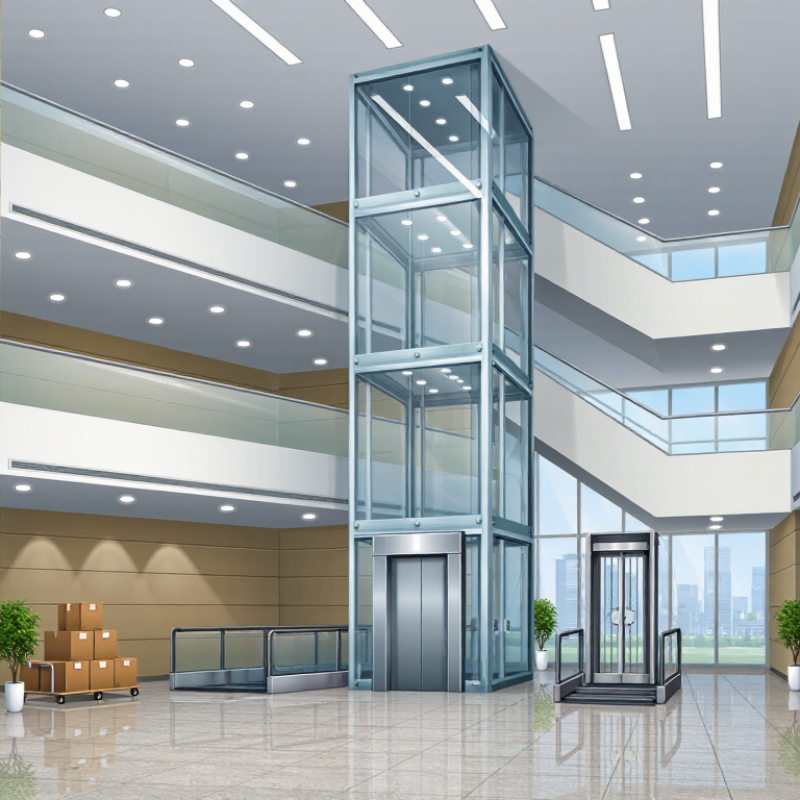
| Passenger Lift | Offices, hotels, residential buildings, retail centres and public buildings | About 450–2,500 kg, depending on car size and building requirements | Often about 0.5–2.5 m/s in low- and mid-rise buildings; high-rise systems may be faster | Usually uses an electric traction system: a motor moves the lift car and counterweight with ropes or belts. Some low-rise models use hydraulic power. |
| Freight or Goods Lift | Warehouses, factories, loading areas and commercial buildings moving bulky goods | Commonly about 1,000–10,000 kg; specialist installations can differ | Often about 0.15–1.0 m/s, depending on load, travel height and duty | A heavy-duty traction or hydraulic drive raises a reinforced car. Larger doors, durable finishes and load controls support goods handling. |
| Service Lift | Hotels, hospitals, restaurants and offices moving supplies, laundry or equipment | Often about 500–1,600 kg for a person-sized service elevator; smaller service lifts have lower capacities | Varies by building and system; commonly comparable to a low- or mid-rise passenger lift | Typically operates like a passenger lift, using traction or hydraulic drive, but is configured for staff, equipment and service routes. |
| Dumbwaiter | Restaurants, hotels, libraries and multi-level food-service or storage areas | Often about 50–300 kg, subject to the model and local requirements | Varies by installation; intended for short-distance, small-load movement | A compact powered carriage travels in a shaft between floors. Interlocks and controls are designed to prevent access while it is moving. |
| Platform Lift | Small commercial premises and locations where an accessible route is needed over a short vertical distance | Often about 250–500 kg, depending on design and applicable regulations | Generally slow-speed; maximum speed and travel are governed by the lift type and local accessibility and safety rules | A platform moves vertically using a screw, hydraulic or other approved drive. Controls, barriers and safety features depend on the installation. |
| Vehicle Lift | Car parks, vehicle showrooms, workshops and sites with limited space for ramps | Often about 2,500–5,000 kg for passenger-vehicle systems; heavier designs are available | Usually low-speed, with travel and cycle time selected for the building and vehicle type | A vehicle platform or carrier is raised by a hydraulic or traction mechanism, with guides and safety devices controlling its movement. |



 Close