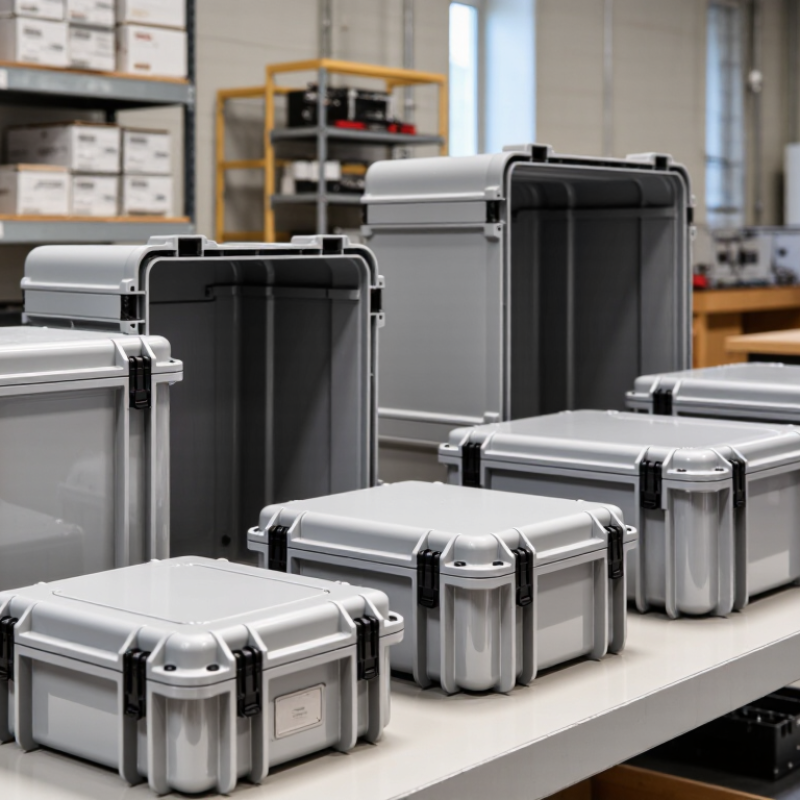
| Enclosure application and design | Confirm the enclosure is designed for the intended use, such as electrical distribution, automation, instrumentation, or outdoor equipment. | Dimensioned drawings, mounting details, door and gasket design, cable-entry options, and rated operating conditions. | Similar-looking boxes can differ in usable space, mounting strength, access, and suitability for the installed equipment. |
| Ingress protection | Check the exact IP rating required for exposure to dust and water, and whether the rating applies to the complete assembled enclosure. | IEC 60529 test documentation. For example, IP66 indicates dust-tight protection and protection against powerful water jets; IP67 includes specified temporary immersion testing. | Ratings depend on configuration, including doors, seals, cable glands, and accessories. Confirm the tested configuration matches the order. |
| NEMA enclosure type | For North American projects, determine whether the specified NEMA type is required and verify the enclosure’s intended environmental application. | Documentation to the applicable NEMA 250 requirements, including the stated type and product configuration. | NEMA enclosure types and IEC IP codes use different classification systems; they should not be treated as direct one-to-one equivalents. |
| Material and corrosion resistance | Compare material options such as painted steel, stainless steel, aluminum, and non-metallic plastics against the site environment. | Material and coating specifications, corrosion-test information where applicable, and details on fasteners, hinges, and seals. | Salt exposure, chemicals, humidity, UV, and cleaning agents can affect the enclosure and its hardware differently. |
| Standards and conformity | Identify the standards and approvals required in the destination market and for the final electrical assembly. | For relevant products, review IEC 62208 documentation for empty enclosures used in low-voltage switchgear and controlgear assemblies, and applicable UL 50 or UL 50E evidence for the U.S. market. | An enclosure approval does not automatically certify the complete assembled equipment. Confirm scope, certificate holder, model coverage, and market applicability. |
| Dimensions and customization | Confirm external and internal dimensions, cutouts, mounting plates, hinges, locks, and any required custom features. | Approved production drawings, revision control, tolerance information, and a first-article inspection plan. | Clear drawings reduce fit-up problems and help control changes between samples and production orders. |
| Thermal and operating conditions | Check the specified ambient temperature range and assess heat dissipation for the installed components. | Product datasheet limits, material and gasket temperature limits, and thermal calculations or testing for the actual assembly when needed. | Allowable temperatures vary by design and materials; do not assume one range applies to every enclosure from a supplier. |
| Manufacturing quality controls | Review how the supplier controls forming, welding, surface preparation, coating, assembly, and final inspection. | Documented inspection criteria, traceability practices, calibration records, and nonconformance and corrective-action procedures. | Consistent controls help reduce variation in dimensions, finishes, sealing, and repeat production orders. |
| Production capacity and lead time | Validate available capacity, order-size constraints, tooling needs, and lead times for samples and repeat orders. | Written production schedule, stated assumptions, capacity plan, and confirmation of material availability. | Quoted lead times can depend on customization, raw materials, approval cycles, and seasonal demand. |
| Packaging and transport | Check protection against moisture, impact, abrasion, and movement during the planned shipping route. | Packaging specification, pallet or crate details, labeling requirements, and shipping dimensions and weights. | Packaging affects freight cost and the risk of damage during long-distance transport and handling. |
| Commercial and delivery terms | Compare quotation scope, minimum order quantities, payment terms, delivery terms, and responsibilities for freight and insurance. | Itemized quotation and clearly stated Incoterms® rule, named place, currency, and quotation validity period. | Consistent commercial assumptions make supplier quotations easier to compare and help clarify cost responsibilities. |
| After-sales support and risk | Assess responsiveness for technical questions, replacement parts, warranty claims, and quality issues. | Written warranty terms, escalation contacts, spare-parts policy, and documented process for corrective actions. | Accessible support can reduce downtime and simplify issue resolution across time zones and borders. |



 Close