| Compressed non-asbestos fiber sheet | Compressed fiber, fillers, and elastomer binder formed into sheet material. | Compresses into flange-face irregularities to create a continuous sealing contact area. | Usually needs sufficient initial bolt load; recovery is limited compared with elastomeric materials. | Helps block paths across surface scratches, waviness, and small face imperfections. | Pumps, compressors, gearboxes, pipe flanges, and general-purpose equipment. | Check the fluid, temperature, pressure, flange finish, and required bolt load against the material specification. |
| Flexible graphite | Expanded graphite sheet or graphite sealing layers, sometimes reinforced with metal insert or tanged reinforcement. | Flows into surface texture under compression; suitable grades can maintain sealing performance through thermal cycling. | Compressible, with useful resilience depending on construction and reinforcement; can be sensitive to handling damage. | Seals face irregularities and can reduce leakage along the flange interface when properly compressed. | Hot equipment, exhaust connections, heat exchangers, valves, and selected process-fluid joints. | Verify oxidation limits, fluid compatibility, reinforcement, pressure conditions, and installation requirements. |
| PTFE gasket | Skived or expanded PTFE sheet, or a PTFE envelope around a compliant core. | Conforms to flange surfaces and provides broad chemical resistance across many services. | PTFE can creep or relax under sustained load; expanded or filled grades are designed to improve dimensional stability. | Fills minor surface paths at the joint, but long-term sealing depends on managing stress relaxation and bolt load. | Chemical-processing pumps, pipework, mixers, and equipment handling corrosive fluids. | Check grade-specific creep behavior, temperature and pressure limits, permeation needs, and compatibility with the fluid. |
| Elastomeric gasket | Molded or cut rubber-like materials, such as EPDM, NBR, or FKM, selected for the service. | Elastic deformation creates contact pressure against mating surfaces, often at relatively low seating loads. | Typically offers strong elastic recovery, though heat, aging, compression set, and fluid exposure can reduce it. | Blocks interface paths when the seal is correctly sized and compressed; the profile can also seal around ports or covers. | Water pumps, housings, access covers, low-pressure connections, and fluid-handling machinery. | Choose the elastomer by fluid compatibility, operating temperature, pressure, hardness, and expected exposure or aging. |
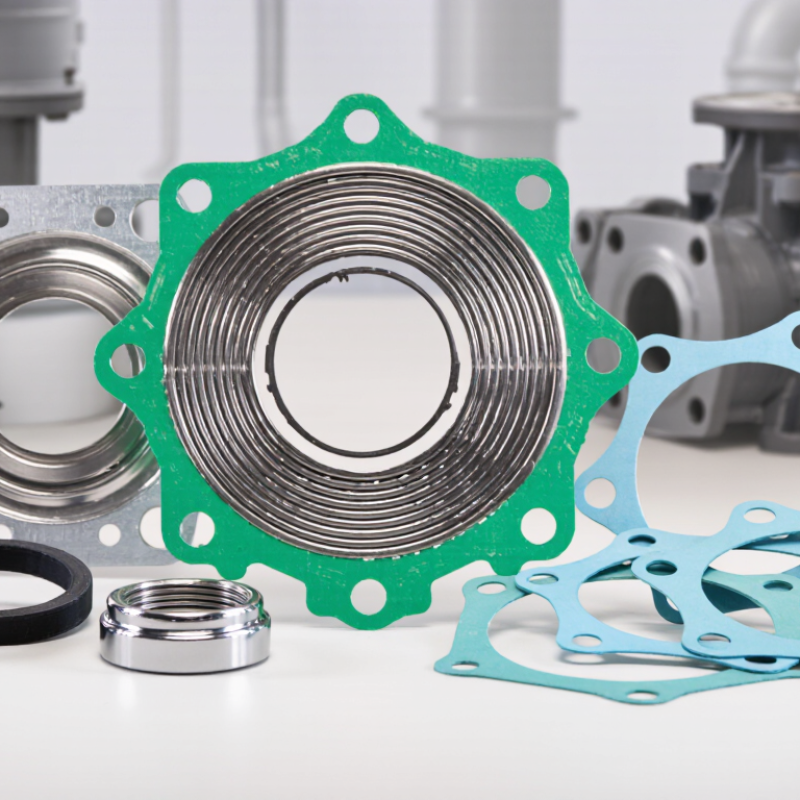
| Spiral-wound gasket | Alternating spirals of formed metal and a soft filler, commonly with inner or outer rings depending on design. | The winding provides a spring-like structure while the filler conforms to flange faces under compression. | Can accommodate some movement and thermal cycling; performance depends on correct compression and suitable flange design. | Provides a tortuous sealing path across the flange interface; rings help control compression and positioning in applicable designs. | Pressure vessels, heat exchangers, steam systems, and process piping on suitable flanges. | Match the winding, filler, rings, flange geometry, bolt load, and service conditions to the joint specification. |
| Metal ring-joint gasket | Solid metal ring with a defined cross-section that seats in matching machined grooves. | High localized contact stress at the ring and groove creates the seal when the joint is correctly assembled. | Little elastic recovery after seating; relies on precise geometry, sound surfaces, and adequate assembly load. | Seals at the narrow metal-to-metal contact region rather than across a broad sheet-gasket area. | Selected high-pressure flanged connections and specialized industrial equipment. | Requires compatible groove and ring dimensions, material suitability, careful inspection, and controlled assembly. |
| Camprofile (kammprofile) gasket | Metal core with concentric serrations, commonly covered by a soft sealing layer. | Serrations concentrate load while the facing material conforms to the flange surface. | Metal core provides stability; the facing supplies local conformity. Recovery varies with facing material and construction. | Limits leakage across the joint by combining concentrated contact at the serrations with a conformable surface layer. | Heat exchangers, flanged machinery connections, and applications requiring a robust semi-metallic design. | Check facing compatibility, flange condition, required seating stress, and whether the joint permits this gasket style. |



 Close