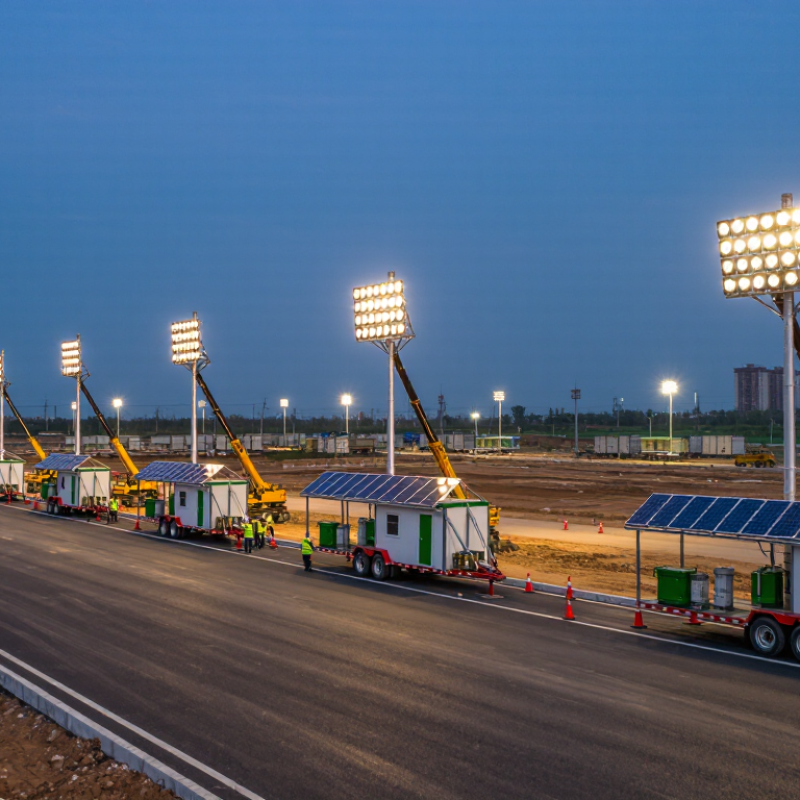
| Lighting Technology | High-efficiency LED modules, generally using 30–200 W LED systems | Modular LED assemblies, adjustable beam options, and replaceable light heads are widely available | Request LM-79 or equivalent photometric data, lumen output, beam angle, and LED service life |
| Solar Array | Photovoltaic capacity commonly ranges from approximately 100 W to 600 W, depending on lighting load | Monocrystalline panels, foldable layouts, and customized panel sizes are commonly offered | Check panel rated power, cell type, conversion efficiency, dimensions, and mechanical protection |
| Battery System | Lithium iron phosphate batteries are increasingly used; lead-acid options remain available for cost-sensitive projects | Battery capacity, enclosure design, battery-management systems, and installation position can often be customized | Confirm chemistry, nominal voltage, usable capacity, operating temperature, BMS functions, and cycle-life test method |
| Operating Autonomy | Many product designs target approximately 2–5 nights of backup, subject to location and operating profile | Dimming schedules, motion sensors, remote controls, and low-voltage protection can extend operating time | Evaluate autonomy using local solar radiation, winter conditions, daily lighting hours, and programmed dimming levels |
| Mast Height and Mobility | Telescopic mast heights commonly fall within approximately 5–10 m for portable lighting towers | Manual winches, hydraulic lifting systems, trailer-mounted frames, and compact transport configurations are available | Check maximum height, folded dimensions, total weight, lifting method, wheel or trailer requirements, and ground stability |
| Weather Resistance | Outdoor enclosures are commonly designed to IP65 or higher; impact protection may reach IK08 or above depending on the component | Powder-coated steel, aluminum housings, sealed cable glands, and corrosion-resistant fasteners are commonly specified | Ask for ingress-protection and impact-protection test reports, coating specifications, and salt-spray test results where relevant |
| Control and Monitoring | Photocell control, timer-based dimming, motion detection, and remote monitoring are common options | Control systems can be configured for standalone operation, wireless communication, or project-specific monitoring platforms | Confirm communication range, SIM or network requirements, software access, data ownership, and fault alerts |
| Electrical and Safety Compliance | Export projects may require CE, RoHS, EMC, low-voltage, battery-transport, or destination-country compliance documentation | Manufacturers commonly provide documentation packages tailored to the target market and project application | Verify certificates against the exact model, test laboratory, applicable standards, and production revision |
| Customization Capability | Common customization areas include LED power, battery capacity, mast configuration, trailer frame, control logic, and enclosure color | OEM and project-based manufacturing are widely used for infrastructure, construction, emergency, and event applications | Request engineering drawings, a bill of materials, prototype approval procedures, and change-control documentation |
| Quality Management | Export-oriented factories may operate under ISO 9001-based quality-management systems | Typical production controls include incoming-material inspection, assembly testing, charging tests, and final inspection | Review the quality certificate scope, inspection records, factory audit results, and sampling or acceptance criteria |
| Warranty and After-Sales Support | Product warranties commonly range from 2–5 years, depending on the system and contract | Remote troubleshooting, spare-parts supply, installation guidance, and replacement-component support are commonly offered | Clarify warranty exclusions, response times, spare-parts availability, battery replacement terms, and local service responsibilities |



 Close
Close