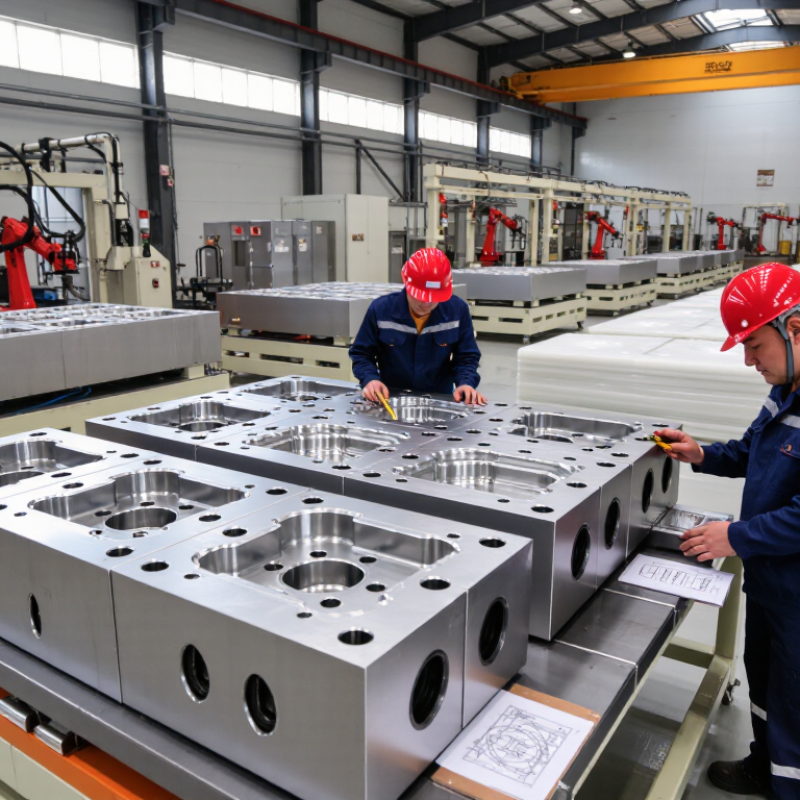
| CNC-Machined Aluminum Tooling | Solid or semi-hollow mold assembled with vacuum ports, cooling passages, mounting plates, and interchangeable inserts. | 6061-T6 or 6082 aluminum; cast aluminum for larger or more complex shapes. | Automotive interior components, appliance housings, packaging tools, and medium-to-high production volumes. | Good thermal conductivity, repeatable dimensional accuracy, fast heat transfer, and relatively low tool weight. | CMM inspection, vacuum-port verification, surface-finish measurement, assembly alignment checks, and first-article inspection. | ISO 9001 quality-management systems; ISO 1101 or ASME Y14.5 for geometric tolerancing; ISO 20457 for applicable molded-part tolerances. |
| Cast Aluminum Tooling | Cast mold body followed by CNC finishing, drilling of vacuum holes, installation of fittings, and integration of cooling or heating components. | Cast aluminum alloys selected for thermal stability and machinability. | Large-format panels, vehicle trim, refrigerator liners, bath products, and tools with deep or irregular geometry. | Cost-effective for large surfaces; supports integrated cooling channels and complex external contours. | Material-certification review, X-ray or dye-penetrant inspection when specified, dimensional inspection, leak testing, and surface inspection. | ISO 9001; documented casting traceability; ISO 1101 or ASME Y14.5 drawing controls; customer-defined acceptance criteria. |
| Epoxy or Composite Pattern Tooling | Master pattern, composite mold shell, structural backing, vacuum fittings, and replaceable wear surfaces. | Filled epoxy tooling board, epoxy resin, fiberglass reinforcement, carbon-fiber reinforcement, or hybrid composite systems. | Prototype parts, low-volume production, design validation, and short lead-time tooling. | Rapid production and lower initial cost; generally lower thermal conductivity and service life than aluminum tools. | Pattern dimensional checks, resin-cure documentation, vacuum integrity testing, surface-finish checks, and trial-forming validation. | ISO 9001 where applicable; resin supplier technical data sheets; controlled curing procedures; documented prototype acceptance criteria. |
| CNC-Machined Steel Tooling | Steel cavity or insert system with hardened wear areas, guide features, vacuum passages, and replaceable components. | P20-type pre-hardened mold steel, tool steel, or stainless steel for corrosion-sensitive environments. | High-cycle production, abrasive sheet materials, precision components, and applications requiring extended tool life. | High wear resistance and stiffness; slower heat transfer and higher machining cost than aluminum. | Hardness verification, CMM inspection, surface roughness measurement, vacuum-flow checks, and assembly repeatability testing. | ISO 9001; ISO 1101 or ASME Y14.5; material certificates; heat-treatment records; controlled tool-maintenance procedures. |
| Additive-Manufactured Tooling | Printed mold body or insert with optimized internal channels, followed by sealing, machining, finishing, and hardware assembly. | Aluminum, stainless steel, nickel alloys, high-temperature polymers, or reinforced polymer composites, depending on process and temperature. | Prototype tools, conformal-cooling inserts, lightweight molds, and geometries difficult to machine conventionally. | Enables complex internal cooling layouts and rapid design iteration; surface finishing and thermal durability require careful validation. | Build-record review, CT or internal-channel inspection where required, dimensional scanning, pressure or vacuum testing, and thermal-cycle trials. | ISO/ASTM 52900 terminology for additive manufacturing; ISO 9001; process-specific qualification and post-processing records. |
| Electroformed Nickel Tooling | Nickel shell formed over a master pattern and supported by a rigid backing structure with vacuum and mounting hardware. | Electroformed nickel with aluminum, steel, or composite backing materials. | Detailed surfaces, thin-gauge packaging, textured finishes, and applications requiring accurate reproduction of a master pattern. | Excellent surface replication and dimensional detail; shell thickness and backing design must be controlled for stiffness. | Shell-thickness measurement, master-to-tool comparison, surface-profile inspection, vacuum testing, and thermal-cycle verification. | ISO 9001; plating-process control; master-pattern traceability; drawing-based dimensional and surface-finish requirements. |
| Multi-Part Mold Assembly | Separate cavity sections, inserts, clamping frames, alignment dowels, vacuum manifolds, and replaceable wear components. | Aluminum, steel, stainless steel, engineering plastics, or combinations selected according to temperature and wear requirements. | Large parts, undercut features, modular production tooling, and molds requiring frequent maintenance or design changes. | Improves serviceability and changeover efficiency; joint alignment and sealing are critical to part quality. | Datum and alignment checks, insert interchangeability tests, vacuum-leak testing, joint-gap inspection, and trial-part measurement. | ISO 1101 or ASME Y14.5 for datums and geometric tolerances; ISO 20457 for applicable part-tolerance planning; documented assembly procedures. |
| Vacuum-Port and Airflow Integration | Distributed vacuum holes, machined channels, manifolds, filters, fittings, and independently controlled vacuum zones. | Usually integrated into aluminum, steel, cast aluminum, or composite mold structures. | Deep-draw parts, fine-detail surfaces, thin-gauge sheet forming, and components requiring uniform material distribution. | Port layout influences draw uniformity, webbing risk, corner definition, cycle time, and final wall-thickness distribution. | Vacuum-flow measurement, leak-rate testing, blocked-port checks, port-diameter verification, and trial-forming analysis. | Process specifications are normally customer- or application-defined; vacuum-system components should be selected for the forming temperature and pressure range. |
| Integrated Cooling and Heating Assemblies | Internal cooling channels, external heaters, thermal sensors, manifolds, insulation, and controlled connection points. | Aluminum or steel mold bodies; copper-alloy components may be used selectively for heat transfer. | High-cycle production, thick-gauge forming, temperature-sensitive polymers, and parts requiring short cycle times. | Improves thermal uniformity and cycle repeatability; channel placement must avoid distortion and weak sections. | Pressure testing, flow-rate measurement, thermal mapping, sensor calibration, and cycle-to-cycle temperature verification. | ISO 9001; calibrated measurement equipment under ISO 10012 principles; documented pressure, temperature, and maintenance records. |
| Surface Finishing and Texture Replication | Machined cavity with polishing, bead blasting, chemical texturing, laser texturing, or applied surface treatment. | Aluminum, steel, nickel, or coated tooling surfaces selected according to required texture and wear resistance. | Visible automotive trim, consumer products, sanitary components, packaging, and parts requiring controlled gloss or grain. | Surface texture affects appearance, release behavior, friction, cleaning, and the replication of the sheet surface. | Gloss or roughness measurement, visual master comparison, texture-depth inspection, release testing, and sample-part approval. | ISO 21920 for profile surface-texture specification and measurement; customer-approved visual standards; controlled sample retention. |
| Final Assembly and Validation | Complete mold assembly including cavity, base, inserts, vacuum system, cooling or heating circuits, sensors, and mounting hardware. | Material combination based on production temperature, wear, corrosion, thermal conductivity, and maintenance requirements. | Production release, replacement tooling, engineering changes, and global transfer of thermoforming programs. | Focuses on repeatability, safe operation, maintainability, dimensional conformity, and compatibility with the forming machine. | Design review, FAI, CMM or 3D-scan report, vacuum and pressure tests, machine tryout, capability study, and corrective-action records. | ISO 9001; ISO 19011 audit principles where applicable; ISO 1101 or ASME Y14.5; customer-specific PPAP or production-approval requirements when requested. |



 Close