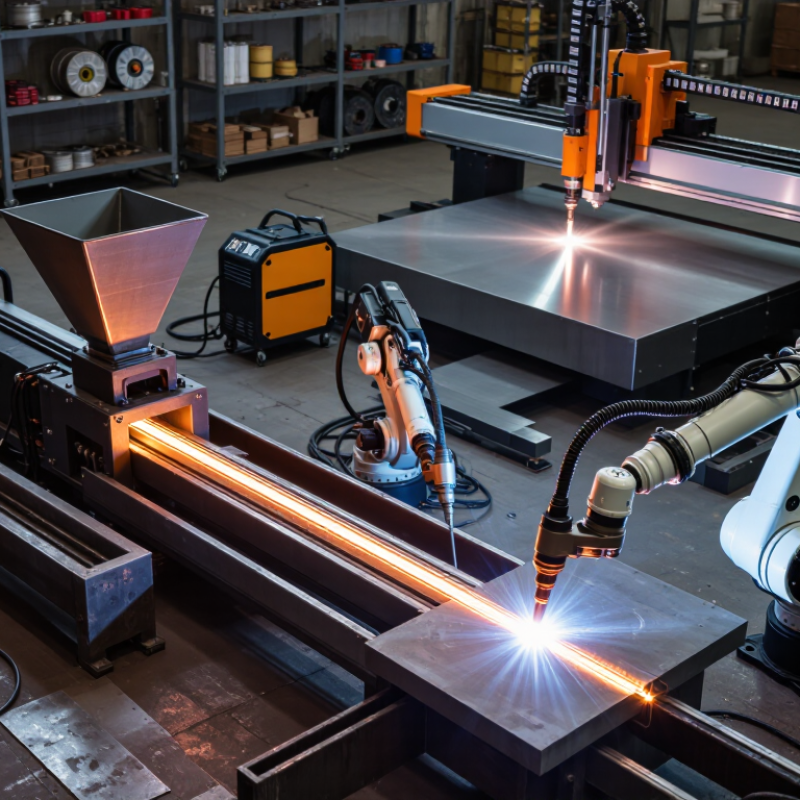
| Mechanized welding tractor or carriage | Usually a continuous wire-feed FCAW torch; may be configured for gas-shielded or self-shielded flux-cored wire. | A powered carriage travels along a seam or guide, maintaining a set travel speed while the operator sets and monitors welding parameters. | Long, accessible straight or gently curved welds on plate, frames, and structural assemblies. | Needs a suitable travel path and consistent joint fit-up. A carriage mechanizes travel but does not automatically correct poor alignment or changing joint geometry. |
| Fixed-head mechanized station | Typically uses gas-shielded FCAW where the workpiece and station can be kept in a controlled environment; self-shielded wire may be selected for suitable applications. | The torch remains mounted in a set position while a fixture holds or indexes the workpiece. Controls regulate wire feed, voltage, and related cycle settings. | Repeatable production of similar parts, welds, or assemblies in a dedicated work cell. | Fixtures and part presentation are important. Gas-shielded FCAW requires suitable shielding-gas delivery and protection from disruptive drafts. |
| Gantry or column-and-boom system | A mounted FCAW torch can use gas-shielded or self-shielded flux-cored wire, subject to the wire, equipment, and procedure requirements. | The torch is carried on a guided boom or gantry, allowing controlled movement along large or heavy workpieces. | Long seams on large plates, beams, tanks, and other components that are difficult to move through a compact station. | Requires adequate floor space, workpiece access, and accurate positioning. The system’s size and setup are best suited to planned production or large jobs. |
| Robotic FCAW cell | Commonly configured with gas-shielded FCAW for programmed production; wire and shielding choices depend on the welding procedure and work environment. | A programmable robot follows a taught or programmed path. Fixtures, sensors, and process controls can support repeatable positioning and monitoring. | Repetitive, multi-pass production welds on parts that can be positioned consistently within a cell. | Requires programming, safety guarding, suitable fixturing, and ongoing maintenance. Accurate part presentation is essential for consistent results. |
| Tandem-wire mechanized system | Uses two welding wires and coordinated power sources in a specialized FCAW arrangement; exact wire and shielding configurations depend on the procedure. | Two arcs operate in a coordinated setup to deposit metal along the weld path, with synchronized travel and process settings. | High-deposition production applications where the joint design, equipment, and qualified procedure are suited to tandem welding. | More complex to set up and control than single-wire FCAW. Requires compatible equipment, careful parameter coordination, and procedure qualification. |



 Close