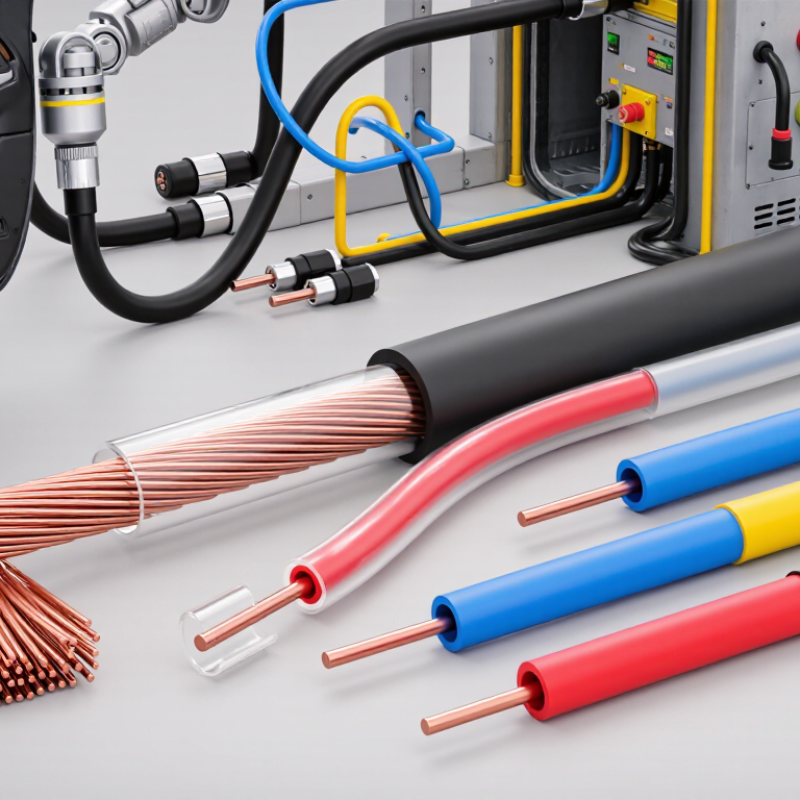
| General-purpose stranded copper wire | Multiple copper strands gathered into a conductor; insulation is commonly PVC or another application-appropriate material. | Good for routine routing and installation where the wire may need to bend during assembly. | Control panels, equipment wiring, vehicles, and general electrical connections. | Choose conductor area, insulation type, voltage rating, and temperature rating for the specific installation. Stranded construction is more bendable than solid wire of the same conductor size. |
| Fine-stranded flexible copper wire | Many smaller copper strands; flexible conductor constructions are commonly identified as Class 5 under IEC 60228. | Very good for repeated repositioning and routing through tight spaces. | Portable equipment, control wiring, and assemblies that need easier handling. | Use compatible terminals and ferrules where required; fine strands can be damaged by unsuitable stripping or termination methods. |
| Extra-fine-stranded copper wire | A conductor made from numerous very small strands; some flexible constructions are classified as Class 6 under IEC 60228. | Excellent for demanding bending and compact routing, subject to the cable’s design limits. | Robotics, moving equipment, and specialized flexible cable assemblies. | For continuous motion, check the cable’s stated bend radius and flex-life data. A flexible conductor alone does not make an entire cable suitable for continuous flexing. |
| Flexible cord conductors | Stranded copper conductors enclosed in a shared jacket; jacket and insulation materials vary by cord type. | Designed for handling and movement associated with portable equipment. | Appliance cords, extension cords, and portable tools where permitted by the applicable electrical code. | Match the cord type and rating to the environment and use. Do not substitute flexible cord for fixed building wiring unless regulations allow it. |
| Welding cable | Typically a fine-stranded copper conductor with a tough, flexible insulating jacket. | High flexibility for moving leads and equipment connections. | Welding circuits and other applications specifically allowed by the cable’s rating. | Verify conductor size, duty requirements, temperature rating, and suitability for the installation. Do not assume all welding cable is approved for every wiring use. |
| Silicone-insulated flexible wire | Usually stranded copper with silicone-rubber insulation. | Flexible across a broad temperature range for products designed for that service. | Appliances, lighting, and equipment where heat-resistant insulation is needed. | Temperature and voltage limits depend on the specific wire. Silicone insulation may have lower abrasion or cut resistance than some tougher jacket materials. |
| Flexible shielded wire or cable | Insulated conductors with a surrounding braided or foil shield; the conductors may be stranded copper. | Varies with conductor stranding, shield construction, and outer jacket. | Signal and control circuits where reducing electromagnetic interference is important. | Check shielding coverage, grounding approach, bend limits, and whether the cable is rated for movement or continuous flexing. |



 Close