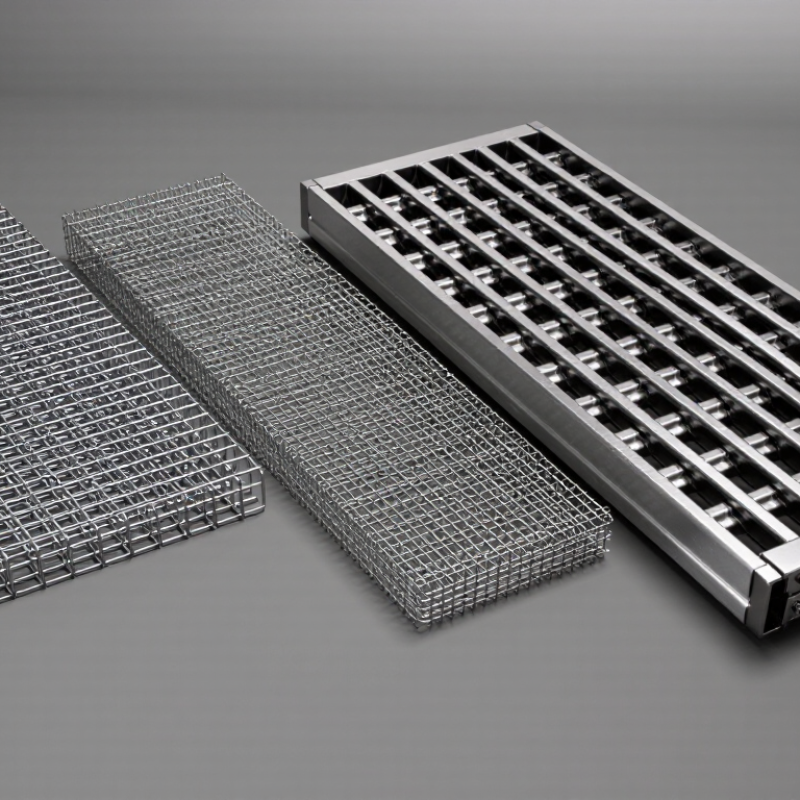
| Crimped Woven Wire Grate | Wires are mechanically crimped before weaving. The bends help hold the wires in position at their crossing points. Common forms include plain, intermediate, and lock crimp. | Rigid, open construction with a regular pattern. Wire diameter and opening size can be selected to balance strength, screening, and material flow. | Screening and sorting, guards, baskets, ventilation panels, and general-purpose industrial grates. | Specify wire diameter, opening size, weave pattern, panel dimensions, and stainless steel grade according to load, exposure, and the material being screened. |
| Plain-Weave Wire Mesh | Each warp wire passes alternately over and under each weft wire in a simple, balanced pattern. | Uniform openings and a straightforward construction; commonly used for fine-to-medium screening where a regular mesh is needed. | Filters, sieves, screens, insect screens, and protective mesh panels. | For larger openings or heavier wire, compare rigidity and panel stability with crimped or welded constructions. |
| Twill-Weave Wire Mesh | Each wire passes over and under two or more wires in a repeating pattern, producing diagonal lines across the mesh. | Can accommodate relatively fine openings with heavier wires than a comparable plain weave, depending on the specification. | Fine filtration, screening, and applications requiring a denser woven surface. | Its openings and weave should be matched to the required filtration or screening performance; it is not automatically a load-bearing floor grate. |
| Dutch-Weave Wire Mesh | Uses different wire diameters and mesh counts in the warp and weft; some versions use closely packed wires to create small filtration passages. | Designed primarily for fine filtration rather than large, open grate surfaces. | Process filtration, separation, and filter elements for liquids or gases. | Choose by filtration requirements, flow conditions, and pressure limits; confirm the specific weave and opening specification with the fabricator. |
| Welded Wire Mesh Panel | Longitudinal and transverse wires are joined at their intersections by welding. | Fixed rectangular openings and a stable panel form; panel strength depends on wire size, spacing, weld quality, and support conditions. | Machine guards, partitions, cages, racks, and protective panels. | Check panel span, support arrangement, load requirements, and the suitability of the stainless grade for the operating environment. |
| Expanded Stainless Steel Grating | A sheet is slit and stretched to create a connected pattern of openings, rather than being woven from separate wires. | One-piece construction with open areas; the pattern and sheet thickness affect stiffness, weight, and slip resistance. | Walkway panels, platforms, screens, and protective covers where an open sheet construction is suitable. | Confirm load capacity, opening shape, edge treatment, support spacing, and surface requirements for the intended installation. |



 Close