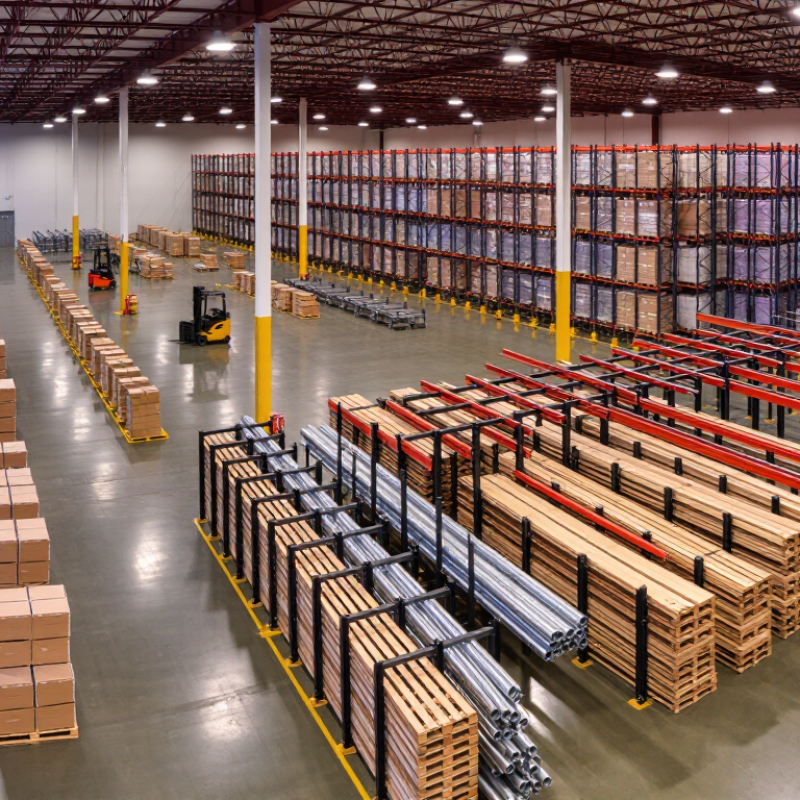
| Selective Pallet Racking | Pallets are stored on horizontal beams in individual bays, with aisles between rack rows. | Upright frames, load beams, beam connectors, base plates, anchors, and row spacers where required. | High selectivity: each pallet position is generally accessible directly from an aisle. | A versatile option for many SKUs and frequent picking. Aisles take up floor space, so storage density is usually lower than in deep-lane systems. |
| Double-Deep Racking | Two pallet positions are placed one behind the other, usually using a double-reach truck. | Upright frames, beams, deep-lane supports, pallet stops where specified, and compatible handling equipment. | Medium selectivity: front pallets must generally be moved to reach rear pallets. | Can increase storage density compared with single-deep layouts. Works best when products are stored in multiple pallets per SKU and inventory rotation is planned. |
| Drive-In Racking | A forklift enters a rack lane to place or retrieve pallets supported by rails along the lane. | Upright frames, lane rails, rail supports, entry guides or guards, and structural bracing. | Low selectivity: pallets are commonly accessed from one end, so the lane operates on a last-in, first-out basis. | Suitable for high volumes of relatively few SKUs. Requires careful forklift operation within the lanes and attention to load placement and rack protection. |
| Drive-Through Racking | Forklifts enter the lane from one side and can exit from the opposite side; pallets rest on lane rails. | Upright frames, lane rails, rail supports, entry guides or guards, and bracing. | Access from both ends; lanes can support first-in, first-out flow when loading and unloading are managed from opposite sides. | Useful where product rotation is important and high-density storage is needed. Requires access aisles on both ends of the rack lanes. |
| Push-Back Racking | Each new pallet pushes earlier pallets deeper along inclined carts or nested carriers within a lane. | Upright frames, beams, inclined tracks, nested carts or carriers, and lane stops. | Typically accessed from one aisle; pallets within a lane are retrieved in last-in, first-out sequence. | Provides multiple pallet positions per lane without forklift travel into the rack. Appropriate for multiple pallets per SKU; lane depth and load compatibility need to be assessed. |
| Pallet Flow Racking | Pallets move by gravity on inclined roller or wheel tracks from the loading face to the picking face. | Upright frames, inclined flow tracks, rollers or wheels, flow brakes, guides, and end stops. | Separate loading and picking faces support first-in, first-out rotation within each lane. | Can reduce travel between replenishment and picking areas. Pallets must be suitable for the track system, and lanes require routine inspection and maintenance. |
| Cantilever Racking | Long or bulky goods rest on projecting arms, leaving the front of the rack open for loading. | Upright columns, horizontal bases, cantilever arms, braces, and arm stops where needed. | Open-face access; goods are typically handled from the front with suitable lifting equipment. | Commonly used for lumber, pipe, sheet material, and other long loads. Arm spacing, load length, and load distribution must suit the stored items. |



 Close