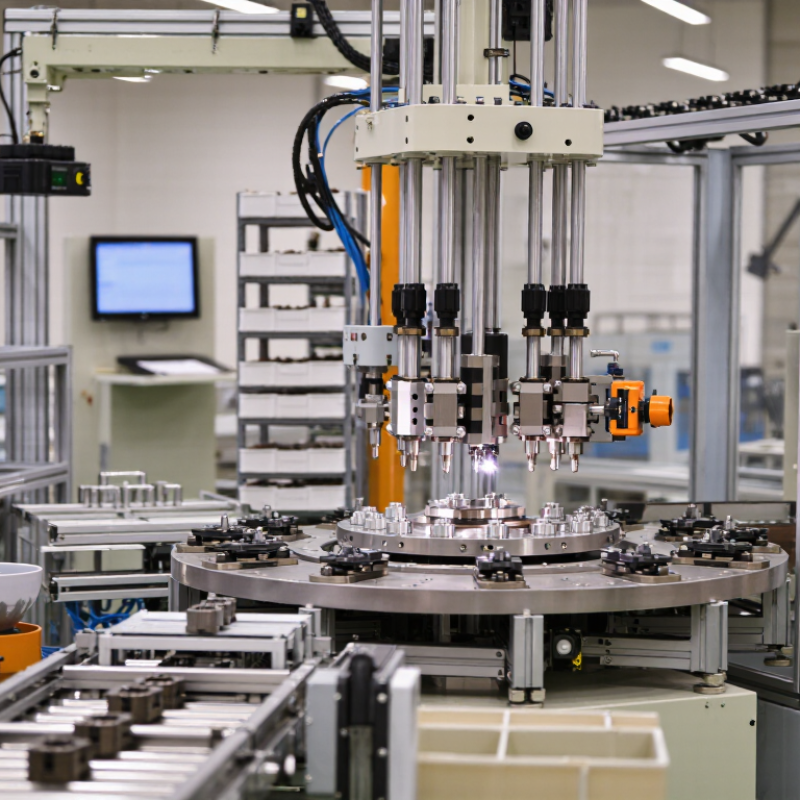
| Machine Frame and Base | Supports all mechanical, electrical, and control elements. | Provides a rigid structure that maintains the alignment of stations, tooling, conveyors, and safety guarding. | Input: Mechanical loads and vibration.
Output: Stable working platform. | Usually fabricated from steel, aluminum profiles, or a combination of both. | Rigidity, vibration resistance, accessibility for maintenance, and floor-space efficiency. |
| Part Feeding System | Supplies components to the assembly process in a controlled orientation and sequence. | Uses hoppers, conveyors, trays, bowl feeders, step feeders, or robotic feeders to separate and position parts. | Input: Bulk or pre-oriented components.
Output: Singulated parts at a defined pick-up point. | Feed rate depends on part geometry, mass, surface finish, and required cycle time. | Reliable singulation, low part damage, low noise, and consistent replenishment. |
| Conveyor or Transfer System | Moves workpieces between assembly stations. | Transfers parts using belts, pallets, indexing tables, linear slides, or walking-beam mechanisms. | Input: Workpiece at the previous station.
Output: Workpiece at the next station. | May operate continuously or in indexed movements with controlled stops. | Position repeatability, transfer speed, product protection, and synchronization with tooling. |
| Locating and Fixturing Unit | Holds and accurately positions parts during assembly. | Uses nests, pins, clamps, vacuum fixtures, or custom tooling to constrain the workpiece. | Input: Unsecured or partially positioned part.
Output: Precisely located part. | Designed around part geometry, datum features, tolerance requirements, and access for tools. | Repeatability, quick changeover, prevention of incorrect loading, and protection against deformation. |
| Actuators and Motion Mechanisms | Generate the movement required for inserting, pressing, rotating, clamping, or transferring parts. | Converts electrical, pneumatic, or hydraulic energy into linear or rotary motion. | Input: Electrical, compressed-air, or hydraulic energy.
Output: Controlled mechanical movement. | Motion may be driven by servo motors, electric cylinders, pneumatic cylinders, or hydraulic actuators. | Force, speed, stroke length, positioning accuracy, service life, and energy consumption. |
| Assembly Tooling | Performs the specific joining or installation operation. | May insert, press-fit, screw, rivet, crimp, weld, dispense, clip, or fasten components. | Input: Components and process energy.
Output: Joined or assembled product. | Tool selection depends on joint type, material, required force, torque, temperature, and process tolerance. | Joint strength, process repeatability, tool wear, changeover time, and traceability of critical operations. |
| Sensors and Detection Devices | Detect the presence, position, orientation, quality, or completion status of parts and operations. | Provides signals from photoelectric, proximity, pressure, force, displacement, vision, or torque sensors. | Input: Physical condition or measurement.
Output: Electrical feedback signal. | Can provide binary detection or measured values for process control and inspection. | Detection accuracy, response time, calibration stability, environmental resistance, and false-rejection rate. |
| Programmable Logic Controller | Coordinates the machine sequence and manages inputs and outputs. | Executes a programmed logic cycle that reads sensor signals and commands actuators, tools, and material handling devices. | Input: Sensor and operator signals.
Output: Commands to motors, valves, tools, and alarms. | Controls sequencing, interlocks, timing, fault handling, and communication with other devices. | Program reliability, diagnostic capability, scan time, expandability, and ease of maintenance. |
| Human-Machine Interface | Allows operators and technicians to monitor, operate, and adjust the machine. | Displays status, alarms, production data, recipes, maintenance messages, and setup controls. | Input: Operator commands and settings.
Output: Machine status and control instructions. | Common functions include start, stop, reset, manual jog, recipe selection, and fault guidance. | Clear messages, access control, language support, data visibility, and operator safety. |
| Inspection and Quality-Control System | Checks whether the assembled product meets defined requirements. | Uses dimensional measurement, presence checks, force monitoring, torque verification, leak testing, or machine vision. | Input: Completed or partially completed assembly.
Output: Pass, fail, or measured quality result. | Inspection criteria may include position, completeness, orientation, dimensions, force, torque, and surface condition. | Measurement capability, repeatability, defect detection rate, calibration, and data recording. |
| Pneumatic or Electrical Control System | Distributes and regulates energy for machine functions. | Uses valves, regulators, manifolds, drives, relays, power supplies, and motor controllers to operate components. | Input: Electrical power or compressed air.
Output: Regulated energy to machine devices. | Pneumatic systems require clean, dry air; electrical systems require correctly rated voltage and protection. | Energy efficiency, leak prevention, overload protection, controllability, and ease of troubleshooting. |
| Safety Guarding and Interlocks | Protects personnel from moving parts, stored energy, hot surfaces, and process hazards. | Uses fixed guards, access doors, safety switches, light curtains, emergency stops, and safety controllers. | Input: Access or hazardous-condition signal.
Output: Controlled stop or prevention of machine operation. | Safety functions are selected according to the machine risk assessment and applicable regulations. | Reliable fault detection, safe stopping performance, visibility, accessibility, and controlled restart. |
| Discharge and Sorting System | Removes completed products, separates rejected items, and directs output to the next process. | Uses conveyors, chutes, robotic pickers, diverters, bins, or automated packaging interfaces. | Input: Tested assembled product.
Output: Accepted product, rejected product, or downstream transfer. | Can separate products according to inspection results, batch, orientation, or destination. | Product protection, reliable rejection, capacity matching, traceability, and easy collection. |
| Data and Traceability Module | Records production, quality, maintenance, and process information. | Collects cycle counts, inspection results, alarms, component identifiers, recipes, and operator actions. | Input: Machine and inspection data.
Output: Records, reports, and traceable production history. | May use barcode or code readers, local storage, network communication, and production databases. | Data accuracy, timestamping, storage capacity, cybersecurity, and retrieval speed. |



 Close