| Standard Soda-Lime Glass | The most common glass composition, made primarily from silica, sodium compounds, and calcium compounds. | Clear, but it may show a noticeable green tint along thick edges. | About 85–90% for clear sheet glass, depending on thickness and manufacturing quality. | Good surface hardness, but untreated glass can break into sharp shards if fractured. | Decorative side tables, console tables, and tabletops where cost and general clarity are priorities. |
| Low-Iron Glass | A highly refined glass with reduced iron content, minimizing the green coloration found in ordinary clear glass. | Very high clarity with a more neutral, color-accurate appearance. | Approximately 90–92%, depending on thickness and coating. | Similar basic strength to other annealed glass unless it is heat-treated or laminated. | Premium crystal-style tables, display tables, and interiors where maximum visual clarity is desired. |
| Tempered Glass | Glass that has been heat-treated to create compressive stress at the surface and improve resistance to impact and thermal shock. | Clear and visually similar to annealed glass; slight optical distortion may occur in some panels. | Usually about 88–91% for clear panels, depending on glass type and thickness. | Typically several times stronger than annealed glass of the same thickness; when broken, it crumbles into small, relatively blunt pieces. | Dining tables, coffee tables, desks, and frequently used household surfaces. |
| Laminated Glass | Two or more glass layers bonded to an internal plastic interlayer, commonly polyvinyl butyral. | High clarity; the interlayer can also provide color, translucency, or decorative effects. | Approximately 80–90%, depending on the glass layers and interlayer. | The interlayer helps hold broken glass in place, reducing fallout; it does not make the surface unbreakable. | Large tabletops, elevated surfaces, and designs where retained fragments are an important safety consideration. |
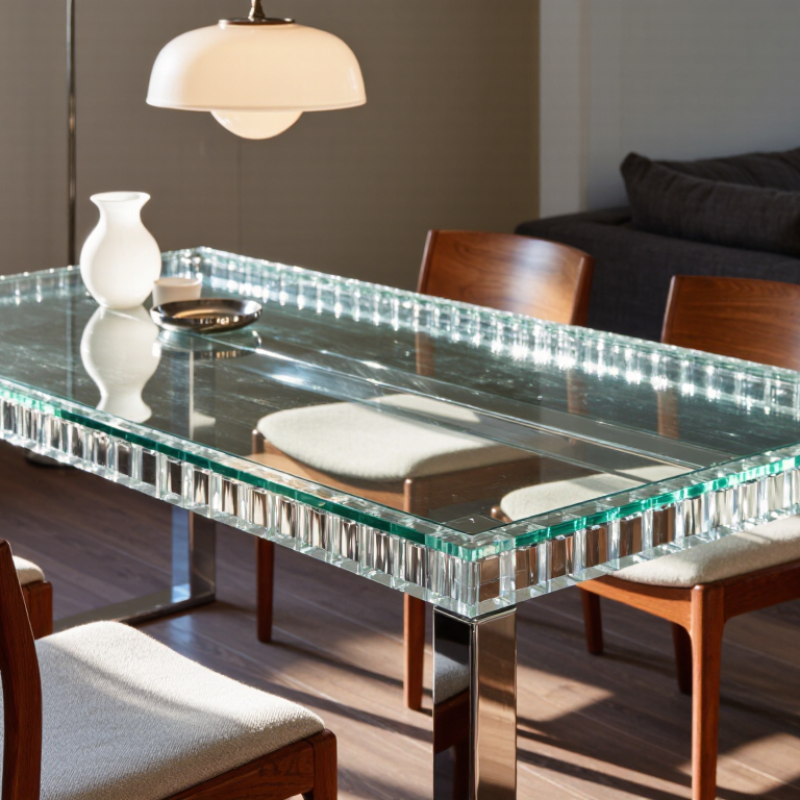
| Lead Crystal Glass | Glass containing a significant proportion of lead oxide, traditionally used to increase density, refractive index, and sparkle. | Exceptionally bright and reflective, with strong prismatic highlights and edge sparkle. | Often around 80–90%; transmission varies with composition, thickness, and surface treatment. | More decorative than impact-resistant; it should be engineered and supported like other glass furniture surfaces. | Ornamental accents and luxury-style furniture where brilliance and visual weight are central design features. |
| Lead-Free Crystal Glass | Crystal-style glass made with alternative mineral oxides, such as barium, zinc, or potassium compounds, rather than lead oxide. | Very clear and sparkling, although the exact brilliance depends on the formulation and surface geometry. | Commonly about 85–92%, depending on composition and thickness. | Strength depends on whether the glass is annealed, tempered, or laminated; the word “crystal” alone does not indicate impact resistance. | Crystal-look coffee tables, console tables, and decorative tabletops intended to combine sparkle with a lead-free composition. |



 Close