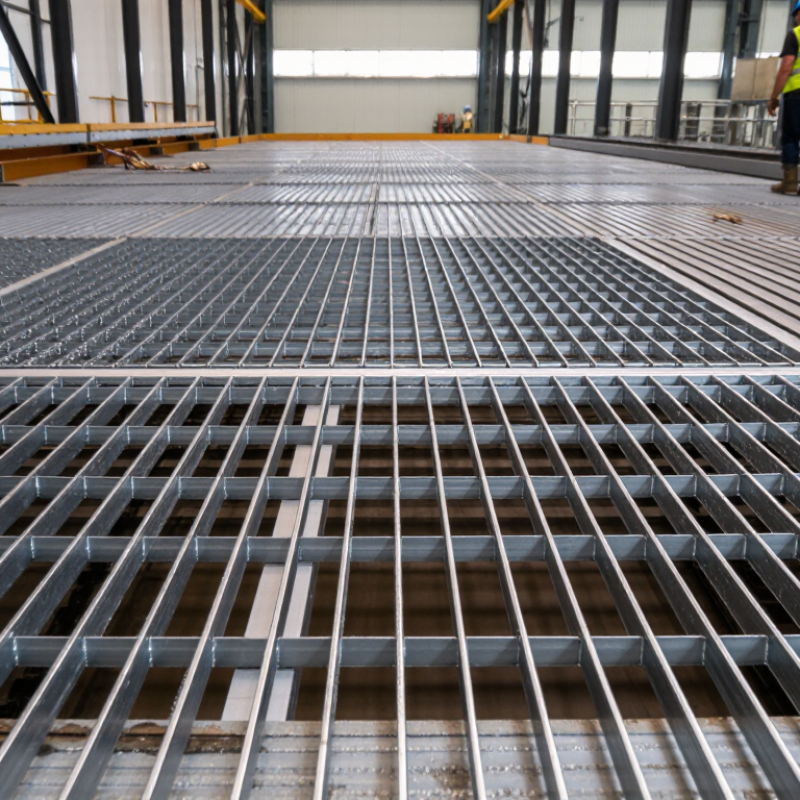
| Welded bar grating | Carbon steel, usually hot-dip galvanized | Load-bearing bars commonly 25–50 mm deep; cross bars are welded at regular spacing. | Approximately 60–80%, depending on bar spacing. | About 7,850 kg/m³ for carbon steel | Standard surface provides moderate traction; serrated bars improve grip in wet or oily areas. | Factories, platforms, walkways, machine rooms, drainage zones, and maintenance areas. | High strength, good rigidity, efficient drainage, broad availability, and economical fabrication. | Unprotected carbon steel can corrode; galvanized surfaces may be damaged by cutting, welding, or aggressive chemicals. |
| Press-locked grating | Carbon steel, stainless steel, or aluminum | Cross bars are mechanically pressed into pre-punched bearing bars, creating a clean, flush appearance. | Approximately 50–75%, depending on the spacing and bar profile. | About 7,850 kg/m³ for carbon steel; 8,000 kg/m³ for stainless steel; 2,700 kg/m³ for aluminum | Serrated bearing bars are recommended where water, oil, dust, or process residue may be present. | Architectural industrial floors, stair treads, service platforms, and areas requiring a uniform appearance. | Neat appearance, flexible material selection, good drainage, and consistent panel geometry. | Load capacity depends strongly on bearing-bar depth, spacing, span, and support conditions. |
| Molded FRP grating | Fiberglass-reinforced polymer with a resin matrix | Integral molded grid; common panel thicknesses are approximately 25–40 mm. | Typically about 30–45%, depending on grid configuration. | Approximately 1,800–2,000 kg/m³ | Gritted top surfaces offer strong traction in wet, oily, or chemically contaminated conditions. | Chemical plants, wastewater facilities, offshore areas, cooling systems, and corrosive processing zones. | Lightweight, electrically nonconductive, corrosion-resistant, and easy to cut and install. | Lower temperature resistance than metal; resin type and fire rating must match the application. |
| Stainless-steel bar grating | Stainless steel, commonly corrosion-resistant grades selected for the process conditions | Welded or press-locked construction; typical bearing-bar depths are about 25–50 mm. | Approximately 60–80% for many welded configurations. | About 8,000 kg/m³ | Serrated bearing bars can provide improved traction in wet processing areas. | Food and beverage processing, cleanrooms, pharmaceutical production, and corrosive washdown areas. | Strong corrosion resistance, cleanability, long service life, and good high-temperature performance. | Higher initial cost; the selected stainless grade must be compatible with chlorides, acids, and cleaning chemicals. |
| Aluminum grating | Aluminum, commonly welded or press-locked | Typical bearing-bar depths are about 25–50 mm; panel design should be checked for deflection. | Approximately 60–80% for open bar configurations. | About 2,700 kg/m³ | Serrated surfaces are preferred for wet or contaminated walking surfaces. | Lightweight access platforms, marine facilities, transportation equipment, and areas requiring manual handling. | Low weight, good atmospheric corrosion resistance, and relatively easy installation. | Lower stiffness and strength than steel for comparable dimensions; can be affected by galvanic contact with dissimilar metals. |
| Heavy-duty grating | Carbon steel or stainless steel | Deeper and thicker bearing bars, often with closer spacing and reinforced support zones. | Often about 40–70%, depending on the load and opening requirements. | About 7,850–8,000 kg/m³ | Serrated surfaces are recommended where vehicle tires, mud, oil, or water may reduce traction. | Loading bays, forklift routes, industrial floors, trench covers, and high-traffic maintenance platforms. | Greater load capacity and impact resistance than standard walkway grating when correctly engineered. | Heavier and more expensive; the support structure and fixing system must be designed for the applied loads. |



 Close