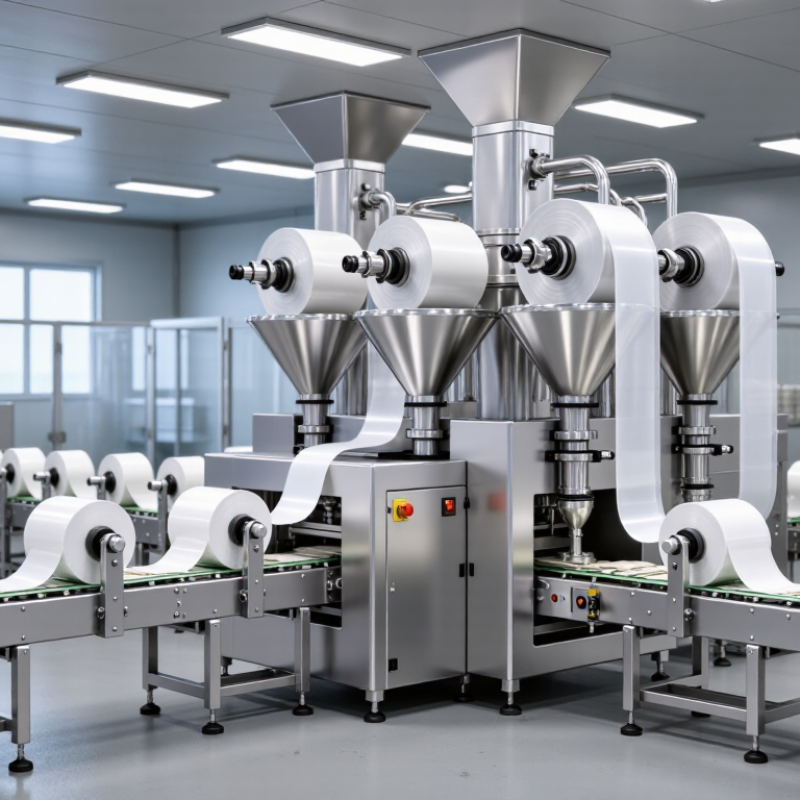
| Basic Operating Principle | One dosing and sealing lane produces one pouch at a time. | Two synchronized dosing and sealing lanes operate in parallel. | Four synchronized lanes increase output within one machine frame. | Six lanes are used for higher-volume simultaneous production. | Eight lanes provide high-throughput multi-lane production when product demand supports the investment. |
| Typical Output Range | Approximately 20–60 pouches per minute | Approximately 40–120 pouches per minute | Approximately 80–240 pouches per minute | Approximately 120–360 pouches per minute | Approximately 160–480 pouches per minute |
| Common Pouch Format | Small stick packs or narrow sachets | Stick packs and compact three-side-seal sachets | Stick packs or sachets for retail and portion packaging | High-volume stick packs or multi-lane sachets | High-volume portion packs and narrow-format sachets |
| Typical Fill Range | About 0.5–100 g, depending on the auger and product | About 0.5–100 g, depending on the auger and product | About 0.5–100 g, depending on the auger and product | About 0.5–100 g, depending on the auger and product | About 0.5–100 g, depending on the auger and product |
| Filling Technology | Usually an auger filler for powders with stable flow characteristics | Multi-head auger dosing with synchronized feed control | Independent or centrally driven auger dosing across four lanes | Six synchronized auger dosing units with individual adjustment capability | Eight synchronized auger dosing units for continuous high-volume operation |
| Typical Dosing Accuracy | Often within approximately ±1–2%, subject to powder properties and calibration | Often within approximately ±1–2%, subject to powder properties and calibration | Often within approximately ±1–2%, subject to powder properties and calibration | Often within approximately ±1–2%, subject to powder properties and calibration | Often within approximately ±1–2%, subject to powder properties and calibration |
| Recommended Production Scale | Product trials, low-volume production, and frequent changeovers | Small to medium production runs | Medium to high production demand | High-volume production with regular order schedules | Large-scale production requiring maximum lane utilization |
| Space Efficiency | Lowest output density but generally simple to install | Higher output per machine footprint than a single-lane unit | Good balance between floor space and production capacity | High output from a relatively compact continuous packaging system | Very high output density, but it requires more installation and service clearance |
| Operational Advantages | Simple operation, easy cleaning, and lower initial investment | Improved productivity while retaining manageable setup procedures | Higher throughput with better utilization of operators and utilities | Reduced cost per pouch when demand is consistently high | Maximum production capacity and efficient labor utilization for suitable products |
| Key Considerations | May not meet high-volume demand without adding additional machines | Requires lane synchronization and consistent powder feeding | Changeover and cleaning procedures require more planning | Product flow consistency and preventive maintenance become increasingly important | Higher capital cost, more complex maintenance, and greater sensitivity to uneven powder distribution |
| Suitable Powder Products | Seasoning, instant drink powder, flour, spices, and nutritional powders | Seasoning, coffee powder, salt, sugar, and powdered supplements | Food powders, detergent powders, pharmaceutical powders, and agricultural powders | High-demand food, chemical, and household powder products | Large-volume retail, food-service, and industrial powder applications |
| When to Choose This Configuration | Choose when flexibility, low investment, and simple operation are more important than maximum output. | Choose when production demand is growing and a moderate capacity increase is required. | Choose when a strong balance between throughput, floor space, and operating cost is needed. | Choose when stable high-volume orders justify greater automation and capacity. | Choose when consistent demand, available floor space, and technical support can justify the highest throughput level. |



 Close