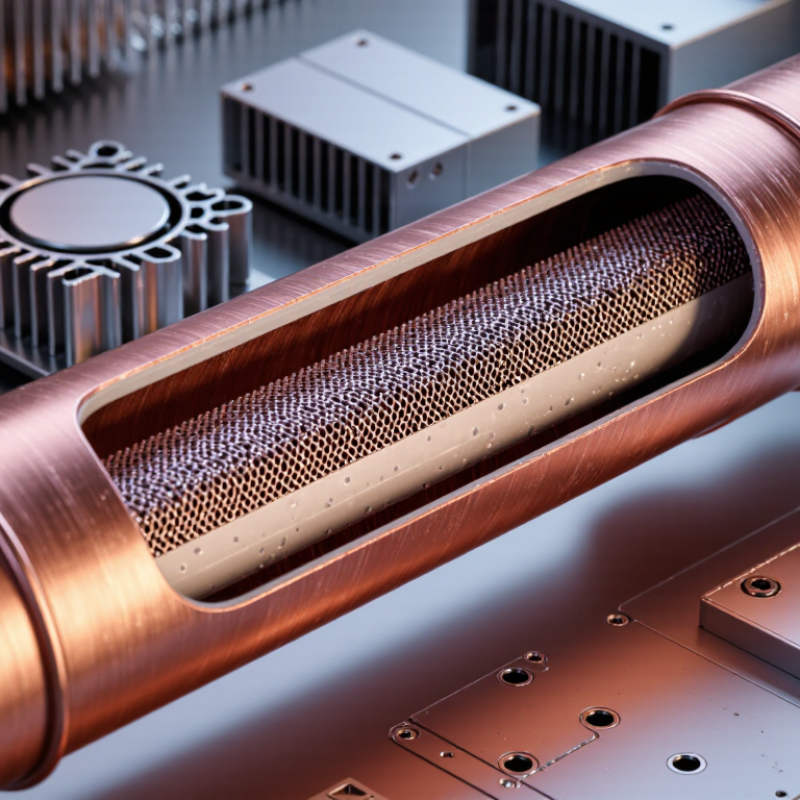
| Heat Transfer Efficiency | Transfers heat through evaporation, vapor movement, condensation, and capillary return of the working fluid. | Effective thermal conductivity is commonly reported in the approximate range of 10,000–100,000 W/m·K, depending on geometry, working fluid, wick structure, and operating temperature. | Enables compact thermal designs and can reduce the amount of solid metal required for heat spreading. |
| Passive Operation | Operates without an electric pump, fan, or external power supply. | Heat transfer is driven by phase change and pressure differences inside a sealed pipe. | Reduces auxiliary power consumption, noise, moving-part count, and maintenance requirements. |
| Heat Spreading Distance | Moves heat from a concentrated source to a remote condenser or larger dissipation area. | Heat transport distance is application-specific; standard assemblies are often designed for lengths from several centimeters to more than one meter. | Supports flexible placement of heat sources and heat sinks in electronics, battery systems, lighting, and industrial equipment. |
| Operating Orientation | Performance depends on wick type, internal structure, heat load, and the direction of gravity. | Sintered and grooved wick designs can support operation against gravity; actual limits must be verified by thermal testing. | Allows thermal solutions to be selected for fixed, tilted, rotating, or mobile equipment when orientation requirements are defined early. |
| Temperature Capability | Can be engineered for different temperature zones by matching the working fluid, envelope material, and wick structure. | Common water-based copper heat pipes are generally used around 30–150°C; the final operating range depends on the design and application. | Makes it possible to source one thermal technology for multiple product platforms with different temperature requirements. |
| Heat Load Flexibility | Can be manufactured as straight pipes, flattened pipes, vapor chambers, or shaped assemblies. | Heat transport capacity varies widely, from a few watts in small electronic assemblies to hundreds of watts or more in larger engineered systems. | Provides a scalable platform for different product sizes, power levels, and enclosure constraints. |
| Space and Weight Optimization | Moves heat efficiently through thin or narrow profiles while separating the heat source from the heat rejection area. | Typical flattened heat pipes can be produced in thin profiles, with thickness selected according to required heat load and mechanical constraints. | Helps meet compact enclosure, low-profile, and weight-reduction targets without adding active cooling hardware. |
| Reliability and Maintenance | A sealed heat pipe has no internal mechanical moving parts and normally requires no service during its intended life. | Reliability depends on leak-tight sealing, material compatibility, cleanliness, structural protection, and correct operating conditions. | Simplifies maintenance planning and can improve product availability in remote or difficult-to-service installations. |
| Material and Fluid Selection | Copper/water, aluminum/ammonia, and other material-fluid combinations are selected according to temperature and compatibility requirements. | Copper/water combinations are widely used for moderate-temperature electronics; material compatibility must be validated for every design. | Creates sourcing flexibility across different climates, industries, regulatory environments, and application temperatures. |
| Quality Control Requirements | Requires controlled filling, vacuum processing, sealing, dimensional inspection, and thermal performance verification. | Recommended checks include leak testing, visual inspection, cleanliness control, temperature cycling, and sample heat-load testing. | A clear inspection specification improves supplier comparison and reduces quality variation across international production locations. |
| Total Cost Consideration | The component cost must be evaluated together with assembly, power consumption, maintenance, enclosure space, and system-level cooling requirements. | Cost varies with material, diameter, length, wick structure, forming process, tolerance, testing, and annual volume. | Enables a total-cost comparison rather than judging the thermal component by purchase price alone. |



 Close
Close