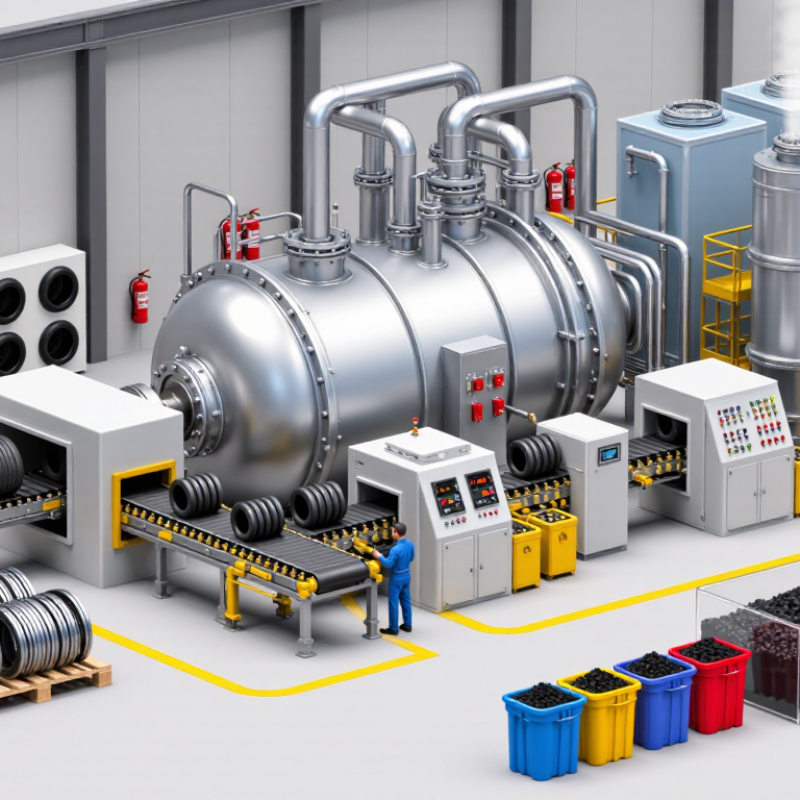
| Recovered tyre steel | Approximately 10–15% of tyre mass | Diverts steel from disposal and reduces the need for virgin steel feedstock when the recovered material meets recycling specifications. | Creates a saleable secondary raw material and reduces the amount of residue requiring disposal. | Steel should be separated, cleaned, and handled according to the requirements of the receiving recycler. |
| Pyrolysis oil yield | Approximately 35–45% by mass | Converts part of the tyre’s hydrocarbon content into a liquid product instead of sending the material to landfill or uncontrolled combustion. | Can provide a revenue stream as an industrial fuel or chemical feedstock after testing and, where required, upgrading. | Composition and quality vary. Use may be subject to fuel, emissions, storage, and waste-product regulations. |
| Recovered carbon-rich solid | Approximately 30–40% by mass | Recovers carbon-containing material that may partially replace virgin carbon materials in suitable applications. | May be sold as recovered carbon material, filler, or a fuel component, depending on quality and market requirements. | Additional milling, classification, pelletizing, or surface treatment may be needed for higher-value applications. |
| Non-condensable gas | Approximately 5–15% by mass | Using the gas internally can reduce the need for externally purchased process fuel and may improve overall resource efficiency. | Internal use can lower operating-energy costs and reduce dependence on natural gas or other purchased fuels. | Gas cleaning, safe handling, pressure control, and combustion equipment are essential. |
| Typical operating temperature | Approximately 400–700°C | Thermal decomposition occurs in a controlled, oxygen-limited environment, avoiding direct burning of the whole tyre. | Operating conditions affect product yields, energy consumption, throughput, and equipment design. | Temperature range varies by reactor technology and desired product distribution; it is not a universal operating specification. |
| Material recovery from one metric tonne of tyres | Roughly 350–450 kg oil; 300–400 kg carbon-rich solid; 100–150 kg steel; 50–150 kg gas | One tonne of waste tyres can be converted into several material and energy streams rather than being disposed of as a single waste product. | Multiple outputs diversify potential income and can reduce dependence on one commodity market. | These figures are indicative ranges and may not total exactly 1,000 kg because of moisture, textile content, process losses, and variation in feedstock. |
| Landfill and stockpile diversion | Up to the full processed tyre input, subject to process residues | Reduces long-term stockpiling risks, including fire hazards, pest habitats, and the loss of recoverable materials. | May reduce disposal, storage, and transport costs where local waste regulations charge for end-of-life tyre handling. | Actual benefit depends on collection systems, plant availability, residue management, and compliance with local regulations. |
| Resource-efficiency benefit | Three principal outputs: liquid hydrocarbons, carbon-rich solid, and steel, plus process gas | Supports material recovery and energy recovery within a circular-economy model. | Allows a facility to serve several downstream markets instead of relying only on tyre disposal fees. | End markets must be verified before investment; product quality and local demand determine commercial value. |
| Potential emissions advantage | Lower impact is possible, but no universal percentage applies | A well-designed plant with gas cleaning, vapour condensation, leak control, and continuous monitoring can avoid uncontrolled emissions associated with open burning or poorly managed disposal. | Efficient emission-control systems can support permitting, operational continuity, and long-term market access. | Environmental performance must be demonstrated through site-specific measurement and life-cycle assessment; pyrolysis is not automatically low-carbon. |
| Main economic value drivers | Feedstock cost, product yield, product quality, energy use, labour, maintenance, and compliance costs | Efficient sorting, heat recovery, and pollution control can improve resource efficiency and reduce avoidable losses. | Profitability depends on the combined value of recovered products and any applicable collection or disposal fees, not on oil yield alone. | Market prices, permitting requirements, financing, logistics, and plant utilisation should be included in a feasibility study. |



 Close