| Capacitance has dropped below its rated value | The capacitor provides less phase shift and reactive current than the motor circuit requires. | Slow starting, reduced torque, humming, or difficulty maintaining normal speed under load. | Higher operating current, reduced efficiency, increased winding temperature, and possible thermal overload trips. | High | Disconnect power and have the capacitor tested with a capacitance meter. Replace it if it is outside the equipment manufacturer's tolerance. |
| Capacitance has increased above its rated value | Excessive phase-shift current flows through the auxiliary winding. | The motor may run unevenly, draw abnormal current, or produce unusual heat and noise. | Auxiliary-winding stress, overheating, reduced motor life, and possible winding damage. | High | Stop operation and verify the capacitor value, voltage rating, wiring, and motor specifications before replacement. |
| Open-circuit capacitor | The intended auxiliary current path is interrupted, so the motor may lose its designed running phase relationship. | A single-phase motor may fail to start, hum, or require manual assistance to begin rotating. | Rapid overheating if power remains applied while the rotor is stalled or heavily loaded. | High | Switch off and isolate the supply. Do not repeatedly attempt to start the motor until the capacitor and circuit are checked. |
| Short-circuit capacitor | Very high current can flow through the capacitor circuit, limited mainly by the supply and circuit impedance. | Fuse operation, breaker tripping, smoke, melted wiring, or visible damage to the capacitor. | Damage to wiring, windings, switching components, or other connected electrical parts. | High | Keep the equipment de-energized. Inspect for secondary damage and replace the capacitor with one having the correct capacitance and voltage rating. |
| Bulging, splitting, leaking, or distorted case | Internal pressure, dielectric breakdown, overheating, or electrolyte degradation may have affected the capacitor. | Visible swelling, oil or electrolyte residue, cracked casing, or a vent that has opened. | Unreliable motor operation, reduced capacitance, short circuit, or complete failure. | High | Do not continue operating the equipment. Replace the visibly damaged capacitor and investigate overheating or overvoltage causes. |
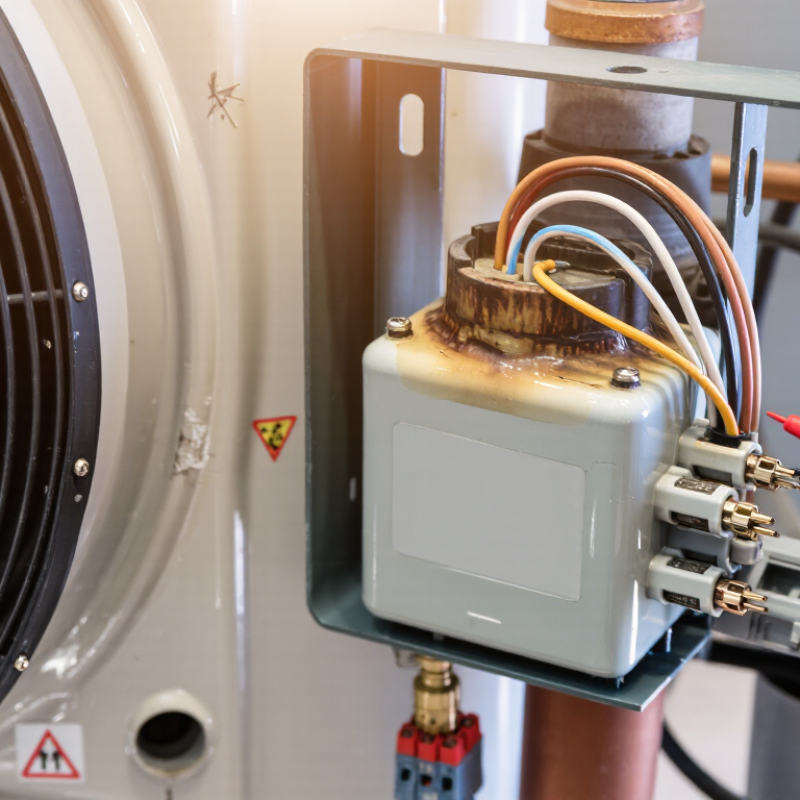
| Excessive heat near the capacitor | Heat accelerates dielectric aging and can increase electrical losses inside the capacitor. | Discolored casing, softened terminals, brittle insulation, or a noticeable hot smell. | Premature capacitance loss, insulation failure, and shortened motor or capacitor service life. | Medium to High | Check ventilation, ambient temperature, motor current, terminal tightness, and the capacitor's temperature rating. |
| Loose, corroded, or burned terminals | Increased contact resistance creates voltage drop and localized heating. | Intermittent operation, arcing marks, flickering, buzzing, or heat at the terminal connection. | Unstable motor performance, terminal failure, and possible damage to the capacitor or winding circuit. | Medium to High | Isolate power, inspect and repair the connection, and replace damaged terminals or conductors before restarting. |
| Abnormal motor noise or vibration | Incorrect capacitance changes the phase relationship and can make the motor's magnetic field less balanced. | Humming, rattling, rough running, increased vibration, or a change in normal operating sound. | Additional mechanical stress, bearing load, heat generation, and reduced motor efficiency. | Medium | Check the capacitor value and motor alignment, bearings, mounting, and load before returning the equipment to service. |
| Repeated thermal-overload trips | Capacitance deterioration may cause the motor to draw more current than its normal operating value. | The motor runs for a period, becomes hot, and shuts down until the overload protector resets. | Repeated thermal cycling and insulation aging, potentially leading to permanent winding failure. | High | Measure running current and capacitor capacitance. Do not bypass the overload protector or continue repeated restart attempts. |
| Incorrect replacement capacitor | A mismatched capacitance or insufficient voltage rating changes circuit current and dielectric stress. | Immediate overheating, poor performance, nuisance trips, or premature capacitor failure. | Motor winding stress, reduced efficiency, capacitor rupture, or electrical damage. | High | Use the specified capacitance, equal or higher AC voltage rating where permitted, correct frequency suitability, and proper physical connections. |
| Normal aging and repeated electrical cycling | Dielectric materials gradually lose performance; each start, stop, heat cycle, and voltage transient adds stress. | Gradual loss of motor torque, increasing noise, longer run-up time, or a measured capacitance outside tolerance. | Declining efficiency and eventual open-circuit, short-circuit, or unstable operation. | Medium | Include the capacitor in scheduled inspection and replace it when testing shows deterioration or when the equipment service procedure requires it. |



 Close
Close