| Primary Function | Applies controlled hydraulic pressure to a hose assembly and checks for leakage, deformation, or failure. | Confirms whether the assembled hose is suitable for service before it is installed or returned to operation. | Test the complete assembly, including the hose, fittings, adapters, and connection points. |
| Common Test Medium | Clean hydraulic oil or water-based test fluid, depending on the tester design and hose manufacturer’s instructions. | The medium affects safety, cleanliness, corrosion risk, and the consequences of a hose failure. | Use only a compatible, clean, and approved test medium. Remove trapped air before pressurization. |
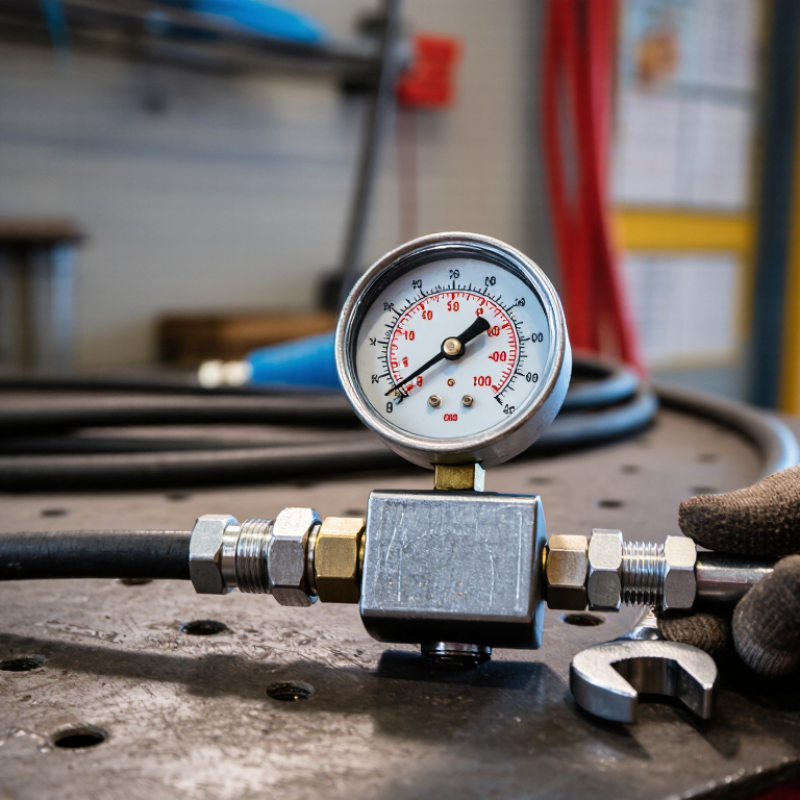
| Pressure Measurement | Usually displayed in bar, MPa, or psi through a calibrated pressure gauge or digital sensor. | Accurate measurement is necessary for repeatable tests and reliable pass/fail decisions. | Verify gauge calibration and select a pressure range that allows the target value to be read clearly. |
| Typical Working-Pressure Coverage | Many workshop testers cover low- to high-pressure hose applications; the available range depends on the pump, circuit, and test chamber. | Different hose assemblies can have substantially different working-pressure ratings. | Never assume that one tester or one setting is suitable for every hose. Follow the hose assembly specification. |
| Proof-Test Pressure | Often set above the hose’s maximum working pressure, commonly according to the applicable hose, assembly, or industry standard. | A proof test checks assembly integrity without intentionally testing to destructive failure. | Use the exact proof-test value specified for the hose construction and application; do not estimate it from appearance. |
| Test-Hold Period | Commonly a defined period such as 30 seconds to several minutes, depending on the test procedure. | A hold period can reveal slow leaks, pressure decay, fitting movement, or progressive hose damage. | Record the starting pressure, ending pressure, hold time, and any visible change during the test. |
| Leak Detection | Visual inspection for fluid seepage, sprays, wet fittings, pressure loss, or visible hose damage. | Leaks can cause loss of machine performance, environmental contamination, and injection injuries. | Never use hands to search for a high-pressure leak. Depressurize the system before touching the assembly. |
| Hose Assembly Inspection | Checks for incorrect routing, exposed reinforcement, cuts, abrasion, blistering, twisting, kinked sections, and damaged covers. | Pressure testing cannot correct poor assembly or damage that may shorten service life. | Inspect the hose before, during, and after testing. Replace assemblies showing structural damage or unsafe deformation. |
| Pressure Stability | Stable pressure during the hold period generally indicates that the test circuit is not losing fluid through a leak. | Unexpected pressure decay may indicate leakage, trapped air, temperature effects, or equipment problems. | Check the tester, couplings, valves, and test connections before concluding that the hose has failed. |
| Safety Requirement | Use a guarded or enclosed test area, suitable rated components, pressure relief protection, and remote operation where practical. | Hydraulic fluid released under pressure can penetrate skin and components can separate violently if they fail. | Keep personnel away from the assembly during pressurization and follow a documented safe-work procedure. |
| Test Result | Pass when the assembly meets the specified pressure, hold time, and inspection requirements without unacceptable leakage or damage. | A documented result supports quality control, maintenance decisions, and traceability. | Mark failed assemblies clearly and remove them from service until they are correctly replaced or reassembled. |
| Recommended Records | Hose identification, assembly date, test pressure, hold time, test medium, gauge identification, operator, and result. | Records make recurring failures easier to investigate and help demonstrate that testing was completed. | Retain records according to the site’s maintenance, quality, and regulatory requirements. |


 Close
Close