How to Choose a Hydraulic Hand Pump?
Choosing a Hydraulic Hand Pump starts with the job, not the catalog. What must it lift, press, or hold? Check the required pressure, oil volume, cylinder capacity, and available stroke. A compact pump may suit a service kit, while a larger reservoir can matter when a cylinder needs repeated movement. Match the pump’s pressure rating to every component in the circuit. The lowest-rated part sets the safe limit.
“Match pressure, flow, and cylinder volume to the task; a high pressure rating alone does not make a pump suitable.” This is an editorially composed quotation, not a verified statement from a named industry expert. A genuine expert attribution should be checked against a reliable source before publication. That detail matters. It protects readers from invented credentials and keeps buying advice trustworthy.
Look closely at practical features, too. A release valve should lower a load in a controlled way. The handle should clear nearby frames, and the reservoir should be easy to fill without spilling oil. Consider hose connections, mounting options, and how often the pump will be used. For example, a pump operating a small workshop cylinder has different needs from one carried between field jobs. Don’t overlook the operator’s effort. A pump can meet its pressure target and still feel tiring after many strokes. Compare specifications, then check the actual application. A neat data sheet cannot reveal every awkward corner. Some selection decisions need a second look.
Identify the Hydraulic Task and Operating Environment
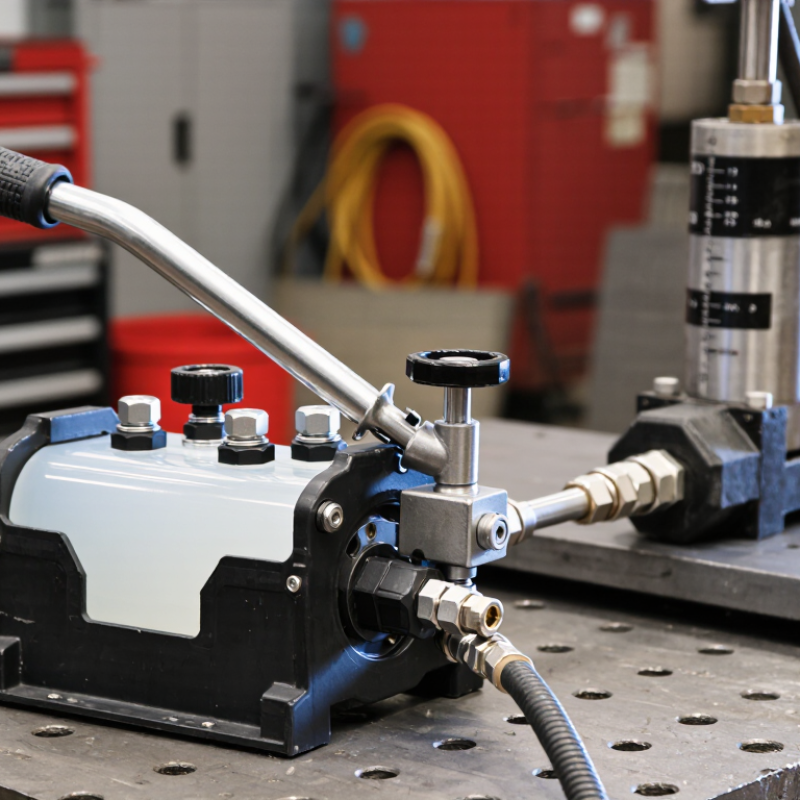
Before choosing a hydraulic hand pump, define the job: required pressure, cylinder capacity, stroke length, and number of cycles per shift. A 2-inch-bore cylinder at 10,000 psi can theoretically produce about 31,400 pounds of force. Check that the pump’s pressure rating, oil volume per stroke, and fittings match the cylinder. A high-pressure pump may still be a poor choice if it takes too many strokes to complete the lift. That part is often underestimated.
Then assess the operating environment. Dust, water, cold starts, and limited space affect seals, fluid choice, and handle clearance.
The U.S. Department of Energy’s Improving Pumping System Performance sourcebook estimates pumping systems use 25–50% of energy in some industrial facilities. That figure concerns powered systems, not hand pumps, but it highlights why the application and duty cycle matter.
For occasional emergency use, compactness may count most; repeated daily operation calls for attention to handle effort and operator fatigue. I would also check access for maintenance. It is easy to overlook.
Tips: Confirm the load, pressure, and cylinder volume on site. Test the handle swing where the pump will sit, especially near walls or machinery.
Calculate Required Pressure, Flow, and Pump Capacity
Choosing a hydraulic hand pump starts with the load and the cylinder, not the pump catalogue.
Calculate required pressure by dividing the force by the cylinder’s effective piston area. For example, a
10,000-pound load on a 5-square-inch piston needs about
2,000 psi before losses. Add a suitable margin, but stay below the rated pressure of every component.
Measure the load carefully. A rough estimate can lead to a pump that stalls or overloads the system.
Flow determines how quickly the cylinder moves.
Estimate the oil volume by multiplying the cylinder area by its stroke length, then divide that volume by your acceptable operating time. A hand pump’s output per stroke varies with the operator, oil temperature, and pressure. Check the rated displacement and usable reservoir volume, too.
A long hose or restrictive fitting can slow movement noticeably. Not exact. I would treat the calculation as a starting point, then test the setup under a controlled load.
If the pump feels unusually hard to operate, stop and recheck pressure, connections, and cylinder sizing.
Match the Pump to the Cylinder and Hydraulic Circuit
Choosing a hydraulic hand pump starts with the cylinder, not the handle. Estimate the force required, then calculate pressure using the cylinder’s effective piston area. For a double-acting cylinder, the rod side has less area, so extension and retraction may need different pressures. Check that the pump’s rated pressure meets the job while staying within the limits of the cylinder, hoses, and fittings. Never assume a higher pressure rating means a better match. Pressure creates force; pump displacement affects how quickly the cylinder moves and how many handle strokes are needed.
Match the pump’s valve arrangement to the circuit. A single-acting cylinder needs a way to release oil for return, while a double-acting cylinder needs flow directed to either side. Check reservoir capacity against the cylinder’s oil volume, especially with a long-stroke cylinder. Fit matters too. Confirm port threads, hose connections, oil compatibility, and whether a pressure gauge is needed for controlled operation. A calculation can miss real friction or load changes, so leave a sensible margin without exceeding component ratings. Hand effort matters. A small pump may reach the pressure, yet require tiring strokes; a larger-displacement model may move the load faster but demand more force at the handle.
Compare Pump Types, Reservoirs, and Operating Features
How to Choose a Hydraulic Hand Pump?
Compare Pump Types, Reservoirs, and Operating Features
A hand pump’s design affects how quickly and smoothly it moves a load. A single-acting pump delivers oil on the downstroke and returns on the upstroke. It suits many straightforward lifting tasks. A double-acting pump delivers oil on both strokes, which can reduce the number of handle movements. That benefit matters during repeated cycles, but it may not justify extra complexity for occasional use. Small jobs differ. Check the cylinder’s required oil volume and pressure before choosing either type.
Reservoir size should match the cylinder and the full stroke, with some allowance for oil returning to the pump. A tank that is too small can interrupt work; a larger one adds weight and bulk. Think about where the pump will sit, too. A compact reservoir may be easier to carry, but awkward to refill in a cramped space. Check the gauge, release valve, hose, and coupler for clear operation and compatible pressure ratings. I would not choose by advertised pressure alone; handle effort and stable control matter in real use. Check the fit. A pump that feels suitable on a bench may be tiring when used repeatedly at floor level.
Check Safety, Durability, and Maintenance Requirements
A hydraulic hand pump should feel controlled, not merely powerful. Check its rated pressure, oil capacity, hose connection, and overload protection against the cylinder’s requirements. ISO 4413:2010 sets safety principles for hydraulic systems, including protection against pressure-related hazards. Before use, inspect the hose for cuts, the couplers for looseness, and the release valve for smooth movement. Keep hands clear of suspected leaks; a pinhole jet can penetrate skin. Small details matter.
Durability depends on more than a thick metal body. Look for corrosion-resistant surfaces, replaceable seals, and a handle that does not flex under load. Ask whether spare seals are available and how often the maker recommends inspection. Hydraulic-fluid cleanliness also matters. ISO 4406:2021 classifies contamination using particle counts at three sizes: 4, 6, and 14 micrometres. Follow the pump manufacturer’s cleanliness target rather than guessing; a clean-looking fluid may still contain harmful particles. That is easy to overlook.
Maintenance should fit the real worksite. A dusty workshop may need more frequent checks than occasional indoor use. Wipe the reservoir area before opening it, use the specified fluid, and record leaks or sluggish strokes. I would not stretch service intervals just because the pump still works. That judgment can be wrong. Recheck after heavy use, and depressurize the system before disconnecting any line.
How to read this chart: Compare the pressure a pump can deliver with the force your application requires. Values show theoretical force on a 10 cm² piston, calculated as pressure × area; actual force may be lower due to system losses. Check that the pump, hoses, fittings, and cylinder are all rated for the intended pressure, and follow the manufacturer’s inspection and maintenance instructions.



 Close